Wednesday, March 23, 2011

A Review of The Extra 2%


There is no doubt some of the best sports books ever have been about baseball. Every baseball fan has their favorites. Personally, I am fan of The Curious Case of Sidd Finch, Boys of Summer, and Ball Four.

But whereas the amount of literature is staggering and certain stories have been told, re-told, and told once again, no one had yet written about the Tampa Bay (Devil) Rays – unless you count Vince Namoli’s Baseball, Business, and Beyond. But if a book is written, and no one reads it, does it count?

Esteemed baseball and business writer Jonah Keri attempts to rectify this lack of Rays literature with his new book, The Extra 2%: How Wall Street Strategies Took a Major League Baseball Team from Worst to First. Keri, who has written for Baseball Prospectus, ESPN.com, The New York Times, The Wall Street Journal, and many other places, tells the tale of the rise of the Rays, from the early days of expansion to the present era.

The Extra 2% is not a typical baseball book, however. Focusing primarily on the new Rays ownership, Keri looks at the Rays history from a business perspective, using terms such as “leveraging”, “opportunity cost”, and “arbitrage”. Having been years removed from my college business course, I was a bit intimidated, but Keri’s writing style speaks to the average fan and carefully explains the business terms and makes them easily digestible. Even for an English major.

Written in chronological order, the first few chapters of the book detail the excruciatingly poor business operations of Vince Namoli. Although Namoli is given credit for battling MLB to get a team in St. Petersburg, he is vilified for each of the boneheaded blunders he makes when the Devil Rays actually start play. There are stories of failed fan interaction, mangled marketing, poor public relations, and awkward organizational management. Keri doesn’t mention what Namoli is up to currently, but given his detailed mistakes, it’s hard to see him positively contributing to any company these days.

In the early chapters, Keri also discusses the ineptitude of the Devil Rays’s baseball operations, to include former Devil Rays GM Chuck Lamar. Unlike Namoli, Lamar comes off as a sympathetic character. His quotes throughout the book do everything short of apologizing to the fans. He seems like a man who was overmatched and misplaced, and one you hope has found better employment.

As the book progresses, Keri writes about the Wall Street careers of Matt Silverman, Stuart Sternberg, and Andrew Friedman. Keri covers their successes in trading, evaluation, and decision making and their adoption of those same skills to the Rays front office. He delves deep into the background of Joe Maddon, discussing his propensity for ideas and why he was the perfect fit for the Rays. Once these characters are introduced, Keri talks about the deals, signings, and business decisions this new team had to make to transform the laughing stock of baseball into AL East contenders.

While Keri did a great job providing background and bios and making even the most astute Rays fan realize the magnitude of this Cinderella story, I do have a few critiques. First, there is no index. I know it would have been more work on the writer, editors, and other members of the Keri team, but for a book with so many characters, and one that will probably be referenced for years to come, I would have liked to see that feature.

Keri also spends too much time detailing the Devil Rays failure to draft Albert Pujols. Although there was no reason for the Devil Rays not to draft him, a writer could write volumes on missed picks and failed draft opportunities. And besides, a year later, the Devil Rays did follow the advice of a traveling scout and signed a player from an obscure backwoods area. That scout did such a great job finding the next “Babe Ruth” that both he and the player were mentioned in dozens of national publications. The scout’s name was Benny Latino and his prized find: Greg “Toe” Nash, a legendary slugger from the swamps of Louisiana who was out of professional baseball after only one year.

Despite those and a few other small critiques, The Extra 2% is an absolutely great read, not only for Rays fans, but baseball fans in general. According to his notes, Keri interviewed approximately 175 people, everyone from Joe Maddon’s mother to the Cowbell Kid to Rays front office folks to people who worked for the City of St. Petersburg. There is a lot of work evident in The Extra 2%, and it’s great to finally have all that history and those perspectives in one place instead of scattered throughout the Internet.

The Extra 2% has already often been compared to Michael Lewis’s classic Moneyball. And that is true to an extent. Both highlight unorthodox methods of franchise management, both cover a team’s attention to details neglected throughout the industry, and most importantly, both give snapshots of stories still taking place. These are not books written with the hindsight of history, such as tomes on the 1927 Yankees, the stories of the ’69 Mets, and tales of Hank Aaron’s home run chase. These are living stories, and there are, as Keri mentions, still unresolved issues for the Rays: a stadium no one likes, fans to win over, and the constant struggle against Major League Baseball’s most financially powerful juggernauts.

Jonah Keri’s book is not a book of solutions, nor is it a classic baseball story. It’s the story of the Rays, how they came to be and who they are today. Whereas fifty years ago, Roger Kahn introduced the masses outside of Brooklyn to The Duke, Pee Wee, Jackie, and Campy, Keri introduces the world to the Tampa Bay Boys of Summer: Stu, Matt, Andrew, and Joe.

Wednesday, March 16, 2011

The Rays Combat Coaching Corps


During my time in the military, I could always tell how good a unit was by watching the interaction between the commanding officer and the non-commissioned officers (sergeants and the like) under their command. Good units had tight communication and a well-defined road ahead. Officers dictated their intent and the non-commissioned officers trained and molded the troops to fulfill the vision of their leaders. Less quality units lacked either that overarching guidance or had a commander who suffered from either being too distant, too buried in paperwork, or too full of his own ego to be approachable.

Although football often draws the most war-like comparisons, there are a few baseball-military comparisons that can be made. One could liken Spring Training to a sort of Basic Training, where the basic skills are learned or brushed up on and new recruits learn the philosophy of the organization, although there is hardly the level of intensity in spring baseball that there is in a place like Fort Bragg or Camp LeJune. One could also make the leap that daily batting practice is similar to the daily physical training, where members exercise and work out before the duty day.

My favorite baseball-military analogy however is comparing baseball coaching staffs to military units. Like military units, there is one commanding officer – the manager. Underneath him is a team of coaches whose sole objective is to ensure players have the capability to fulfill his strategy. They are essential in bringing out the best in a roster’s manpower. A baseball team, like a military unit, is only as strong as its weakest link, and coaches are there to ensure that weakest link is ready to support whatever weight is placed on it.

(Ok, I know no coach can turn terrible players into all-stars. There is a level of responsibility for the front office to bring in capable talent. But no team can win on talent alone. Managers make decisions throughout the season that rely on the roles and responsibilities of coaches.)

Coaches fall into two categories: strategic and tactical. Strategic coaches – batting and pitching coaches – ensure players know how to perform the tasks required by the manager. They are masters of the specifics, helping refine players’ techniques, such as bunting, baserunning, pick-off moves, etc, to make them better equipped to help the team win. They are very similar to lower level non-commissioned officers who help soldiers with marksmanship, map reading, and their specific job functions. While they may make suggestions during a game, a majority of their work comes between games in the preparation phase.

For the Rays, these positions are filled by Derek Shelton (Batting Coach) and Jim Hickey (Pitching Coach). Both return to the Rays after filling the same positions in 2010. Hickey has been with the staff nearly as long as Joe Maddon, and is regarded as one of the premier pitching coaches in the league. Shelton, on the other hand, was criticized heavily throughout his first year as hitting coach. Perhaps the additions of veteran hitters Manny Ramirez and Johnny Damon can help, as they may provide well-regarded peer-to-peer counseling.

The Rays also have an additional hand in the form of Assistant Pitching Coach Stan Boroski. According to the MLB coaching rosters, most teams do not have assistant pitching coaches. When hired prior to 2010, Boroski took the place of current Rays commentator Brian Anderson. According to the Rays website, Boroski assists with pre-game warm-ups, developing a game plan for the pitchers. After the preparations are complete, he then watches the game in the press box.

Unlike strategic coaches, who work mostly before the game, tactical coaches do most of their work during the game. Tactical coaches include bench coaches and base coaches whose primary function is to advise the manager or the players of decisions that can impact the outcome of a game. There is a lot of dispute over the value of a good tactical coach, but there is a reason most personnel fill one of these positions before taking a managerial role. They are among the most trusted of confidants on the staff and usually directly influence a manager’s outlook.

Tactical coaches are most like the senior non-commissioned officers in a military unit staff who oversee the training, the morale, and the wellbeing of the troops of their unit. They are the personnel who tell an officer if the men can march another mile or if they need food or water. They deal in the immediate and their job is to take care of troops as well as to see that they are put in positions to succeed. Especially if it means waving in the winning run or suggesting which pinch hitter to use.

The Rays bench coach positions in 2011 are filled by George Hendrick and Tom Foley, at first and third, respectively. Both are stalwarts of the coaching staff, with Hendrick having filled the position since 2005 and Foley since 2001. They prove the theory that while a bad coach should be replaced, a good tactical coach is invaluable.

Also invaluable are the Rays are the men on the bench, Dave Martinez and Don Zimmer. Martinez fills the position of bench coach – or in military parlance, Team Executive Officer – and Zimmer fills the role of Senior Baseball Advisor. Although there was concern neither would be with the Rays after 2010 (Martinez was a candidate for the Blue Jays manager position and Zimmer is nearly 80 years old), both are at Joe Maddon’s side yet again. It is interesting that Maddon, one of the most open-minded of baseball managers, is flanked by both one of the youngest assistants in the game and the oldest.

Whereas most teams only list the above coaching positions, the Rays also list two special assistants who should both have a major impact on the team in 2011. Joining the Rays this year is Rocco Baldelli as special assistant in Scouting and Player Development and Dave Eiland, who will be a Special assistant in scouting draft candidates, evaluating minor-league prospects, and offering advice on potential acquisitions.

While we are all familiar with Baldelli’s background, the newcomer Eiland gives the Rays an new unprecedented advantage. For the last three years, Eiland served as pitching coach of the New York Yankees. And with the Yankees only making one major pitching acquisition this offseason, signing former Ray Rafael Soriano, the Rays now possess a source that knows everything there is to know about the capabilities of one of their biggest rivals. There is no doubt Eiland’s knowledge of the enemy will help both Joe Maddon and the Rays hitters prepare against the Yankees hurlers. I’m sure he has already visited the Rays’ top secret labs, met with their Sabermetric Keebler elves, looked over the Rays scouting reports of Yankees pitchers, and provided intelligence that will prove key on the field of battle.

Ironically, Eiland was replaced by name familiar to the Rays’ faithful, former manager Larry Rothschild. Having been removed from the organization nearly 10 years ago, however, there is probably little Rothschild can bring to the Yankees in regards to intelligence on the Rays.

Finally, wrapping up Joe Maddon’s support corps are the bullpen hands of Bobby Ramos (Bullpen Coach) and Scott Cursi (Bullpen Catcher). With his famous off-kilter personality, Ramos is comparable to an old cagey sergeant who is in charge of the mess or the supply tent – maybe like Corporal Klinger in MASH. Cursi, on the other hand, is one of the most unlikely veterans on the staff – a man with little professional baseball experience coming into the position, but who has made himself invaluable since 2000 with his steady service.

Of course, as an aside if he makes the team, the internet’s favorite Rays reliever Dirk Hayhurst fits the mold of Anthony Swofford, John Crawford, or Tim O’Brien – military members who wrote of tales from the front lines. Could The Bullpen Gospels follow the trail of Jarhead be made into a movie?

Where ever they came from or whatever their backstory, there is no doubt Joe Maddon relies on his squad of coaches more than most. Together, they provide some of the best tactical and strategic advice of any group in the business. While they might not get the headlines or the fame or the glory, the cohesion and teamwork of the Rays coaching staff is an essential part in the war for the AL East.

Friday, February 25, 2011

Baseball is Back in Clearwater

(This post originally appeared on Bus Leagues Baseball.com)

Over the last month, while winter held the north in its cold embrace, buses full of baseball equipment migrated to Florida and Arizona. Then, following the buses, hundreds and pitchers and dozens of catchers made their pilgrimage to their respective spring homes. Finally, a few days later, the rest of the rosters traveled from around the world to fill their positions.

Before we kick off the spring contests in full bore this weekend, I had a chance to take a sneak peak at the old ballgame by attending the almost annual contest between the Florida State Seminoles and the Philadelphia Phillies. I say "almost annual" because in the five years I have lived in Tampa, I have seen three games, there was one rain-out, and another year it was not scheduled. But no matter how often they play, for Florida State fans and alumni, myself included, the game is still a treat.

(In case you are wondering why the Seminoles take on the Phillies, it is because the mayor of Clearwater, Frank V. Hibbard, is a Florida State alumnus. To me, the fact that he brings FSU down for a game as often as possible is reason enough to keep re-electing him.)

Even though the final score was 8-0 Phillies and the Seminole bats were completely overmatched, it was good to be at Brighthouse Field. Good to see the fans, the vendors, and of course the players. Good to see the Phillies play some of their regulars - Ryan Howard, Carlos Ruiz, and Shane Victorino all contributed to the Phillies offensive attack. Good to see some obscure names such as Delwyn Young, Josh Barfield, and Brian Schneider, all of whom I thought were out of baseball. Good to do the Seminole Chop with my FSU family. Good to lead a concession stand in "Take Me Out to the Ballgame".

And best of all, it's good to know baseball is back.

Bring on the rest of the spring.

Monday, February 21, 2011

Keeping Faith in the Cowbell


“Absolutely!! Have faith in us!! RT @GtotheLee: @DAVIDprice14 there goes Soriano & Balfour is there anybody left to field a team?”- David Price on Twitter, Jan 14th, 2011

We live in a very fickle society, and many things we hold dear one day we have no problem parting ways with the next. We swap our phones, move on to other jobs, flip our homes, and even trade in our cars often times without the slightest regret.

We call it “upgrading” and we are modern masters.

Sometimes, however, we don’t the ability to move up.  Sometimes life deals us a bad hand and we lose the very thing that comforted us the most.  Sometimes we have to pull out the duct tape, bubble gum, toothpicks, and screwdrivers and do our best MacGuyver impression. Sometimes, like David Price said, we gotta have faith.

That’s not to say the 2010 Rays were perfect. They had their faults. Scoring runs was a problem – calls to “Get The Man In” were often drowned out by loud collective groans whenever a Rays player struck out looking. They had an unsettled motley crew behind the plate – Shoppach couldn’t hit, Jaso couldn’t quite catch, and Navarro couldn’t keep his hands out of the donut box. And finally, at the end of the season, they faced the buzzsaw known as Cliff Lee two too many times.

But they did win 97 games and the American League East. And Cliff Lee is now in Philadelphia.

As pitchers and catchers start whipping around the cowhide (baseballs went from horsehide to cowhide in 1974, by the way) and the position players start arriving at Port Charlotte like secret agents in a Mission Impossible movie, Rays fans stand at the proverbial fork in the road. Will they root wholeheartedly for this assorted band of newcomers – some of whom they still don’t know by name? Or will they accept the uninformed generalization that marquee names, big contracts, and all-star jerseys win championships?

Those of little faith think the mountain is too high. They cower in the symbolization of Carl Crawford and Rafael Soriano signing with division rivals. They look at the no-name bullpen with derision. They miss the hustle, grit, and “most valuableness” of Jason Bartlett. They assume the signing of Johnny Damon and Manny Ramirez was strictly to sell jerseys, or better yet to invoke memories of the Hit Show. For them, competing for the division is only a pipe dream, and the youth of Baltimore and the shrewd dealings of Toronto mean the Rays will soon resume their familiar role as cellar-dwellers. These faithless masses may have been at Fan Fest, but they are waiting until June to visit regularly.

On the other side of the aisle are the hardcore Rays disciples. They believe every word of the Book of Friedman, recite the Psalms of Sternberg, and buy into the Bible of Silverman. They crucify non-believers and think any past success, no matter how obscure, indicates future superstardom when plugged into the Maddon Machine. They adhere to the philosophy that success and domination are guaranteed, no matter what moves peers or competitors make. Their cowbell is always perfectly tuned and they have their hat, jersey, and even their Rays socks picked out for Opening Day.

In the middle are the realists. They believe, but have their questions. They know David Price and Evan Longoria are still superstars, but they are not sure James Shields can stop giving up homeruns. They know Matt Joyce and Sean Rodriguez should get better with age, but they are not sure which Ben Zobrist is appearing this year. They are excited to watch Desmond Jennings, unsure about Dan Johnson, and have accepted the fact that BJ Upton is, well, BJ Upton. And even though they like Kyle Farnsworth, his attitude, and his mad fighting skills, they have no idea who or what a Joel Peralta is.

Realists will be at the Tropicana Field, economy permitting, but don’t be surprised if their visits are directly proportional to the Rays proximity to first place, or at least the wildcard. Come a disappointing August, they would rather watch the Rays from the comfort of their living rooms and send their love and admiration from a far.

No matter how much or how little faith Rays fans have, there is no doubt this season will be among the top five in Rays history – you still remember how bad they were, right? Barring an absolute cataclysmic catastrophe, there is no way the 2011 Rays will lose 100 games. They did not switch personnel with the Pittsburgh Pirates. As Rays fans, it is inherent that we come to terms with basic baseball economics more so than any other fanbase.  We have a stadium we don’t like, a team payroll smaller than the combined annual salary of one of our competitor’s infield, and a bullpen full of guys wearing “Hi, My Name Is” stickers.

Rooting for the Rays in 2011 may not be easy. It very well could be painful. On the other hand, it could be another magical summer. But these are the times that try the mettle of fandom, when the bandwagon is mostly empty. It is the time when every baseball fan gets goose bumps, whether they believe in process or predestiny, intelligence or intangibles, mathematical spreadsheets or managerial subconscious. It’s time for fans to walk with faith, knowing well that that very faith may have to carry them through the year.

But best of all, it’s time for baseball fans to ease away from the heat of the hot stove and bask in the warm sunshine of spring baseball.

Tuesday, January 25, 2011

Bowling with Bossman


Yesterday, BJ Upton held the first annual “Bowling with BJ” charity event at Splitsville in Tampa. I, your humble correspondent, decided to attend. Not only was I very impressed, but as far as I could tell, the event was a resounding success.

We all know homelessness is a problem in the Bay Area. According to the Homeless Coalition of Hillsborough County, there were nearly 10,000 homeless men, women, and children living in the area in 2009. Hillsborough County also has the highest percentage of homeless people in the State of Florida. Once again, as he has in previous years, BJ Upton decided to do something to help.

Throughout the night, Splitsville was packed with fans, media, and plenty of Tampa Bay sports stars, including of course BJ and his brother Justin, as well as David Price, Reid Brignac, Gary Sheffield, Carl Everett, and Bucs legend Mike Alstott. Even recently departed Ray Matt Garza tossed a few down the lanes. Although I didn’t get a chance to talk to anyone famous, I did get my picture taken with Matt Joyce.

I think he dug the ‘fro.

As the night went on, there were a few things that caught my eye:

  1. David Price bowls left-handed. I would have thought he would minimize the risk to his valuable left arm and roll his bowling balls with his right hand – although former Giants ace John Burkett for years swore by the benefits of bowling.

  2. David Price was able to finish his game. I was expecting Joe Maddon to show up and pull Price in the seventh frame and have a different relief pitcher throw each frame thereafter.

  3. For someone who has watched his share of strikes go by, BJ Upton sure can’t roll one. That may or may not be a joke.

  4. Don Zimmer is The Man. I was really surprised to see him there. He has sort of a Yoda-esque look to him, like he has forgotten more about baseball than most people ever know. Although he didn’t stay long, he looked like he had a fun time.

  5. There were more than a few autograph seekers there. That must get really annoying as an athlete to sign your name on everything people pass to you. I’m not even much of a photo guy – the Joyce pic being an exception – but I really don’t get the autograph collectors. Especially when they are over the age of 15. A little kid getting his or her favorite star’s name on a ball is cute; a grown man shoving a baseball in Justin Upton’s face is not. Fortunately, the autograph seekers weren’t too bad. But they were still there.

  6. I saw several reporters and media folk. For whatever reason, they always look so bored. It must be tough when you are supposed to cover people having fun.
All in all, “Bowling with BJ” was a success and definitely worth the admission fee. Especially when the proceeds went to a good cause.

Friday, December 10, 2010

Return to the Winter Meetings

(This post originally appeared on Bus Leagues Baseball.com)

There are many baseball-related advantages to being a Tampa-based writer. I am 30 minutes from MiLB Headquarters, within an hour from at least five minor league ballparks, and the Rays are only a hop, skip, and a jump across the bridge. But one of the biggest baseball-based advantages to living in Tampa is that I'm in close proximity to the Swan and Dolphin Hotel, frequent host to the Baseball Winter Meetings.

Back in 2006, in one of my first-ever blog posts, I chronicled my first trip to the Baseball Winter Meetings. It was a fun time, highlighted by interactions with Ozzie Guillen, Omar Minaya, Jim Leyland, and Tony LaRussa. I was a fan, and they were larger than life baseball personalities. I was in awe.

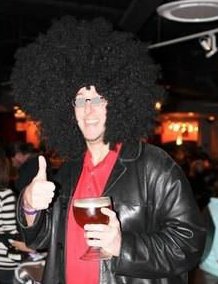
Four years later, I find myself in a different phase of life. I'm obviously still blogging, but this time my goal is to be taken a little more seriously. I'm no longer blogging about baseball under an alias and I've reached out to various other writers through the years for support and advice. Although I may still clown around under an afro wig at a game, I now consider myself a legitimate writer.

Albeit a part-time one.

And that is a big disadvantage in a place like the Winter Meetings. Wandering the halls and lobbies of the Swan and Dolphin Hotel, I saw plenty of professional baseball reporters in their natural habitat. They were tapping away at their Blackberrys, tweeting rumors, breaking news, and using their network of sources like they were case workers at Interpol. All the big names were there: Jason Stark, Tim Kurkijan, and even the legendary Peter Gammons.

I was just a guy with a green notebook and pen that ran out of ink.

Of course, even though my chances of rubbing elbows with baseball's bourgeoisie were slim, I did take in the sheer magnitude of one of Disney's finer resorts. Trust me when I say the Mouse spares no expense. Giant Christmas trees, Santa Claus displays, and a quartet of carolers singing the sounds of the season were only a few of the temporary decorations. The hotel itself is also extravagant, with giant swan statues adorning its facade, fountains and columned walkways connecting the various buildings of the resort, and various restaurants, to include the famous Shula's Steakhouse.

Even though I didn't do much socializing with baseball's elite, I did talk to a few people. The first, and from a bus leagues perspective most important, was Minor League Baseball President Pat O'Conner. You may remember my interview with Mr. O'Conner from a few weeks ago. Fortunately, O'Conner remembered it as well. So we talked for a few minutes, but as the head of the organization responsible for organizing the Winter Meetings, Mr. O'Conner was quite busy.

So I continued my aimless wandering, once nearly running into Nolan Ryan and his bodyguards. I don't know if he was lost on his way to the Rangers' dinner reception or if he walked with security because of his stature as an all-time great, but seeing Nolan Ryan with a posse in tow did not surprise me at all. I think at this point Nolan Ryan has transcended baseball and become a legend - one of our few remaining links to the typical American, John Wayne-type hero.

A few hours later, I met with a few friends of Bus Leagues Baseball. Fellow MiLB fan Nykki aka @Nyk29 and fellow blogger Evan Brunell. Nykki was there for the job hunt, having traveled all the way from Washington State to be involved in baseball. That's dedication and best of luck to her.

Evan, on the other hand, was there with CBSSports.com. Over plates of overpriced salads, we talked about our backgrounds; how we knew the not-quite-legendary co-founder of Bus Leagues Baseball, Eric Angevine; our equal admiration for Tim Wakefield; and the latest news and nuggets from the day in baseball.

After finishing dinner with Evan, I decided to walk around the lobby a few more times to see what I could see. Within minutes I was a few steps away from former manager and front office guru Jack McKeon as he talked about his use of Josh Beckett in the 2003 World Series. I also talked briefly to Tampa Bay Rays owner Matt Silverman. As a Rays part-time season ticket holder, I thanked him for putting on a good product. I don't know if ownership people hear that very often, but I thought it was good idea to tell Silverman that I enjoy myself at his events.

As it was getting late I made an effort to network with at least one more writer before I making my grand escape. After seeing a tweet by Craig Calcaterra, friend of e-migo Jonah Keri and Blogger-in-Chief at HardballTalk at NBC Sports.com, I figured I would take a chance to say hello to another complete stranger.

So I tweeted Calcaterra, namedropped Keri, and asked Craig if I could meet him. Craig was kind enough to meet up with me and talk blogging for a few minutes. In exchange for my business card, he imparted on me some writing and career advice - non-guaranteed words of wisdom for making it in the highly competitive field of sports writing.

And with that, and as rumors stopped and the baseball's bourgeoisie engaged in a late night cocktail hour, I again exited the Baseball Winter Meetings and made the trek back to Tampa, this time a step wiser and more networked than I was four years ago, but still with much more work to do.

Saturday, November 27, 2010

Psycho about Cycles

(This post originally appeared on Bus Leagues Baseball.com)

(This post isn't about the minors, sorry. But it is, of course, about baseball.)

The most recent issue of Baseball Digest had an interesting feature on cycles. A few things struck me by surprise:

* There have been more no-hitters in Major League history than cycles, 268 to 266. There were six no-hitters in 2010 and only four cycles. I wonder if anyone has a graphic representation of no-hitters versus cycles. Have they ever been more than 10 apart?

* People called 2010 "The Year of the Pitcher", yet there were four cycles. In 1968, the most famous "Year of the Pitcher", only one batter hit for the cycle, Jim Fregosi. Ironically, Fregosi is best known for being traded for Nolan Ryan, the author of a record seven no-hitters.

* There are only two teams who have never had a player hit for the cycle: the San Diego Padres and the Florida Marlins. There are only two teams who have never had a player throw a no-hitter: the New York Mets and the San Diego Padres.

* The baseball media usually makes a big deal of former New York Mets who eventually threw no-hitters (Seaver, Ryan, Cone, Gooden, etc.), but did you know four ex-Padres eventually hit for the cycle? Kevin McReynolds (SD 1983-1986); Gary Matthews, Jr (SD 1999); Mark Kotsay (SD 2001-2003); and Jody Gerut (SD 2009) all hit for the cycle after leaving San Diego.

* To date, only two ex-Marlins eventually hit for the cycle: Greg Colbrunn, who played for the Fish from 1994 to 1996 and again, Mark Kotsay, who manned the outfield for the Marlins from 1997 to 2000.

Lastly, looking up no-hitters and cycles, for some reason the MLB website lists them in different formats. No-hitters are listed chronologically and cycles by team. I wonder why. Aren't no-hitters more of a team effort than cycles? No teammate helps a player hit for the cycle, whereas eight other players help a pitcher attain a no-hitter.

Thursday, November 18, 2010

An Interview with Pat O'Conner, President of Minor League Baseball, Part 4


(This post originally appeared on Bus Leagues Baseball.com)

A few weeks ago, Bus Leagues Baseball had the privilege of sitting down with the President of Minor League Baseball, Mr. Pat O'Conner, at Minor League Baseball Headquarters in St. Petersburg, Florida. Mr. O'Conner was gracious enough to answer all of our questions and talk with us for nearly an hour.

This is Part 4 of our 4-part interview. Part 1 was Monday. Part 2 was on Tuesday, and Part 3 was featured on Wednesday.

An Interview with Pat O’Conner – President of Minor League Baseball


Bus Leagues: Before I go, I have a few miscellaneous questions. First, do you have a favorite league to visit during the year?

O'Conner: That is like asking a father which one of his kids he loves best.

There are two or three things that go on my calendar in January with respect to blocking time. I am huge fan of what we call our “marquee events”, which are the Triple-A All-Star Game and the Triple-A Championship Game. As long as I am able, and as long as there no unavoidable conflict, I think those are marquee events. We are not shy about telling Triple-A baseball that we think those are marquee events for all of Minor League Baseball. So I like to go to those.

Earlier, Steve (Densa – Media Relations Director) mentioned the “Appy League” tour. This is the purest form of baseball in the Minor Leagues. It is the Appalachian League and it is ten teams. All the teams are by the Major Leagues but owned by local, mostly not for profit, booster clubs and groups. I’ll go in and call the league president and say I can be there Thursday, I gotta leave Monday morning and that’s it. He takes care of the rest. It’s really great. We go and there are booster club picnics and we meet people. It is just the purest form of professional baseball. It is where kids go – literally kids 18, 19, 20 years old – to be indoctrinated into professional baseball. So that is a very special trip for me.

Outside of that, what I have found after almost three years is that getting there is getting increasing difficult, to travel 200-plus days. But being there is just as much fun as it ever was. So you work through getting there.

When I go to a game, I’ll do all the media that they need me to do, I’ll sit with the owners for a while, and then I come up missing for 20-30 minutes and I walk the ballpark. One, I want to see the ballpark through my eyes and two, I want to see the fans. It kinda validates what we do. So I think that within a favorite places, my favorite part of every trip is being in the ballpark and being with the fans, being with the players, and getting to know them, as well as saying hi to the staff and meeting them.

When I go to a city and I talk to an owner, there are two questions I’ll ask: one, I want to know what you’re biggest worry is everyday and two, what can we do for you? And from there, it takes care of itself.

Bus Leagues: You mentioned meeting the players. Is there a player – whether he made to the Majors or not – who really stood out to you?


O'Conner: Well, when I was in the Texas League in 1983, we had a shortstop, a 20-year old (ed. 19) Venezuelan named Ozzie Guillen. And every day they were home, Ozzie would spend 15 to 20 minutes in my office sitting right across my desk just like you are. And we would talk about anything and everything. And he did that every day. He went home that winter, worked with Luis Aparicio, came back, was traded to the White Sox, and the rest was history.

That’s something I will never forget.

I learned to eat payaya from Joaquin Andujar. He was on an injury rehab in Kissimmee and he said, “Have you ever had payaya?” I told him I didn’t know what it was. So he brought me some. Just little things like that.

I’ve got those stories. Some of them are funny. Some of them I don’t want to repeat, but they are all part of it.

When I ran a ballclub, I went into the manager’s office before and after every game. I’d ask, “what do you need?” and “what do you want to do?”. I would tell them before the first game of the season, “I am not going to question what you do, but I might come and ask you why you did it.”. So I can learn. Things like that.

I had a pitching coach when I was in Kissimmee named Jack Billingham. He lives over in New Symrna now with his wife. Just a quality guy. When you are there seven years together you form some special bonds.

Sal Butera was a manager of mine for years. Rick Sweet was a one year manager of mine. When I saw Sweet and he finished his second or third year in Louisville, he’ll come up, we’ll give our bear hug to each other, and he will say to whoever is in the room, “This is the best GM I ever had.”.

You don’t do this for 30 years and not have those kind of stories. Which one is my favorite depends on what mood I am in when you ask, I suppose.

Bus Leagues: What are some of your favorite promotions, either of this year or of the past?

O'Conner: I saw one this year that without a doubt moved me more I have been moved in the last thirty years. I was in Winston-Salem, and there are several clubs that do this, but I saw it in Winston-Salem. We are at the ballgame, and I am up in the suite with the owner and we just had a bite of lunch, and we were watching the game, and it was the third inning. I just happened to look down on the field and both teams were getting out of the dugout and standing on the foul lines. I was thinking that it was too early for “God Bless America” and I asked myself, “What are they doing?”.

Then they bring out this group from the home dugout and it has this little girl and she is obviously a cancer patient and her hair is all but gone. They make this announcement that with her is her treatment team from Wake Forest Medical College and that she is in fact in remission. And they talk about what she had been through and they recognize her parents and her brother and sister and her doctors and nurses and the treatment team. They play this music and the teams are on the lines watching this with the two managers at home plate.

Then this little girl runs down the first base line high-fiving the home team, jogs the bases, then goes down the third base line high-fiving the visiting team, and touches home plate. Now I walked away. I couldn’t stand it. It was the most moving emotional thing I had ever seen in my life.

She gets to home plate and in the meantime they had brought up an autographed bat and the two managers did a photo op, and then she goes off the field.

My first reaction as a purist was “What the hell are they stopping the game for?”. And I was all but in tears when she was done. It was the most amazing thing I had ever seen in my life. Absolutely.

And to see Class-A ballplayers who were obviously in to it, of course the ones that knew about it were obviously more so, but they all stood there, they all clapped while she was running, and they all gave her the high-five. To see anyone from 20-to-25 years old who you might envision not caring, or not understanding. It was the most amazing thing I had seen in 30 years. Without a doubt.

I used to think when I was in Vero Beach that the 100-foot long ice cream sundae was the coolest thing, you know? We’ve had the sumos and the other funny stuff. But I have to tell you, and maybe it is because of where I am in my life and my career, that that was the most amazing thing I had ever stood through in my entire life.

Bus Leauges: That is one of things I see. The players might not be there for very long, but the fans are. The communities are. And the families are. And they embrace the players for that year.


O'Conner: Exactly. I used to tell my players that from a management standpoint it’s not that I didn’t like them, it’s that I didn’t want to see them the next year. If they were there the next year, we didn’t do our job. Our job is to move them on.

The fans understand that. Sure they like the guy, but they are quite content with saying they knew him when he was here. Not, “I’ve known him for six years, he is a good friend of mine.” I want to see you when you come in to Atlanta and I can drive up there, or you come in as a visiting player to Tampa. Our fans understand that. When we do host families in some of our cities and we do those barbeques and picnics, those things last lifetimes. Those are friendships and relationships that last. I don’t what other sport or what other type of environment you can create those kind of lasting relationships.

Bus Leagues: My last question is: what do you love about baseball and what have you loved about it?


O'Conner: That there are 27 outs per side. It is very hard for me to sit and watch an entire baseball game. It’s not that I am not a fan. I am very much a fan of the game of baseball and the 27 outs per side. I can sit and watch a game.

Let me tell you a story: when we got into the umpire business in 1997, my world changed because I had to look at a ballgame differently. I used to watch games with umpire supervisors and they would say, “Did you see that?”.

I would say, “Yeah, he missed the cut-off man”.

They would reply with, “No, the umpire didn’t do this, that, or the other”.

But to sit and watch a baseball game is a work of art. To understand why he is holding his glove up to his mouth like that and the wheel play. The things you pick up after watching 2,000-plus baseball games in 30 years. It is especially difficult having gotten into the business in operations, it is difficult for me to sit there and watch a game because I never did that. I was always taught if you are going to run a ballpark, you have to be in the ballpark, and the only way to be in the ballpark is to move. So when I go to games with people, after three or four innings, chances are I am going to stretch my legs and take a walk.

But to go back to something you talked about with the fans. When I go out now, I’ll go and do the things I need and want to do. But I like to walk. Because there is that generational aspect. You will see kids, parents, and grandparents – sometimes in the same family unit – at these ballparks. And it validates everything we do. It makes every airplane flight worth it. And it makes every long day worth it when you see kids smiling, parents sharing quality time with their kids, and the seniors not being excluded. It’s a little Pollyannic but that’s part of our story, that’s part of our benefit to communities, and that’s part of our legacy.

Wednesday, November 17, 2010

An Interview with Pat O'Conner, President of Minor League Baseball Part 3


(This post originally appeared on Bus Leagues Baseball.com)

A few weeks ago, Bus Leagues Baseball had the privilege of sitting down with the President of Minor League Baseball, Mr. Pat O'Conner, at Minor League Baseball Headquarters in St. Petersburg, Florida. Mr. O'Conner was gracious enough to answer all of our questions and talk with us for nearly an hour.

This is Part 3 of our 4-part interview. Part 1 was Monday. Part 2 was on Tuesday, and Part 4 will be featured on Thursday.

An Interview with Pat O’Conner – President of Minor League Baseball


Bus Leagues: In your biography, it says that one of your priorities is to “deal with digital assets”. Is there a push to capitalize on the Web as a medium for Minor League Baseball, especially with the decline of the local newspaper industries? How is Minor League Baseball adapting to the change in multimedia?

O'Conner: It is critically important to our long-term success for a few reasons.

One, we cannot generate new revenue much more than we are doing now. When I talk about new revenue, I am talking about real growth, where we are capitalizing and operating at a fairly high capacity of our local markets. So the need and the desire for more revenue has to come from two ways: one, artificially from price increases in the current structure, which there is very much a ceiling for. And in this economy it is a very low ceiling. You just can’t raise ticket prices and concession prices and sponsors just can’t pay more. So if you want to have growth, you have to have what I call “real growth” and that comes from new sources.

So if you are operating within a certain capacity within your market, there are two things that we have done: one is that we are reasonably comfortable that we are not operating at maximum capacity, because we are not tapped into the diverse markets on the fringe of our mainstream within our team markets. The second is to get more of the pie. You have to make the pie bigger. So you have to expand your universe. And the internet allows you to expand your universe, to not only connect the dots between the 160 cities, but to go beyond the borders and go international and truly worldwide.

The Web is critically important for a second reason. In order to connect the dots, expand your universe, or operate outside of your current market, you have to go talk to people in ways they are currently talking. And that is digital and it is social media and it all of those wrapped up into one and it is ever changing. It is like The Blob from the old science fiction movies – it is never the same on any two days. The Web is our growth for the future, it is the communications mechanism for the current, let alone the future. There is no question about that.

So what we were able to do is to bundle the vast majority – 155 of our 160 clubs – and create, for lack of a better term, a baby BAM (Major League Baseball Advanced Media). We have BIRCO, the Baseball Internet Rights Company, doing the bundling. There is a power of one in that industry. The sum of 155 pales in comparison to the one of 155. You bundle every club and add up what they can do individually, it pales in comparison to what 155 can do together. So there is that synergy and that “power of one”. That is what we have been able to capture. We are getting our feet on the ground, but it is a very complicated business to deal in and it especially difficult because it changes constantly. We have a great partner in BAM where effectively all of professional baseball is under one engine, which creates tremendous synergy and horsepower.

I think it is future. You know, people go where they want to go. You can’t force people to buy what they don’t want, and you can’t talk to people who don’t talk back. So we can’t get into a situation where we are sending out media and it is falling into a big black hole. We have to go to where people are. And that is certainly digital.

Bus Leagues: One of the things I noticed is that in recent years all the minor league teams are under the umbrella of sites, whereas in years past, teams would have their own sites.

O'Conner: Yeah, you had to Google and find the sites. And you had to know who you were looking for. Now you can Google “Minor League Baseball” and it brings you right to MiLB.com. It is truly a full service web site. It has the reach to link into not only MLB.com, but also all of our affiliations and relationships. It really has centralized the ability to go to one place and access professional baseball.

Bus Leagues: I see teams also utilizing things like Facebook and Twitter to push their information.

O'Conner: Absolutely. And that is where if you have a solid base and you have a foundation that deals with the core issues, then these fingers can go out. Let’s face it, there are clubs in our 160 who don’t have the interest, the resources, or the capabilities to do some other things. But the way we are structured, it doesn’t hold back those who do. And in fact, there will be a residual benefit for those who can’t, won’t, or don’t just by the fact that others are. They will plow the fields and it will be easier for us to come in from behind and bring all of them into the fold. So it is a “better late than never”.

That was one of the biggest challenges in forming BIRCO and bundling our rights. Of 160 clubs, we had some that were truly in the dark ages from a technological stand point to others that were on the cutting edge. And what you don’t want to do is to bring down the leaders to bring up those trailing. So we’ve kinda been able to bring the group up through BIRCO and merchandising platforms and things we’ve done to offer to them while at the same time giving them as much flexibility as possible to operate their site from a local perspective.

Bus Leagues: What are some of the guidelines you have in regards to putting local perspective to the sites?


O'Conner: Well, it is a menu and an inventory where there are certain pages. Certain pages are reserved for BAM and national spots to deal with. It is all spelled out in the agreement. It is designed to allow for enough centralized inventory to drive the collective cost but not hamper them on their local ability to generate local inventory and to value-add locally. If you are doing something with a major sponsor and you want to value-add, you can still do that.

Part 4 tommorow!

Tuesday, November 16, 2010

An Interview with Pat O'Conner, President of Minor League Baseball Part 2


(This post originally appeared on Bus Leagues Baseball.com)

A few weeks ago, Bus Leagues Baseball had the privilege of sitting down with the President of Minor League Baseball, Mr. Pat O'Conner, at Minor League Baseball Headquarters in St. Petersburg, Florida. Mr. O'Conner was gracious enough to answer all of our questions and talk with us for nearly an hour.

This is Part 2 of our 4-part interview. Part 1 was Monday. Part 3 will be featured on Wednesday and Part 4 on Thursday.

An Interview with Pat O’Conner – President of Minor League Baseball


Bus Leagues: You’ve been president since 2008, and of course one of the biggest factors to effect sports since 2008 has been the economy. How has Minor League Baseball dealt with the balance that on one hand you become a cheaper entertainment alternative, but at the same time there is the potential that less fans could afford to go to a game?

Pat O'Conner: First, I would slightly modify your proposition that we “become” a more affordable, we have always been a more affordable alternative. We tend to do as well or better than size-specific or size-comparable industries in downturns., because we are there, and we are always there, and we don’t have to retool. We don’t have to change our pricing structure to adapt to a downturn in the economy.

So, yes, we do feel it and it is necessary for us to react but it is not a total retooling. In a downturn in the economy, people know we are there and we become the alternative to the more expensive or the more time-consuming or more elaborate plans. They won’t go to the beach, they’ll go to a few more games. They won’t go to grandma’s for a week, they’ll go to a few more games. People are going to commune and recreate. They are going to do that. This country is based, in large part, on that. They are going to get together, and they are going to get together in like mind to do like things. So we are not only affordable in bad times, we are always affordable.

We deal with these times by becoming more entrenched with the communities we are already in, and becoming more of an option, and we will value-add. We will value-add to the point where we will do things with concessions – kids eat free, etc. We have had clubs respond to their communities, where have been pockets of unemployment and allowing the unemployed to come to the game for free. We’ve had fans who have felt severe cutbacks and they get some benefit.

So that’s how we deal with it. I don’t think there are less fans that can afford to come to a game but it is that more fans are forced to make significant or difficult decisions on what they are doing with their discretionary income. And we like our chances when we get into that analysis. When a family decides “What are we going to do?” and a ten dollar bill gets the whole family in, I’ll stack that option against going to the movies or doing anything else of value.

So we do well. We are a collection of 160 small businesses scattered throughout the country. If you take the size of our businesses and you compare other sectors of the economy with businesses our size, we do very well comparatively. Our downturn was less than 4% last year and about a half of a percent this year in attendance. We actually sold as many tickets in 2009 as we did in 2008 from the standpoint of the walk-up was much better. Of course, we were down in season tickets and pre-season because it follows to reason that if you are a man or a woman with two kids, you are not going to buy season tickets in March and pay for the entire year. So what our clubs did was perhaps offer mini-plans or “pay as you go”.

Also, businesses weren’t scheduling picnics for employees because they didn’t know if they were going to have 200 or 20 by August. So those were the impacts. But as far as the family unit and the individual, they came out as strong in 2009 and 2010 as they ever have.

Bus Leagues: You mentioned local entities and local businesses. How do you maintain control while still providing the freedom for teams to cater to their local markets?

O'Conner: Well, we are philosophically by choice a states’ rights organization, if you think of it in a governmental sense. We provide the four corners of an agreement that secures aspects out of their control, namely relationships with Major League Baseball and the intra-league relationships that are necessary to keep the group together. It is all contained in our constitutional bylaws and you maintain control through a system of governing bodies. We have the board of trustees, which is the policy making element, and we have the Council of League Presidents, which is made up of the president of each league, which executes the policies set forth by the board.

It’s kinda like there is law and order because people believe in it. There is a set of rules and our job is not beat them over the head with it, but to make them aware. Our primary job is to create an environment that allows them to excel in their local market. Not to tell them how to do it. I can’t tell you what’s going to work best in Salt Lake City. I would be arrogant and overconfident in my own abilities to think that I could. Just like I can’t tell you what’s going to work in Sacramento or in Bluefield, West Virginia, but I guarantee I could get on the phone with the guys from Sacramento, Salt Lake City, and Bluefield and they can tell us. So it’s what I want or we want, it is what is best of the teams. And that is the role of this office – to keep them honest. And to secure relationships beyond their control – with Major League Baseball, with the media, with major sponsors in a national scope that is out of their control – that creates an environment that allows the teams to do well.

Bus Leagues: I noticed a lot of the teams are staffed by interns and volunteers. How hands-on are you in regards to employee guidance?

O'Conner: Well, at the team level, those again under the states’ right model, are decisions for them to make. We do deal with them on governing rules and laws in respect to labor and that kind of thing. But in regards to telling them you have to have to have so many people, and you have to do this, and you have to do that, no.

In December of 2009 however, we rolled out a diversity initiative. It is as strong of a statement as we have taken in respects to aspects of the business at the local level. But it is not a mandate. It is a vision created in this office that allows us to deal with what is becoming an ever-changing world on the outside. The public and this country is undergoing a transformation in its makeup. So what we have done is laid out five pillars. Employment at the Executive Level and Employment at the Middle and Lower Management Level are two of the five pillars that allow us to diversify our workforce and our employee census in order to deal with a more diverse public.

So outside of that, we don’t get involved in the manning. They have to name an ultimate authority, there has to be one go-to person in each organization. Outside of that, they are under rule by not only NA agreement and league by-laws, they are obligated to run a vibrant and ongoing entity. And it is inherent in that that you will need some number of people, but it not specified.

Bus Leagues: How does the Mexican League fit in to Minor League Baseball and your relationship with Major League Baseball and how did they become a AAA-league?


O'Conner: It is a history lesson. There is historical significance that goes back to the days of Max Lanier. There was a period, back when (Happy) Chandler was the commissioner.

The long and the short of it is it got to a point where the big leagues were going down and tapping into the Mexican League talent. And almost in retaliation, the Mexican Leagues came up and signed what would have been at the time the equivalent of free agent players. Under the reserve system, they were exactly free, but they didn’t have a valid contact. So they signed contracts with Mexico that were lucrative. And basically, it created a bidding war for talent. So to resolve that issue, there was a gentlemen’s agreement between the Mexican League commissioner and the Major League Baseball commissioner to recognize each other’s authority and recognize each other’s contracts and in fact fold them into the structure that is Minor League Baseball and we agree to accept them as members.

Their designation as AAA was probably appropriate at the time, and I think it is still appropriate. But understanding the sovereign nature of baseball in Mexico, they are in the agreements, and there are aspects of it that are applicable to them, and aspects that are not. There are some cultural differences and there are some business things that happen. For instance, if you go to a Mexican League game, you will conspicuously see logos everywhere – pants, shirts, butts, jerseys, legs, backs, everything. That is a cultural difference that came to us 50-60 years ago that way and it has been allowed ever since.
There are some things with Mexican labor laws, for instance, that make the signing of players slightly different. Reserve systems, bonuses, and other things that are different in this country. Nothing in the NA agreement or in the Professional Baseball Agreement supersedes federal law or local law. It is the same thing there. And there are some things that are unique to Mexican labor laws that have been folded in.

So that is a historical relationship, one that quite honestly, is very difficult to manage from the standpoint of the cultural differences. The purpose of the league is not necessary to develop players for beyond the Mexican League. They do sell players, and there are trades and exchanges, but that’s not their primary business. Their primary business is to win baseball and to win Mexican League Championships.

So that sets it apart. But it is far more appropriate to have the Mexican League in with us than to not have it with us.

Bus Leagues: How cognizant are you of fan safety?


O'Conner: Well I think we are very cognizant of it and we are very aware of what goes on. We try to stay on the front end of options and changes and that. Again, this is an element of the local nature of it. The fans and the ballclubs will come to a mutual agreement on what is acceptable as far the constraints, the ability to move around, to be behind a screen or not behind a screen. We are aware of the ADA (Americans with Disabilities Act) and other acts and we make sure our clubs are aware of them. But as far as going in and dictating exact what needs to happen, we don’t do that.

Part 3 tomorrow.