Showing posts with label Front Office. Show all posts

Sunday, October 3, 2021

Opposing the Sister City Plan at the Oxford Exchange

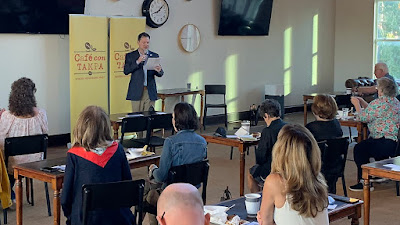
         Picture from BayNews9


Finally getting my thoughts down about the Rays Sister City presentation at the Cafe Con Tampa meeting at Oxford Exchange in downtown Tampa on October 1, 2021. This may be a long read, so you are warned. Feel free to screenshot, and use an image, but like the issue itself, my thoughts are best understood in full context.

Overall

In attendance were business leaders, politicians, fans, and media. I recognized Charlie Frago of the Tampa Bay Times and JP Peterson of his radio show. There was also Spectrum News and other television networks. The MC of the event was Del Acosta.

Here is Rays President Brian Auld's 11 minute presentation. This was the only part of the morning that was allowed to be video recorded. As per the Cafe con Tampa rules, videoing in the Q&A was discouraged. If you haven't seen it, I recommend watching before you read on. Here is the link if you are on mobile: “One Team Two Cities --The Tampa Bay Rays Sister City Plan” Brian Auld, President, Tampa Bay Rays. 


I liked how Brian said this issue is not ideal for discussing on social media or in sound bytes. I agreed with that 100%. It is complicated. I have been writing about it for years.

The following is my perception and an attempt to take apart the Rays Sister City argument. For those new to my work, I have been a loud opponent of the Rays Sister City plan since Day 1.

Talking to Their Target

There are three stakeholders in the Rays stadium saga: politicians, business leaders, and fans.

Friday's presentation was for business leaders and politicians. City council members, lobbyists, lawyers, and prominent business leaders were in attendance. The presentation was geared to them. It was slick, shined, and practiced. Auld spoke about revenue streams, costs and the potential for increased business relationships and tourism. Among the supporters of the idea was Richard Gonzmart of the Colombia Restaurant Group, who added the potential for flights from Tampa to Montreal.

(If you don't know who Richard Gonzmart is, he is a BIG DEAL. Click for is his bio. That the Rays have him in their corner supporting the Montreal plan is a significant win for them.)

Many business leaders don't care about baseball games. They don't care about wins or losses on the emotional level. They don't wear Rays hats to sports bars, or bring their families for a night out at the ballpark. The only reason they go to games is to hobknob and make deals in luxury boxes. They care about how partnering with the team can make them more money.

Politicians also don't care about wins and losses on an emotional level. They are also not going to games for recreation. They care about the image of the city. Champa Bay is a huge hook to hang their marketing and sales pitch on. It doesn't matter if the team plays one or 100 games in Tampa Bay. If they are champions and the name "Tampa Bay" is attached, politicians will attach their efforts to it.

So if the business leaders are on board because they see dollars, and the politicians are on board because the Rays are asking for less money and the team might make the area more attractive, then where does that leave the fans?

The Rays Failure for Fans

The Rays don't have a pitch for the fans. The Rays seem to believe they don't need one. They think they can get the Sister City done without engaging the fans. And technically, on paper, they can. They need money and they need political support. As HeroHabit recently wrote in a post about the Oakland A's stadium/relocation situation, "The fans don’t get a vote in the matter so it doesn’t make any difference if they have five million fans or five thousand fans."

If there was a popular referendum on the Sister City plan, my guess is that it would fail spectacularly. But the Rays don't need a vote because they aren't a government entity, even if by their name they do represent the Tampa Bay region. They can do whatever they can afford. That's important to remember.

The Rays also don't understand how fans think. Under the Sister City plan, the Rays want the same amount of fans who go to 81 games in Tampa Bay to go to 40 games. Increasing attendance isn't done by decreasing games, it's done by increasing fans.

(And don't get me started on Brian Auld's mention that people travel all summer and would rather go to North Carolina than a baseball game in St. Pete. Or that any significant amount of fans will travel to Montreal to see the Rays. That just shows who the presentation is geared for. Hint: not the regular fan.)

As proven by the harsh reaction to the Sister City sign the Rays planned to put in the outfield during the playoffs, the fanbase will react negatively to the idea of losing games to Montreal. Especially if all Tampa Bay gets is the beginning of the season - the Rays typically lowest attended and watched games. 

I have no doubt season ticket sales will drop. If corporations buy seats, few Rays fans will take their company's tickets. The negative feeling of betrayal may possibly negate the increased revenue of a new stadium, making a new stadium worthless to the Rays and a financial burden on the City of Tampa.

The Rays have proven to be poor at getting the Tampa Bay area excited about Rays baseball. Notice how few gigantic banners support the Rays versus how many support the Lightning or Bucs. It will take a herculean marketing effort to get fans excited in a team after taking 40 games from them. The fanbase does not buy that the Sister City plan is the only way to keep baseball in Tampa Bay. Not with NHL, NFL, four spring training teams, four minor league teams, soccer, and a successful Major League team already in the area. No one believes the Rays are not profitable. Billionaires don't continue to own assets that lose money.

Loans and Leases

Brian Auld was asked what will prevent Stu Sternberg from selling the team and the team being eventually moved to Montreal fulltime. According to Brian, there will be an lock-tight agreement between the Rays and the City of Tampa that will prevent the team from moving. 

Of course, the last time Stu Sternberg faced a legal agreement that mandated his location, he went behind everyone's back and negotiated for a move, albeit partial. Legal agreements are only as good as their enforcement and Stu Sternberg has shown he doesn't care about agreements with our region. There is nothing preventing him from selling in 2032 to the Montreal group. Then what happens?

I do believe Brian Auld, Rafaela Fink, and other Rays front office folks love Tampa Bay. I do believe they enjoy living here and enjoy being part of our community. However, I also believe Stu Sternberg does not care about this community one bit. Living here is temporary for him and once he sells the team, he is gone. He has done nothing for this community - more on that later.

Brian Auld also mentioned the Rays don't want to be in the red moving into a new home. This means they don't want to pay a mortgage - they claim this will hurt the on the field product. But shouldn't a new stadium bring in increased income? If the Rays can't maintain their same payroll and use the new park revenue to pay off the ballpark, that's not our problem. That's theirs. Again, they should be able to build more relationships with local businesses and fans. But their behavior over the years has poisoned that water. They don't see their failure to drum up corporate support in 2018 as their fault, they see it as the fault of the region. Then why don't similar sized markets have the same problem?

Yes, they will have to take out a loan. Yes, they can't leverage the value of the team to buy a stadium. But there is an expected revenue gain from new stadium ticket sales - both corporate and individual - as well as many other revenue streams that open with a new stadium. They can also steal advertisers from the Yankees and their organization.

(No one has yet mentioned how that relationship will work. If they move to Ybor, the Rays will essentially be in the Yankees market. They will have to negotiate for the Tarpons lost revenue. Perhaps the Rays know negotiating with the Yankees will not be cheap.)

Maybe the Rays don't think these streams will be enough. Maybe Stu Sternberg should open his own wallet. Maybe he is not as rich as we think.

The Stu Sternberg Perception Gap

During the presentation, Brian Auld mentioned how good of a boss Stu Sternberg is. He mentioned how Sternberg empowers his employees and encourages outside-the-box decision making. Auld said Sternberg allows the Rays to support movements and social issues and allows employees to get involved in their community. These are all good things.

But the Rays don't understand - or don't care - how Stu Sternberg is perceived by the fanbase. I can't speak for the politicians or business leaders, but the fanbase does not like Stu Sternberg. "Screw Stu", "Sell the Team", and "StuSux" are common refrains. Sternberg is often referred to as one of the worst owners in sports. I personally have written about his bad image for over 10 years. He is not customer friendly and his faux pas have added up. The fanbase thinks of him as a carpetbagging, New York investor who has no interest in Tampa Bay other than to make money and not spend his own.

If the Rays want the fans to have an open mind on the Sister City Plan, Stu Sternberg - not the Rays - needs to fix his perception. Because right now, he is not trusted nor liked. While Jeff Vinik sets an extraordinary high bar for a local sports owner, Stu Sternberg doesn't even clear the lowest bar. The Steinbrenners do more for Tampa Bay than Stu Sternberg.

The Partial Market Argument

If you are looking for a summary, here it is: the Rays goal is to create a Top 10 market by combining two mid-sized markets. They claim Tampa Bay, in its current state, is not capable of supporting Major League Baseball. We are too spread out, we lack major corporations, and our per capita income is too low. All of these are true.

We have also voted down transportation initiatives, protested against increased density, and although small to mid-sized companies are moving here, no major corporation has decided to call Tampa home.

They claim that by adding the power of the Montreal market, the Rays will be able to compete regularly with the Red Sox and Yankees. But don't they already do that now? Their only reason to add a complete additional market is to make more money. An additional TV deal, an additional radio deal, and an additional fanbase. Yes, a combined market would have a better chance of signing Wander Franco to a 20-year, billion dollar contract. But it is not needed. What is needed is a centralized stadium and a monopoly of baseball interest. The Rays need to be the only baseball option in Tampa Bay. When I was tracking regularly, the Rays only accounted for 50% of total baseball tickets sold in Tampa Bay. 50% of ticket sales went to local spring training and local Minor League Baseball. A Major League team cannot succeed with this level of competition. Especially if it plays in a bad location.

I would also like to see how the Rays rated all available markets. Why Montreal? What makes Montreal a part-time market? Does MLB think it is unable to sustain a full-time team? How do the Rays and MLB rate other markets? 

Why not look to the east to the biggest US market without any baseball? Orlando is completely untapped. Rays fans might not mind splitting the team with a city an hour away. Granted, that would mean only one TV deal. But expanding to the Orlando market would add 2 million people to the Rays fan pool. Outside of a few exhibitions at Disney in 2008, the Rays have completely neglected Orlando.

Speaking of TV, Auld's reference to pandemic ratings as evidence fans will watch no matter where the team plays is incredibly unfair. The Rays, Lightning, and Bucs represented Tampa Bay in 2020. We were all in it together, remember? The best thing fans could do was watch as their favorite teams played in "bubbles". Watching sports was a reprieve from the drama of COVID-19. But when the Montreal Rays play on TV, Tampa fans can't attend those games because an ownership group looking for more revenue moved them from our city, not because of a public health crisis. Huge difference.

Attendance Aspirations

Brian Auld mentioned the Rays would like to have 35,000 tickets sold a night. That was the 2019 average of the Houston Astros, who play in a metropolitan area of 6.5 million, or 3.5 million more than Tampa Bay.

I like to compare Tampa Bay to Pittsburgh. Pittsburgh is a similar sized metro area with three major sports teams. In 2015, the Pittsburgh Pirates drew nearly 2.5 million fans (2.498). They drew over 35k thirty times. 35,000 times 81 is 2,835,000 fans per year. In 2019, an attendance of 2.8 million would be 10th in Major League Baseball. If that's their goal, that is impossible. There are few untapped metropolitan areas that will get the Rays to that goal.

In 2017, I interviewed Brian Auld for this website. He said the Rays goal was league average. In 2019, league average per game was 28,355. That's 2,296,796 for the season. The Washington Nationals were closest to the average in 2019 with 2,259,781 tickets sold. 

"I think Pittsburgh is an apt comparison. We look at the Ohio markets as well – Cleveland and Cincinnati." - Brian Auld, 2017

Also in 2017, I wrote a post for Fangraphs on whether the Rays could ever reach average attendance. I concluded that the Rays' goal should not be average among MLB, but to be average among similar sized markets - Baltimore, Cincinnati, Cleveland, Milwaukee, Oakland, Pittsburgh, San Diego, Seattle, and Kansas City.

My conclusion was with "a new stadium closer to the center of Tampa Bay’s population, the Rays may be able to sustain or exceed the average small-market attendance. That, along with a new TV contract, would help with revenue and in turn, aid payroll, which may add to talent depth, and possibly equal more wins making the Rays more long-term competitive."

But as mentioned, the Rays goal is not average among small to mid-sized markets. They want to be a Top 10 market by combining the power of the Tampa Bay and Montreal market. Again, they want the same amount of fans to condense their buying habits in half the time. Tampa Bay's 3 million people and Montreal's 4.2 million people does turn the Rays into a large market, if the fans cooperate, which I don't think will happen.

(Personal note, my birthday is in September. If the Rays do the beginning of the season in Tampa and the second half in Montreal, I will never again be able to go to a local ballgame on my birthday. Something I have done for over 30 years. I can't move my birthday to the beginning of the season. I am sure I am not the only one.)

Opening the Pandora's Box of Relocation

If the Rays succeed in splitting their season between Tampa and Montreal, what is preventing Major League Baseball from splitting other cities? What is preventing them from pairing up expansion markets and making a Portland/Nashville team or a Vegas/Charlotte team?

The Rays are often imitated. The Sister City idea sets a very bad precedent for sports geography. If the Rays can get out of having to try harder to make one market work, then why can't other teams move? If they can combine markets for extra revenue, why can't other teams in similar sized markets? Fans and the record books will be confused with the fluidity when other teams will start moving. Imagine the excitement when the Nashville/Pittsburgh Music Pirates play the Vegas/Cleveland Desert Guardians in a World Series that won't be local to half the applicable fanbases.

MLB needs to nip this stupid idea in the bud now before its gets even more stupid.

What Can Fans Do?

The Rays discussion at Cafe con Tampa was insightful not only to get the Rays perspective, but also to show who supports the effort. For example, I mentioned Richard Gonzmart as someone already excited to work with the Sister City plan. Gonzmart owns the Colombia and Ulele. Rays fans could boycott these restaurants or protest outside of them. If the Rays can't be convinced to drop their support for the Sister City plan, perhaps their business partners could be.

Rays fans also need to be seen. Look up these social meetings for Rays appearances. Spread the word, come in with several questions, and ask one or two. Also meet the movers and shakers. Meet Brian Auld and the Rays front office personnel. Do not give a speech that doesn't end with a question. Force the Rays to engage the fans. Be civil and be seen. The more Rays fans are seen asking the Rays tough questions, the more people will see Rays fans standing up for Major League Baseball in the area.

I have been writing about baseball in this area for over a decade. MLB can succeed here if given a chance. The Rays need to either give it a chance or leave completely.

Tuesday, July 27, 2021

The Disrespected Rays Fans


(This was submitted to the Tampa Bay Times Editorial page on July 7th, 2021. After 3 weeks of no response, I decided to publish it here. I don't have 1% of the Times reach. I do like to think I have an informed opinion on these matters. After all, I have been writing about the Rays and baseball in Tampa Bay for over 10 years. But for whatever reason, the Tampa Bay Times didn't feel the need to print this.)

Over the last two years, all Tampa Bay sports has done is win. No matter the sport, we’ve made championships, won trophies, and been the talk of the sports world. And our fans have enjoyed every minute of it. Most of them.
 
While Lightning fans get boat parades and Bucs fans get the glory of the greatest of all time, Rays fans are living with the idea that they won’t have a team to see in the summer and fall of 2027. Or maybe sooner if Rays owner Stu Sternberg gets his way. 

And while outgoing St Petersburg Mayor Rick Kriseman pushes back on the Rays and calls their plan a non-starter, several St Pete mayoral candidates as well as Tampa Mayor Jane Castor support this plan. Who do you think the Rays will want to negotiate with? 

The Rays need a new stadium. That is unequivocally true. The where and how to pay for it has been debated for over 10 years and it is wearing down the fanbase. It is hard for more than diehards to care when the finger pointing and relocation rumors take more headlines than the team’s success. 

The Rays’ Sister City plan of “sharing” a team with Montreal makes no sense for the people of Tampa Bay. It is disrespectful to our fanbase and will lead to the team eventually moving to Montreal for good when Stu Sternberg sells the team. Despite front office claims they want the Rays here for generations, there is no doubt selling the team is Sternberg’s final goal. He wants to maximize his profits first. Two new stadiums in two markets would do that. And when he does sell, what is preventing the new owner from completing the move, leaving Tampa Bay with a useless stadium, too small for a new full-time team and too big for another Minor League team? 

“Never trade with the Rays” is an axiom well known in baseball. They have one of the smartest front offices ever. With over 10 years to prepare and a staff working night and day on metrics, our politicians have no chance negotiating a winning deal for taxpayers unless they play hardball. The current proposal of 40 games of Rays baseball, Spring Training, and a new home of the Rowdies if Tampa Bay builds a new stadium is like trading an all-star pitcher for two benchwarmers and a punter. Local baseball fans know the late season pennant race is the best part of the season, Spring Training is for tourists, and Rowdies soccer, while fun, isn’t baseball. 

Not only will this deal turn off what remains of the Rays fanbase – why support a team that moves midseason? – it will also foster unhealthy debate as to which city supports the team more. Not to mention moments in which the fanbase shows appreciation to players such as jersey retiring ceremonies, statues, or other banners. Will they be held in both locations? Or just the most deserving location? 

Prior to the Stanley Cup Championship, Tampa Mayor Jane Castor said she would discuss sharing a baseball team with the Mayor of Montreal, but she wouldn’t discuss sharing the Stanley Cup. If this was a joke, it wasn’t funny. Tampa Bay area baseball fans were disrespected and blasted the mayor on social media. Unfortunately, Jane Castor has yet to apologize. She has no reason to, even if the Rays leave town, she can still wear a Yankees hat. 

We hope our politicians don’t bend to the whimsical desires of billionaire sports owners. We should not “share” a baseball team. What the Rays need is a centralized stadium and a monopoly of baseball interest in Tampa Bay, even if that means getting rid of regional Spring Training. The Rays are right, no other Major League market has the difficulties of Tampa Bay. But disrespecting the fans is not a step in the right direction.

Tuesday, February 11, 2020

Delusionally Doubling Down on the Montreal Plan

Over the last few days, the Tampa Bay Rays front office have released several quotes advocating their "Sister City" plan to divide Major League Baseball between Tampa Bay and Montreal.

It is a stupid, stupid, stupid plan made by a greedy billionaire designed to rip the heart out of the fanbase and prepare them to lose the team forever.

As I have written several times, I disagree with this plan. I have also been on ABC Action News twice discussing my opposition.


From a business perspective, former Wall Street investor Stu Sternberg is attempting to diversify his assets. He figures if he and his Montreal business partners each have to invest less in smaller stadiums in two markets, there is less total financial commitment while receiving increased stadium attendance bumps in two cities. By going international, he also hedges against a US economic decline. There has been much talk that the US economy will eventually recede, and when it does Sternberg will have Canada to buoy his investment.

Stu Sternberg is not increasing his gains enough here in Tampa Bay. Despite franchise value gains of 27% in 2017, 9% in 2018, 12% in 2019 according to Forbes, that is not enough for his Wall Street wallet. He wants to better maximize his investments. This isn't about emotions or people. It is about dollars and gains.

He invests less, makes more, and is covered against a market tightening. What is there not to like from the perspective of a Wall Street investor?

If one billionaire can do it, can others? Where does this split-city plan stop? In his interview with WDAE at Rays Fan Fest, Sternberg mentioned that MLB did not consider Montreal a full-time MLB market. That is the first I have heard that said, and it should be a big deal.

Consider this: Montreal is a city of 4 million people. In 2015, Montreal had a GDP of $193 billion dollars (Tampa Bay had $118 billion). From 1979 to 1983, the Expos were in the top 5 in attendance in the National League. Montreal is a legit city with an international economy and baseball pedigree.

If they don't reach the level of full-time market, who else doesn't? Does Pittsburgh? Milwaukee? Cincinnati? Cleveland? What is the threshold? Because if owners follow the Rays lead and start splitting seasons throughout MLB, the only teams that will be in their cities full-time will be in the mega markets of New York, Chicago, and Los Angeles.

Would the Pirates consider moving half their season to Nashville? What about the Indians playing half their games in San Antonio? Could the A's play half their games in Portland? Maybe the Marlins split half their games between Miami and Las Vegas.

Where does this end? What is the threshold of a Major League market if neither Tampa Bay nor Montreal make the cut?

By the way, Tampa Bay is a robust enough market for four Minor League Baseball teams, four Spring Training teams, an NFL team, and NHL team, a major college program, and an XFL team. Montreal has excess economic capacity as it only hosts the Montreal Canadiens and the Montreal Alouettes of the Canadian Football League (CFL). But apparently, that is not a enough for a full-time market to Major League Baseball.

Another fallacy in the Sister City argument is that demand is driven by availability. Stu Sternberg and the Rays front office believe they can get the same attendance of 1 million plus fans to Tropicana Field in April, May, and June that they get from April to September because the supply of games is smaller.

There are many reasons why this reduced-supply increased-demand concept isn't realistic.

For one, the Rays will still face an abundance of regional sports competition. If they play in Tampa Bay in the spring, they face competition from four Minor League Baseball teams, the Tampa Bay Lightning, and the new XFL Vipers. As well, many local fans have just spent their money on Spring Training.

Second, traditionally the Rays struggle to draw in the early months of the season, especially in May. May is typically their worst month of the season. People are not yet fully engaged in baseball in May. How do you expect the same type of fanbase excitement in the first half of the season versus the second half? In the first half, teams are still figuring out who they are. There is a saying that baseball teams don't really know what they have until the 1/3 point (54 games) in the season. Will they be contenders? Will they be also-rans? If the Rays play the first three months of the season in Tampa Bay, Tampa Bay will never again experience a pennant race in person.

Third, Stu Sternberg believes the Rays will draw a million people in three months with half a schedule - and maybe less than half the games against the Yankees, Red Sox, and other teams that draw opposing fans. Typically, the Rays play 9 home games each versus the Red Sox and Yankees. What if all 9 games are after June? What if only 3 games versus each are while the Rays are in the bay area? Then the fans in Montreal get to see the Rays top rivals and the fans of Tampa Bay area left with the less appealing part of the schedule.

The Rays cannot expect Major League Baseball to cater the schedule to them and provide them a 50/50 split in opponents for each fan base. And what about interleague rotational games? Fans in Tampa Bay may never get to see players from an interleague team such as the Marlins, Mets, or Cubs play the Rays if those games are always scheduled in the second half of the season.

Fourth and lastly, it is easy to imagine that this arrangement pitting fans and officials of both cities against each other as they will compare and contrast attendance as a measure of what fanbase supports the team more. If Tampa Bay draws less against the Yankees in April (as the Lightning are simultaneously in the playoffs) than Montreal does in September, Tampa Bay fans will probably get mocked. There will be non-stop comparisons as to which city is a better host in the media. Sternberg won't feel this competition as he makes money either way, but the fans and the cities will.

The sister city plan assumes these are loving, cooperating siblings, not competitive, bitter, catty siblings. And if the Montreal team is already saying Montreal is a better city than St. Petersburg, what will they say if the Montreal side of attendance exceeds the Tampa Bay side?

Then again, Sternberg might be the kind of parent who enjoys seeing siblings compete. But the side that has their team ripped from them will not take well to another city saying they are better hosts. There is already a malaise around the Rays. Hearing Montreal boast about being better hosts will only further turn Tampa Bay fans off to the franchise and the arrangement.

Lastly, a huge obstacle to the Rays success in Tampa Bay has always been the presence of the New York Yankees. What if the Rays said they were willing to stay full-time if the city cut their lease with the Yankees? Then Steinbrenner Field could be turned into a larger stadium in a centralized location. The Yankees have enough money to build a new spring training stadium anywhere in the world. The Rays know this, the Yankees know this, the City of Tampa knows this.

But challenging Steinbrenner presence in Tampa is either taboo, forbidden, or never mentioned in public, even though the Yankees have only been playing in Tampa two years more than the Rays have been playing in St Petersburg (1996 to 1998). The City of Tampa loves the Yankees.

By the way, if you haven't read the parody site Tampa News Force article entitled "Tampa Bay Vipers thankful to finally have sports spotlight to themselves", I highly recommended it. It is as much a commentary on the Vipers competition as it is the Rays local competition.
“Spring training starts in a couple of weeks, too”, he continued, as sweat formed on his brow. “I forgot about that. Sure, the Rays train way down in Port Charlotte but three teams, including the New York Yankees, possibly the most prolific and beloved franchises in sports history are right here for over a month, smack in the middle of our season.” He stopped, drew a deep breath and sighed, “The New York Yankees. Not the San Diego Padres or some other godforsaken franchise no one cares about, just the Notre Dame of Major League Baseball, that’s all.”

Friday, June 28, 2019

It is designed to break your heart: Thoughts on the Rays two-city solution


I have been writing about Tampa Bay baseball for over 10 years. For the first five years, I wrote about being a fan. I wrote about the World Series. I wrote about Game 162. I wrote about no-hitters, cowbells, and Rays-hawks. Then in 2014, I started this blog and dedicated myself to determining whether or not Tampa Bay was a Major League market.

As a Tampa resident, I came into the project with biases. I wanted to believe the market was not the problem.

For four years, I wrote every night. I tracked the attendance of the Rays, four Spring Training locations, and the four Minor League teams that call Tampa Bay home. I wrote about promotions. I wrote about bobbleheads. I wrote about traffic conditions and economic growth. I even wrote about hurricanes and Astros games. I was recognized for my research at Fangraphs as a resident writer in June 2017 and by mentions in articles in USA Today and several Tampa area publications.

After landing a consulting job overseas in 2018, I stopped writing regularly. On one hand, I knew writing about baseball from 5,000 miles away was going to be difficult, especially when I didn't know my work tempo. On the other hand, I decided I had written almost everything I could from open source data. From what I could acquire and what I analyzed, Tampa Bay could host a Major League team.

In theory.

Admittedly, there are a lot of problems with the current layout of baseball in Tampa Bay:
The list goes on.

A lot of work needed to be done to make Major League Baseball successful in Tampa Bay. None of these issues were alleviated in 20 years.

On Tuesday, June 25th, the Montreal boogeyman finally appeared in the flesh. After years of avoiding the M-word, Stu Sternberg and the Rays front office announced a plan to split the Rays season between Tampa Bay and Canada. According to Sternberg, the Rays would play the first 40 home games or so of the season in Tampa Bay. Then they would fly to Montreal and play out the rest of the season.

(They also may or may not move their Spring Training back to St. Petersburg from Port Charlotte, Florida in order to give local fans more product. Here is where I say I wrote years ago that Port Charlotte was a mistake and the Rays should have looked to expand their market by spring training near Orlando. But I'm just a guy with a blog.)  

The Rays will do this Tampa Bay-Montreal schedule every year. Forever.

While it is creative, this plan is befuddling at best, irrational at worst. It is like having a pitcher play every position and rotating them on the mound based on the weaknesses of each batter. Sure, it is legal, it may look great on paper, and may actually work, but it is not based in reality.

The Rays two-city solution requires two economies, two fanbases, two marketing staffs, two broadcast teams, and two stadiums (as if one was not difficult enough to fund, locate, and build). Sternberg envisions a "sister-city" relationship between Tampa Bay and Montreal marked by business investment and cooperation. He also envisions tourists travelling to and from each city bonded by fandom.

It is almost as if Sternberg wants St. Petersburg and Montreal to share the Rays as Tampa and New York share the Yankees. Per the latest data, approximately 12% of Tampa Bay roots for the Yankees and the Yankees presence is seen on billboards and marquees in Tampa throughout the spring. Instead of openly advocating for Major League Baseball to eradicate this conflict, and create a monopoly of baseball interest in the Tampa Bay region, Sternberg is using the Yankees-Tampa relationship as a model.

For Tampa Bay, Sternberg is advocating a smaller, more intimate, open-air stadium where the estimated one million Rays fans will buy one or two tickets per season over 40 games. What he fails to understand is that there will still be baseball in the area. After the Rays have their proposed "mid-season send off", local baseball fans can still spend their dollars and evenings watching Minor League Baseball at Spectrum Field in Clearwater, Steinbrenner Field in Tampa, LECOM Field in Bradenton, and a newly refurbished Auto Exchange Stadium in Dunedin. All of which are cheaper than Rays games and require much less emotional investment. Emotional investment that used to be spent on the Rays.

Former Major League Commissioner Bart Giamatti once famously wrote,
"It breaks your heart. It is designed to break your heart. The game begins in the spring, when everything else begins again, and it blossoms in the summer, filling the afternoons and evenings, and then as soon as the chill rains come, it stops and leaves you to face the fall alone. You count on it, rely on it to buffer the passage of time, to keep the memory of sunshine and high skies alive, and then just when the days are all twilight, when you need it most, it stops."
Stu Sternberg and the Tampa Bay Rays are planning to break the hearts of Tampa Bay when the summer is at it's peak. When the evening showers and humidity weigh down the soul of Florida. When our lethargic summer saunters are matched only by the leisurely pace of baseball. For over 20 years in Tampa Bay, fans waited patiently for their two weeks of Fall with a local beer and a Cuban, cheering on the local nine. Now the realities of politics and economics threaten to replace their summer respite with a vast emptiness. Their season will end early, and like Rogers Hornsby, they will stare out the window, remembering the distant echoes of the crack of the bat and listening for the faint advancement of professional football and hockey - franchises that call Tampa Bay home from start to finish.

The biggest shame of this whole debacle is that Stu Sternberg has roots in Brooklyn. He likes to remind listeners that he named his son after Sandy Koufax. But what would Brooklyn have said to Walter O'Malley if he told the Dodger faithful their beloved Bums would split time between Brooklyn and Los Angeles, that they would leave for the West Coast in the middle of every season? How would a Brooklyn business owner named Samuel Sternberg, a family man and soon-to-be father of Stu Sternberg, have reacted?

O'Malley probably would have been booed out of town. With this idea, Sternberg deserves the same.

Friday, May 19, 2017

An interview with Tampa Bay Rays President Brian Auld - Part 2


On May 5, 2017, I had the opportunity to chat with Brian Auld, President of the Tampa Bay Rays. Our conversation in the administrative offices of Tropicana Field lasted nearly 40 minutes as the Rays prepared to play the Blue Jays. At the time, the team record was 15-15. Many thanks to Brian and Razi Amador Fink for their time.

(This is Part 2 of the interview. Part 1 is here.)

Are you seeing younger fans becoming Rays fans?

Brian Auld: Well, we put every kid in tee-ball in a Rays jersey. That is one of our community programs. We want them to say they are on the Rays and to be proud of it. And we are on television every night and we are the local team. You go to games here and you might see Dad and Mom in the other team’s gear and kids in the Rays gear. I don’t think the parents are fighting it. I think they get it. I’ve even see a good number of kids who got their parents to change. I think that will really help. And as that strong affinity grows, when you have that $200 and you are trying to figure out where to spend it, I think you are more likely to spend it on your big league team.

That’s our long term plan. It can be frustrating on a daily basis. We do wish we had more revenue so we can compete more aggressively with the other teams in our division. But again, when I think about all we have done in the last 10 years, it has been significant. We have made a ton of progress. And I think ahead 10 years and I really think we will be in a different place and this conversation will be a thing of the past.

Ten years might not be long for a team, but for an individual, ten years is a long time. Are you expecting to be here in 10 years?

It is a thought that crossed my mind. Stu came in as a very young owner and he is 12 years older than he was then. We all want to build that ballpark. We all want to win that World Series and we all want 30,000 people to come in every night. We all want the same type of feeling that rippled through Tampa Bay in 2008 to happen again. It’s hard. You can’t expect it every year. There are 29 other teams gunning just as hard as you are. That’s what’s great about sports.

So it’s crucial we take a long term perspective. But we certainly want things to happen in our lifetime.

If you could compare Tampa Bay to any other size market, which do you look at? On my website, I have used Pittsburgh, is this correct?

I think Pittsburgh is an apt comparison. We look at the Ohio markets as well – Cleveland and Cincinnati. Nowhere is exactly like anywhere else and the Florida markets have a lot of unique things about them, many of which make our job harder. We want fans to be living and dying with us. We want that passion. I think we are generating it. But I understand people want to go to the beach. But the summer is not the most beautiful time to be outdoors. That’s a disadvantage compared to the guys in Toronto, Boston, and New York. But I wouldn’t trade places with those guys at all.

The other thing I would say about Tampa Bay – more so than any other sports market – is that it is still growing, still rising, and still emerging. It is changing every day – physically changing. It is creating an identity. One of the things I love about being in this position is that we are a big part about crafting the future of Tampa Bay. When we stood for LGBT, I think it sent a message about Tampa Bay to the country in the wake of the Orlando incident. When we went to Cuba, it said something about what we are doing here. I meet with the mayors more than my counterparts in any other market. Partly because it is smaller here, and we are a big fish in a slightly smaller pond. I think that is really cool. I like that. I like that no matter where our ballpark goes, it will dramatically affect everything around it in a way that exceeds what it has done in bigger cities because we are less established and we are coming along right now. And anyone you talk to, any of the business leaders, any of the politicians, they all feel like Tampa Bay is coming into its own right now. So it is a really interesting time for us to be doing what we are trying to do.

There is a great energy here. What is going on at USF-St Pete is interesting. Hopkins coming in, the Innovation District, I think I can throw a baseball and hit nine different breweries. And that’s neat. It’s people who are doing stuff. They are starting things and it is cool things. It is redefining what we are all about. St. Petersburg is a really cool place now. I don’t think I would have said that eight years ago or even five years ago. And I think it is great.

On a personal side, can you talk about your decision to take the job with the Rays years ago? What was the career progression that lead you here?

This is a great job. Who wouldn’t want it? (Laughs.) Well, I have always loved baseball and like anyone who loves the game I would have always jumped at the opportunity to work in the game if it came up. But there are 30 teams. I have people all the time ask me ‘How do I get to where you are?’, and I politely explain that there are 25 times more Major League Baseball players than there are people with my job. People understand how hard it is to be a Major League Baseball players, so then they understand that you have to be 25 times luckier than that. Plus, I keep my job longer. So it is really 50 or 100 times more difficult. There are more US senators than people in my job.

I was aware that if I limited my options to just sports, it would be a rough, rough road. That said, we have people here working for at least $10 an hour – because that’s our minimum wage – people who could be making more money somewhere else, who chose to be in baseball and are running down that track as fast as they can. And I admire them for it.

When I graduated college, I wanted to be a teacher. No baseball team was offering me a senior level position at the time, so the option wasn’t there. I absolutely love teaching. It was a very strong passion of mine. I went to business school with the idea of opening up a charter school and coming out of there was a principal of a public school. Then Matt Silverman called me and said his new boss at Goldman Sachs was thinking about buying the Devil Rays and if his boss did that then Matt would be the team president and he asked if I would be interested in being part of that team. It was too cool to say no to.

I didn’t believe him at first. We were 27 and 28 at the time. I didn’t understand why someone with the means to buy a baseball team would hand the keys over to us and Andrew Friedman as well. But he did and the three of us came down here and had an absolute blast trying to get this business turned around. We worked as hard as we could and so far, so good.

How has the perception of the Rays front office changed among other teams since the days you began here?

I spent my first eight or nine years here very focused on the internal. It was building the mission, creating an “employee-first” culture. We created a great place to work and then told people to do more with less. I think that foundation is important to what we have done here. And it extends to the clubhouse. I think a lot of players want to be here because they feel like we do everything we can for them. Matt was the team president then, so when I got there I was relatively young compared to most of them. We had stopped being the Devil Rays and become the Rays. We were highly respected on the business and baseball side.

I’ll tell you Stu and Matt both think a lot of minds changed after 2008. They were invited to sit a lot more tables. And not everyone has been to a World Series. It is a big deal that we did it and we sustained it for a few years. We won a lot of people over in the room. And that’s a really important room. Going back to the ballpark, we have to convince 29 other teams that building a ballpark here is a good move. Not just for us, but for them. They send a lot of money down here through the revenue sharing program and as the A’s have found out in the most recent CBA (collective bargaining agreement), those payments are not necessarily guaranteed. We certainly cannot build a new ballpark if it means sacrificing revenue sharing. So we are going to need baseball’s blessing and we going to do what we have to to get that. If they think we are on a foolhardy journey and a new ballpark won’t improve revenue, they we might as well stay here in a paid-for ballpark.

Are they sold on Tampa Bay? What is the feeling of other owners and front offices?

There is a healthy skepticism. I think it is warranted. Prior to 2008, I think a lot of folks thought it was the organization. We hadn’t had a lot of winning and we hadn’t done a lot to earn corporate partnerships nor sell season tickets. But that six year run we went on from 2008 to 2013, when we won 90 games five times and made the postseason four times, that was really good. I don’t know how long you have been doing your website, but anyone writing back then thought attendance would jump dramatically and it would have far exceeded what it did. That has given rise to some skepticism.

What I tell everyone in this process is that we need skeptics. You should be challenging everything I say. Our elected officials need to make decisions they feel good about. Don’t trust us or believe in what we are saying. Go find your own numbers and do your own studies on economic development opportunities and whether or not we can be a catalyst and everything else. We are talking about a very big endeavor and a huge public-private partnership. The more people who look at it skeptically, the more people who need to be convinced, the more people with open minds, the better. I don’t want to go forward unless a lot of other smart people have looked at this with their own angles and biases and determined that this is what we should do.

Do you think there has been a shift in awareness of public-private stadium funding? We are now seeing people such as John Oliver analyzing it, as well as several websites and other media. Do you foresee more resistance because the public is more aware?

I think there is more awareness. As I said, I welcome that. I take great pride in how we have done this. It probably has been slower that it could be otherwise. I think with the right political donations, I think we might get a vote through the St Pete City Council a year or two early. That’s never what we wanted to do. If the representatives who were elected to represent St Pete didn’t think that deal was the right deal – I still to this day don’t understand why they didn’t want to let us look on both sides of the bay given the circumstances – but if we couldn’t convince five of the eight of them, we still have a place to play baseball. That’s their job and we welcome that.

Same thing with the public. One thing that I like to tell people is we have to have a conversation about the value of Major League Baseball in Tampa Bay, because it is expensive. What troubles me is the “not one public dollar to stadiums under any circumstances” or even worse the supposition that we can pay for it ourselves but we don’t because we are whatever negative terms people want to use. Then people often point to franchise valuations that exist in magazines but aren’t necessarily real and certainly can’t be monetized.

The best example I have been able to come up with for that is if you are living in your house and it goes from a $100,000 to million dollar house, you still just have your house. The only way to get $900,000 in cash is to sell your house. Then the person who buys your house, they don’t have the $900,000 either. So we can’t access theoretical franchise increases in a way to pay players. It’s not doable. We may be able to borrow a little bit more, and over the years we have done that, and we are able to increase payroll. It’s not as easy as saying Forbes just estimated us at $900 million, so we can pay our players $300 million, because that cash does not exist. And when you look to buying a new ballpark, that money doesn’t exist for that either. We have to finance whatever we put into the new ballpark.  And whatever we put into the ballpark could be used for payroll or other operations of the ballclub. In the event we were able to finance a ballpark – and the most recent ones have billions in the price tag – we would need 85,000 people paying $100 a night to be able to do that. That’s just not how it works.

That’s why our vision has always been for our ballpark to be a public asset and for the community to have a say in how we go about it. We want to meet as many public needs as possible.

What are some of the more unique ideas you have received in regards to the ballpark?

First, whatever we do has to be tied to a transportation plan that can unlock all of Tampa Bay’s potential. My favorite is that we started by saying we wanted to create a baseball experience like no other. Baseball is king. Second, we want to make our ballpark accessible for public use 365 days a year. Why not open the gates and let kids play wiffle ball here in the winter?

As we thought it through, the ideas to make it an accessible place to be 365 days a year are blending with the baseball experience. For example, we need a place where we serve 30,000 people food. What do we do with those kitchens in the other 280 days a year? Could we turn it into a community kitchen? What would that entail? What would it look like? When you start thinking about those things, a community kitchen that can serve fans would be even cooler.

Building it in an open and accessible way might make for a different experience. Bellying up the bar to order your food might not be the way we do things in the new place. My favorite idea, and I am not sure if we are going to do anything with this, is that we have been watching sports the same way since the days of the Greeks and the Romans. Long rows of seats. If you are stuck in the middle, it is a horrible seat. So can we not do something like a horseshoe with a table in the middle?

We don’t have to jam 50,000 people into the smallest footprint possible. We have a smaller market. Let’s take advantage of that and have a place where people are more comfortable and it is more conducive to watching baseball and rethink how we put the seats out there. Engineers are mulling this over. I’m sure I am not the first ever to think of this. But it is that kind of thought process that we are bringing to this endeavor.

I think when we get this done, you will see the first in a new generation of ballpark. People forget Tropicana Field was the last of a previous generation.

I think about the energy they must have had to get Tropicana Field built. We mentioned the growth in St. Pete. It is still the smallest city in Major League Baseball. Although it is growing incredibly. I can’t imagine the foresight people had years ago to imagine Major League Baseball here without a team.

Last question, are you optimistic about the rest of the season? Do you think the Rays can compete?

I think so. We’ve played a very tough schedule so far. And we are .500. Without the guy we thought was going to be our starting shortstop. We just got Colby Rasmus back. Mallex Smith, who is supposed to fill some holes for us, he has been hurt for a little while. Some of our bigger names are not having career years. And we are hanging in there. I think if we keep fighting the way we are, you will see a team that is in it for the long haul. It is a fun team to root for. They are not concerned with any of the things we have been talking about. They just want to win ballgames.

Thursday, May 18, 2017

An interview with Brian Auld, President of the Tampa Bay Rays - Part 1


On May 5, 2017, I had the opportunity to chat with Brian Auld, President of the Tampa Bay Rays. Our conversation in the administrative offices of Tropicana Field lasted nearly 40 minutes as the Rays prepared to play the Blue Jays. At the time, the team was 15-15. Many thanks to Brian and Razi Amador Fink for their time.

(This is Part 1 of our discussion. Part 2 here.)

Let’s start with the big picture, what is the state of the Rays right now?

Brian Auld: As of yesterday, we were .500. Hopefully tomorrow we will be a game over. So the state of the Rays is good.

Let's get the elephant in the room out of the way. What is new with the stadium situation?

There is nothing brand new. But the good news is that our due diligence process over the last year has lead us to believe there is a greater amount of support for Rays baseball in the Tampa Bay region as a whole than we are currently generating at Tropicana Field. That’s a positive development for us. The other positive is that politicians, elected officials, and business leaders on both sides of the bay, and certainly fans are intent on keeping the Rays in Tampa Bay and we certainly want to stay in Tampa Bay. So I think that when all these minds get together and get creative, we are going to figure out a way to do that.

The difficult part is that it is very difficult. It is a very big challenge. Your blog has documented it as well as anywhere as. The attendance issue that we face is that we are not missing by a few hundred people, we are missing by 10,000 plus. The goal we’ve had is to be at league average, or certainly be league average or above when we are playing good baseball, which I think we are now, and we certainly have in the last 10 years. So those challenges are very real. And figuring out if/when/how we are able to build a ballpark that will allow us to cross that hurdle is a major endeavor. It is something we are taking very seriously, have a lot of sharp people on, and I am optimistic that we will figure something out in the next year or so at least.

Recently, you had a luncheon with the Tampa Chamber. How did that go?

It was great. Our players cracked a bunch of jokes and showed people their human side, which I think is always fun. Matt, Kevin, and I were able to talk a little about how the team is doing. We were also able to address a little of the stadium issues for those people and let them know we want to hear from them. It’s important to us and it’s important to Major League Baseball that people stand up and say ‘We want this team here. We want this team in our community and we are going to fight to keep it and we are going to help the Rays generate the kind of revenue you need to be successful’.

I’ve gone to one of those luncheons before in Tampa and the first question is always ‘Will the stadium be built in Tampa?'. I would assume your St. Pete luncheons get the same question but in reference to St. Pete or Pinellas.

That’s good and it is great that everyone thinks the best place for the ballpark is right next to where they live. And you much prefer that to the opposite – get them out of our town. So that is a common question. Another question I am often asked is ‘What is wrong with Tropicana Field?’ to which my answer is always ‘Nothing.’. We’ve put 30 million dollars into this facility and made it a great place to watch baseball.

However, it is aging. And as you are aware, other than the very old ballparks that have had significant facelifts, Tropicana Field is among the oldest in the entire game. People forget it predates the team by 10-15 years. We have some infrastructure issues that we have to deal with and that are getting more expensive every year – the pipes are starting to wear, things like that. But my main problem with Tropicana Field is that not enough people come to watch Rays baseball here. That’s really it. If we were bringing 30,000 people a night every night, we wouldn’t be talking about how we to explore the entire region to find the optimal site.

On that note, what I’ve seen is that from 2008-2010 you were doing well – selling out games against division opponents – then there was a slight drop, and then after 2013, your average attendance dropped again. Could that have been because of the front office changes? Or is any of because with Jeter, David Ortiz, and others retiring, opposing fanbases aren’t coming out as much?

Certainly 2008-2010 were the high water marks for us. But for a team coming off an incredible World Series run and regarded as one of the best teams in baseball during those years, we didn’t hit nearly where we wanted to be. And those sell-outs were after we closed off 10,000 seats. It is important that we convey that even during that time, we still didn’t reach the league average that we were shooting for. Then we continued to be successful through 2013. The drop-off after that, I think, has been because of team performance, more than I would say Jeter or Ortiz. When the Yankees and Red Sox are good, their fans do show up more. That said, we would rather be on top of them in the standings and bring in our own people regardless. That is not something we want to be dependent on.

We are trying to do everything we can. We have tried a lot of different strategies to bring people in. The concert series, for example, use to be a very good way for us to get to 30,000. I think we brought in comparable acts in latter years and didn’t get anywhere near there. So we’ve asked ourselves is it better to have premium giveaways? What else can we try? We are trying a doubleheader this year – a single gate doubleheader. We are going to continue to be creative, to come up with something that works, and then understand that even though we do something that works for a little while, it may not last.

All of that said, if you go back from 1998 to now, the trend has been overwhelmingly positive. One thing I like to tell people is that since I got involved in the organization under Stu Sternberg’s leadership, the progress we have made in the last 10-12 years has been phenomenal. If we can make this same progress over the next 10-12 years, we won’t be having this conversation. And I believe the region is moving in the right direction. St. Pete is a dramatically different city than it was 10 years ago. The Tampa Bay region has become more of a region – there is a lot more cooperation on both sides of the bay. People are getting used to driving over the bridge a little more than they used to. They are saying nicer things about it to each other. So all of that to me means we are moving in a positive direction, and that, more than anything, is why we want to be here. That’s why we never petitioned the City of St. Petersburg to look outside of Tampa Bay. This is where we want to be.

When you look at some of the other local organizations such as the Lightning, and the involvement Jeff Vinik has in hotels and property, and the Rowdies, and all Bill Edwards is doing, do you feel the Rays are falling behind or having to play catch up because of your location and the political hurdles?

I think the Rays organization and brand is very, very strong. We are really proud of that. I think any non-profit the Rays have worked with feels good about how we have supported them. I think we have found a way to touch everyone in the Tampa Bay region and we are getting better and better at doing that every year. You can’t run around Tampa Bay anymore and not see Rays gear. There was a time when we first got here that we gave free tickets to anyone with a Devil Rays hat on. We’ve come a long, long way and I think we continue to move in a very positive direction.

Jeff Vinik and Bill Edwards have a different vision for what they are trying to do than Stu Sternberg and the Rays do. We just want to run a successful baseball team. We want to compete. We want a team that does right by the community, that fulfills our mission to energize the community through the magic of Rays baseball, but we aren’t looking to subsidize our baseball team with development projects. We want to leave that to developers. Which by the way, Jeff and Bill have either become or learned about or hired the right people to bring into the mix. And that’s great. I think it is tremendous. Especially how Jeff is actively involved in shaping the future of Tampa and Tampa Bay. What he is doing with transportation right now, I am incredibly grateful for. But we try to focus on what we know, which is how to run a baseball team and I think we have done a pretty good job of that.

Do you meet with any of the other local sports owners to discuss overall direction?

Definitely. Stu knows the Glazers well. He knows Jeff well. I know Brian Ford of the Bucs and Steve Griggs of the Lightning. I just had coffee the other day with Rick Baker and talked to him about St. Pete. We all have very cordial relationships. We are competitors, but not in a traditional sense. We all recognize that we are all going to do well together, and we are all going to struggle together. We have the same struggles, so we all try to help each other out. We all get along, we root for each other’s teams. We all want each to do well, because more than any other sports region in the country, we are all tied to what happens here. So goes Tampa Bay, so will go the teams. Right now, things are moving in the right direction.

What about in the market of baseball in Tampa Bay with Spring Training, Minor League Baseball, etc.? I’ve heard you have read some of what I’ve written.

Yeah, you have pointed it out very well. Sometimes it scares me how many options there are.

My premise is that if, for example, a family has $200 in January to spend on baseball for the year, there are a lot of different games they can spend it on.

It doesn’t help us, but it is great for baseball and great for Florida. We believe in that. We love having Spring Training here. Our players love it. They get six more weeks at home. It could be a competitive edge for us. We wish all the Minor League and Spring Training teams around us well.

But, does it make it a little easier when you move down from New York and you have the Tampa Yankees right there to hold on to that allegiance and not come over to the Rays? I think it does and it makes our challenge that much more difficult.

I still think we are going to get your kids, though. I think we are seeing that. One of the things I love talking about is that we are just now seeing the first group of kids whose parents grew up as Rays fans. That’s going to start happening more and more. We think that is what is going to make this franchise take off. We don’t have the generational fanbase they have in other markets. And beyond that, we don’t have a group of people who grew up going to games so they think ‘oh, I’ll just bring my kid out to a game’. That’s coming and it’s going to grow stronger and stronger.


Part 2 of this interview coming soon.

Tuesday, February 7, 2017

Rays Front Office to Speak at Tampa Bay Business Journal Event

Every year, the Tampa Bay Business Journal assembles several prominent sports business leaders in Tampa Bay for a discussion. These "Business of Sports" events are usually held at a sports venue (the last two years' events were at Amalie Arena), cost nearly $100, and are hosted by well-regarded sports media personnel.

The 2017 Business of Sports event looks just as good as previous events. Hosted by Sports Business Journal and Sports Business Daily Executive Editor Abraham Madkour, the event features front office personnel from the Lightning, Bucs, Rays, and Rowdies, as well as personnel from major Tampa sporting events such as the College Football Playoff. Representing the Rays will be President Brian Auld and VP of Strategy Melanie Lenz.

Surprisingly absent is Minor League Baseball or any of the Spring Training teams. Those teams are part of the Tampa sports ecosystem. Their facilities are in part paid for by taxpayers and local fans also buy their tickets and merchandise. Both Minor League Baseball and a representative from the Minor League teams should be present at the Business of Sports event.

Personally, I think the most interesting guest of the day will be Tampa Bay Rowdies Owner Bill Edwards. Edwards has big plans for the Rowdies in downtown St Pete. I would ask how these plans coincide with the future plans of the Rays. Unfortunately, however, I will not be attending. But I will be following along on social media.


Monday, February 6, 2017

Tampa Bay Times asks Stu Sternberg more easy questions

Every year, Marc Topkin of the Tampa Bay Times sits down with Rays owner Stu Sternberg for a "State of the Rays" interview. There are usually some questions about the direction of the team, recent acquisitions, players who have recently moved on, a vague update on the stadium, and sometimes a question about food or music.

Although this year's interview did not have a food or music question, it was much of the same.

Of course, Topkin didn't ask Sternberg about his out-of-state residency or the fact that opinion of Rays ownership has plummeted according to ESPN. He also didn't ask about Sternberg's rationale behind being the only MLB owner to oppose the new collective bargaining agreement. Follow up on that issue might have been nice.

Topkin's interview did have some interesting quotes by Sternberg.

I have to give it to the Rays. No matter how many other sports teams expand or ask for funds in Tampa or in St Petersburg, the Rays never go on the offensive at the local level. Case in point, Sternberg does mention the Rowdies growth plans, but mentions the Rays will proceed regardless.

I will have more on this in a later post, but St Pete is not big enough for both an MLS Rowdies and the Rays, despite what Mayor Kriseman thinks.

Sternberg discussed the Rays cable deal, which greatly needs to be renegotiated. Unfortunately, he says it won't happen until 2019, but then say it could be month. Not sure what that answer meant.

Buried towards the bottom were two very key points:

According to Sternberg, the Rays have not turned a profit since 2005. This includes their subsidy from MLB due to revenue sharing. Yes, the value of the team has skyrocketed - this is probably why Sternberg doesn't want to sell - but the team is not financially stable with its current operations. It is not "killing what it eats". It is relying on outside funding or future returns to gain leverage. That's not a good way to do business.

The Rays may need to be more creative in how they make money.

The last but perhaps most interesting point for this site was Sternberg's assessment that attendance will be flat this year and probably similar to last year's 1.2 million. This is surprising. Have the Rays admitted 1.2 million is the new reality? From 2011 to 2013, the Rays averaged 1.5 million. Why is that number unattainable currently? Another 300,000 on top of 1.5 million would equal the Rays 1.8 million attendance reached during their World Series year.

But again, why isn't 1.5 million a realistic number? What changed after 2013 that altered ownership's expectations?

These are the type of questions Marc Topkin should be asking.

Wednesday, August 24, 2016

Rays tap USF Sports Marketing Professor for ideas

I'm not sure what the date on this news is, but according to a press release by the University of South Florida, USF professor Mike Mondello will be working with the Rays throughout the fall in an attempt to help their marketing department.

Per the release:
Sport & Entertainment Management Professor Mike Mondello will use analytics to work with Rays senior management on long-term issues critical to the success of the organization. Mondello will be the first faculty extern for the college, where faculty take time away from teaching and research to help businesses find creative solutions to the issues they face. The externship also gives faculty members a chance to connect with the business community

Using USF Sports Marketing folks is not uncommon for the Rays. Last year, I wrote about a program the team used to bring in interns from the college. The students were used to research how flex packs are being used.

Mondello is also no stranger to commenting about the Rays and the Tampa Bay sports market. He has been quoted in local media several times in regards to the Rays, to include how competitive the market is between the Rays and the Lightning and how the MLB Commissioner is looking to spark the stadium talks. His research and experience in sports marketing is extensive.

I've often said Tampa Bay is one of the most complicated sports markets, especially in regards to baseball, in the country. This is a very smart move by the Rays. With a sports marketing professor on board for the last quarter of the 2016 season, the Rays can pick his brain for ideas they can use in 2017 and beyond. Mondello can then bring his experiences back to USF and bring the Rays problems into the academic laboratories, where students can come up with ideas. This further creates a pipeline between the Rays and USF.

As Jonah Keri wrote years ago, the Rays are an organization always looking for an edge. If tapping into academia gives them a slight advantage over other sports or local venues, then they will fare better in the battle for hearts, minds, and dollars.

Monday, August 22, 2016

Rationale behind Rays freezing season ticket prices

Last week, the Rays announced that they were freezing season ticket prices for the next two years. That means 2016 season ticket holders get the same prices for their 2017 and 2018 season ticket packages.

In a business where prices usually increase, seeing a price freeze makes some think business is doing bad. Cork Gaines of RaysIndex.com called the Rays decision a "terrible sign". Kyle Glazer of Baseball America said what the Rays were doing is "unprecedented".

According to Glazer,
The Rays have the third-lowest average ticket cost in 2016 at $21.04, according to Team Marketing Report’s Fan Cost Index, a nearly four percent drop from their average ticket cost in 2015. The average MLB ticket this season costs $31 and the Red Sox have the most expensive average ticket at $54.79, according to the report.

The insinuation here is that tickets are cheap enough and people should be buying them. Here is the problem with this line of thought. We know the Rays hyper-local population (within 30 minutes) is lower than any other team in Major League Baseball. With the Rays fanbase living further from the ballpark than any other team's fanbase, the overall cost of a game is higher than just the cost of the game. Rays fans have to pay gas and time costs to enjoy a night at the ballpark.

With their recent decision, the Rays are holding the product part of the experience stable. Meanwhile, traffic is getting worse, their stadium is getting older, and faith in ownership is dropping.

Before the season, I had a chance to speak with Rays Chief Business Officer Jeff Cogen. Cogen emphasized repeatedly how the season ticket base was the most important part of the Rays fanbase. Season ticket holders are the base in which all other parts of the fanbase are built. They are guaranteed fans and butts in seats.

Prior to joining the Rays, Cogen was the CEO of the Nashville Predators. He held that position from 2010 to 2015. During our interview, he compared the Rays situation with the Predators when he arrived in Nashville.

Here is a chart of the Predators season ticket prices from 2005 to 2015. Notice anything interesting?


Cogen took over as Predators CEO in August 2010. Predators ticket prices stayed at 2009/2010 levels through the 2010/2011 season and the 2011/2012 season. This is not a coincidence.

The 2016 season is Jeff Cogen's first as Rays Chief Business Officer. He and his staff have been given a very difficult problem. They are probably still gathering information on the fanbase. They are probably still trying to figure out who their fans are and where they are.

Freezing ticket prices for a few seasons is a tried and true first step in holding the base of the fanbase stable. If it draws new season ticket holders, even better. The next step is growing the fanbase. Contrary to what various hot takes believe, that takes time.

Monday, June 6, 2016

17 ideas for the new Rays Stadium

According to Christopher O'Donnell of the Tampa Bay Times, the Rays will soon launch a website to garner ideas for their yet-to-be-built, yet-to-be-funded, and yet-to-find-a-location stadium.

The Rays are looking for ideas from the community and from local businesses on a way the stadium can be more user friendly year-round, from becoming a park to hosting events. The Rays goal is to make the stadium a community asset - a home not only for the Rays, but for everyone in Tampa Bay.

I've been writing about the Rays for a long time. My first post on the team was during a Spring Training game in 2007. Then, in 2008, the Rays won me over. A few years later, following Game 162 in 2011, I wrote my first post offering six ideas to the Rays front office (which, by the way, it looks like they are finally getting around to). In 2012, I wrote another post with 12 more suggestions. Then, two years after that, I started this website.

With that in mind, here are 17 ideas for Stadium X, wherever it may be and whoever is paying for it. Some are facility, some are tech ideas, and some are geared for the fans in the stadium. Some are realistic. Some are pie-in-the-sky. Some the Rays could use right now.

Facility Ideas

1) A brewery - since the Rays want to partner with local businesses, what better way than to partner with a local brewery and brew fresh beer in the stadium?

2) Tampa Bay Baseball Museum - I've written about how the Ted Williams Museum should not be associated with the Rays and Tampa Bay. But a museum that celebrates baseball in Tampa Bay is still a great idea. The Rays should partner with the Tampa Baseball Museum folks and exhibit the long history of baseball in the region, both Tampa and St. Pete.

3) A sports marketing, sports medicine, and sports analytics department - While the Lightning often employ USF Sports Marketing interns, the Rays could do one better and build classrooms to teach sports marketing, sports analytics, and even sports medicine. The Rays would be smart to work with the local universities or set up their own certificate program.

4) Raymond's Fun Cave - I've often advocated turning the TBT Party Deck into a kids' zone. I still think it would be a good idea in Stadium X to have a dedicated area for kids. Even better to associate it with the Rays' mascot.

5) Rays Fan Cave - Like the old MLB Fan Cave idea, the Rays could have a fan live in the stadium for a home series. There could be a Rays room, visits from players, and televisions tuned in to every other game.

6) Spring Training facilities - Since Tampa Bay is a big spring training area, perhaps the Rays can incorporate Spring Training into their stadium. Either the Rays or another team could train in the Rays new stadium. This would allow the stadium to generate income for an extra month of the year.

7) A gondola connected to the roof - Assuming Stadium X has a closed roof, the Rays should install ski lift-like gondolas across the roof along the foul lines. This would give fans an amazing view of the game from the roof of the stadium.

8) A light tube around the interior of the stadium that lights up after a home run - Along the lines of the Tampa Bay Lightning's tesla ball, the Rays should celebrate a home run or a win with "rays of light". As the Rays probably shouldn't project light outside the stadium for air safety sake, using light tubes inside the stadium would celebrate the Rays name.

9) A food truck bay - Food trucks are a big phenomenon. They are also mostly local businesses. During a game or even when there wasn't a game, the Rays could use part of their stadium as a central locale for food trucks. Depending on where the ballpark is, people could visit the stadium for lunch or dinner.

10) A fanatic section - Like many college basketball arenas, the Rays could have a super fanatical section - a place where super fans in costumes, wigs, etc - could gather and be loud and creative. There could be noise makers from drums to vuvuzelas and other apparatuses.

11) A house for Stu Sternberg - Maybe if the new stadium has a place for the Rays owner, he might actually live in Tampa Bay. I couldn't resist.

12) A free knothole wall - While Stadium X will be cutting edge and amazing in every 21st Century way possible, a knothole wall is a throwback to years long ago when kids would sneak a view of their heroes. Keeping that tradition alive is important for baseball. Somewhere where kids feel like they are getting the game for free.

Technology Ideas

13) Twitter and Instagram account - For years, I have said Tropicana Field needs a social media presence. Stadium X needs a social media presence. It needs to share tagged experiences of visitors. It needs to share images of the new stadium.

14) Touchscreens with different angles - Throughout the ballpark, fans should be able to interact with video screens. Allowing fans to watch games from different angles on the screens would make for a unique experience. This would be similar to the touchscreens at the Hard Rock Casino that allow visitors to scroll through the virtual exhibits. Or perhaps these video angles are available through an app that is only accessible while in the stadium.

15) Rays trivia tablets - Similar to Who Wants to be a Millionaire?, a trivia game that builds prizes as the contestant answers more questions correctly within a certain amount of time. Three questions correct might win a hot dog, five might win a free game ticket, 20 might win a 3-game package, etc. This could either be through a specific tablet available in the ballpark or perhaps through the Rays app.

16) A text message service that reminds attendees of the daily promotion when they arrive at the ballpark - With the Rays doing more daily promotions, perhaps they could remind fans of each promotions when they arrive in the ballpark. A fan would check in to Stadium X and immediately get a text that says "Don't forget it's $1 hotdog day" or whatever promotion is in effect.

17) Automatic download link of the Rays magazine - Instead of handing out the Rays magazine, a link could appear in a text when attendees check in to Stadium X. This would cut down paper and the Rays could then see how many fans access the link and for how long they spend reading the Rays magazine. Are the magazines worth the effort?

Here are 17 ideas. If I can create that many, the Rays shouldn't have a problem creating a unique new stadium. If they can find the location and the money.

That might be the biggest challenge of all.

Tuesday, April 26, 2016

Stu Sternberg talks competition in Tampa Bay baseball market


On Sunday, Tampa Bay Times writer Marc Topkin spoke with Rays owner Stu Sternberg about the Yankees receiving money from Hillsborough County for Steinbrenner Field upgrades. I've written about this political decision a few times over the last few weeks. I called it "unnecessary" and "dishonest". I also though it was rushed and based on a biased economic impact study.

Needless to say, I am not a fan.

But Stu Sternberg is.

According to Topkin, Sternberg believes any money spent on any baseball in the area is good for the game.
"It's about the sport. It's good for the sport. It shows that Hillsborough is committed to and sees the value of baseball in their midst."

Even if the baseball is alternative options to his Major League team and commitments that line the pockets of teams his team competes with.

Sternberg also said:
"I'd be more concerned if all the municipalities chose not to want spring training in their midst and not to want teams, because they don't really see the value to their constituents for baseball."

But I thought Hillsborough County re-upped the Yankees because of the tourist income, not because the Yankees had value for the local constituents.

And aren't those constituents the same constituents who could be Rays fans?

Just because every municipality wants baseball, doesn't mean they should get it. Does every Pittsburgh suburb have a team? Does every St. Louis suburb have a team?

No. They don't. They support the regional Major League team.

Then Topkin asked Sternberg about competition in the market. This is a great question and Sternberg's answer was very interesting.
"They're there," he said. "In a straight-up fashion, it is a dramatic impact on us, and it's not positive that we have so many spring training teams in our midst. It has some positive benefits in that we get Blue Jay fans coming to some games, we get Tiger fans coming to some games.

"But to have all those teams around us, it does create a problem in selling tickets and sponsorships, but they're there. We just have to live with it and make the best of it and use it as a positive."

Part of this I disagree with. The Rays would get Blue Jays fans and Tigers fans coming to some games whether Spring Training was there or not. As a matter of fact, they would probably get more if Spring Training wasn't there. Because those fans would have no other choice but to attend a game at Tropicana Field versus the Blue Jays, Tigers, or Yankees. But those options exist and fans spend money on them.

Sternberg's comments might be the first time I've ever heard the Rays mention they have trouble winning the market or bringing in revenue because of Spring Training.

Imagine if Topkin's article had been written with the paragraphs in a different order. Had Topkin entitled his article "Rays Owner Says Spring Training Hurts Sponsorship", the article would have a totally different tone. Had Sternberg's comments about the Yankees-Hillsborough County agreement been buried on the bottom, maybe he wouldn't been seen as compliant to the many obstacles the Rays face in winning their market.

It does surprise me that the Rays never fight back. When other MLB owners don't believe they can succeed in the area and the Rays accept relationships between municipalities and alternative baseball options, the Rays appear weak and powerless in their own region.

Do they really think a new stadium and "second generation fans" are all they need to win the market? Do they not think pushing for a monopoly of baseball dollars in a small market is important? Do they think Tampa Bay has the economic capacity to support more baseball than any other region?

I'm not sure I agree with their position on these questions.

But at least local media asked the right questions.

Thursday, April 7, 2016

Stu Sternberg talks about Tampa Bay baseball market


Prior to the first pitch on Opening Day, several members of the news media caught up with Rays owner Stu Sternberg and asked him about the market and the team.

Sternberg starts his comments by discussing corporate support. The Rays are making a big deal of corporate support this year. According to certain reports, it has either gone down or not gone up since 2010. That's not good. As I wrote a few weeks ago, the incentive might not be there, especially with all the other sports in the area. Why work with the team located on the fringes of the region when you can work with the Bucs, Lightning, Storm, Yankees, Threshers, or Rowdies?

I do find Sternberg's comments a bit hypocritical. He wants businesses to invest in his business. However, he doesn't live in Tampa Bay and may still be an owner of Mets season tickets. So as I have asked before, if Tampa Bay is not good enough for Stu Sternberg, why should the Rays be good enough for Tampa Bay businesses?

I'm not expecting Stu Sternberg to be Jeff Vinik, but compare Sternberg asking for support with Vinik on CNBC a few months ago:
Vinik: "This area is an undiscovered gem. The quality of life here is fantastic. The weather is good. The beaches are good. The people are friendly. Traffic is acceptable. Water. It has all you want. It is like a value stock. It really hasn't been discovered. Right now, business is really starting to take off in the area. I think we are in the beginning of a bull market in Tampa that will last for many years to come."

Years ago, I wrote a blog post to Sternberg with the old adage "you get more bees with honey than vinegar". Perhaps instead of saying how corporations don't see the value in the Rays, he could have said:

"Well, our local economy is on the rise and we have some great growing businesses in the area. We look forward to engaging them to see if they want to be partners with the Tampa Bay Rays."

Stu Sternberg has never been a master of public relations.

In another cringe-worthy moment, Sternberg then is asked about the feelings of other owners about the Tampa Bay baseball market. He claims other owners think Major League Baseball won't work in the area. Sternberg's defense is to put the burden on the shoulders of the fans and their travel times to the ballpark.

Ugh. Ugh. Ugh.

First of all, if Tampa Bay is such a horrible market for baseball, then why do four teams spring train here? Why is it ok for the Yankees, Phillies, Blue Jays, and Pirates to train and have Minor League affiliates in the region if it is not a good area for baseball?

Second, how many fans actually do travel 2, 5, 10, 12 hours for a game? During the week, probably very few. Sternberg cites the Cardinals, Royals, and Pirates as teams that draw well.

There are so many differences between the established fanbases in those cities and the nascent fanbase in Tampa Bay. First and foremost is the amount of fans living near the stadiums. Each of the teams Sternberg mentions have more than double the amount of fans living within 30 minutes of their stadium than live near Tropicana Field.
  • Cardinals: 1.59 million
  • Royals: 1.25 million
  • Pirates: 1.18 million
  • Rays: 675,000

Also, Pittsburgh has not always been a model for attendance. As I wrote in December:
Prior to the team improvement, the Pirates finished last or second to last in the NL in attendance every year from 2004 to 2012. Going back even further, in the 1980s there were several rumors of relocation, despite the fact that the Pirates had been in Pittsburgh since the 1880s.

Then the Pirates got a shiny new downtown ballpark and a winning team and all is well.

Claiming fan travel "is what we are trying to figure out" means there is something wrong with the behavior of the fans. I would hypothesize that Tampa Bay fans travel the same distances to games as other cities (removing outlying tourists to St Louis, NY, Chicago, and Boston where baseball parks are an attraction). What the Rays are lacking is the size of the local fanbase. If the Rays have a million fans, and 1% travel an hour to a game, that's 1,000 fans. If the Cardinals have 5 millions fans, and 1% travel an hour to a game, that's 5,000 fans. Travel time is irrelevant if you have enough fans.

It would be wonderful if one day the owner of the Rays talked about how great the team's fans are, how great the area is, and how positivity will win the day. Instead we again hear how frustrated he is and how he is less optimistic in the team than previous years.

Joy.