Without going into the details of the article and discussing the group of non-baseball fan elites of Tampa who want to rob baseball fans of half the games of their favorite team, let me discuss where the tweet came from.
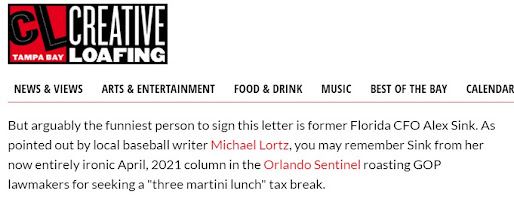
Former Florida CFO Alex Sink was one of the 36 Tampa elites who signed a letter to the Tampa Bay Times claiming half a season of Rays baseball is acceptable because it is better than no baseball. I looked up Ms. Sink on twitter and found a few of her tweets regarding her opposition to giving money to corporations. The Rays are definitely a corporation and would definitely receive public money from the building a new baseball stadium in Tampa. That sounds like something Ms. Sink would be against. Instead she is publicly supporting it.
No rich person is going to tell another rich person they aren't wearing any clothes.
But anyway, I am in Creative Loafing Tampa. Check it out.
Ever since the Tampa Bay Rays have announced their idea to split the baseball season with Montreal, few Tampa politicians have come out and opposed the plan, despite St Petersburg politicians calling out the Rays and opposing their plan.
As I have mentioned before, the Rays have three audiences they are appealing to. They are, in order:
1A) Local politicians - important to pass funding
1B) Local businesses - important to buy ads, corporate season tickets, and other cooperation
3) Fans - irrelevant to funding. Important only for one revenue stream and visuals.
The Rays plan currently is a stadium in Tampa, more specifically in Ybor City. There are several plots in Ybor in which a stadium can be built - many of which are in tax-break funded redevelopment zones. These zones are in the Rays advantage, as they will have to pay less for the stadium.
(Although they are trying to pay nothing as it is, but if they have to pay, they want to be in an area that will give them a tax-break for "redevelopment". How a sports stadium is the best use of land ear-marked for redevelopment is beyond me but that's not the political perspective I want to address today.)
Because Jane Castor and other local politicians don't care how many games the Rays play in Tampa as long as Tampa is in the name and the cost is acceptable.
Let me explain:
Economists like to say that local sporting events are not economic engines and are predominantly only a reshuffling of local money. For example, if they are was no sports in a city, people would go to the movies, go to dinner, go bowling, go to the beach, etc. They would still spend, but on other leisure activities. Local sports doesn't rely on tourists for existence and local economies don't rely on sports for existence.
Tampa politicians aren't supporting the Sister City plan for economic reasons. They are supporting it for marketing reasons.
"Champa Bay" is very catchy. Being a "City of Champions" is a great pitch to tourists, businesses, and people looking to move. Everyone wants to be near a winner and sports is a great community unifier. I guarantee people of differing political, religious, and other demographic persuasions attended the championship river parades of the Lightning and Buccaneers.
As long as the name "Tampa" is on a team, Tampa can reap the benefits of a team's success. The bubbles of COVID-19 seasons proved this. The Lightning didn't play a single home playoff game in the COVID-19 2020, yet politicians were quick to claim them. The team still "belonged" to Tampa, despite playing thousands of miles away.
If a Rays team splitting time with Montreal won the World Series, they would still contribute to Champa Bay. They can play 40 games or 4. It doesn't matter to politicians. They are rarely seen at games anyway for more than political appearances.
I have always estimated that 50% of people are baseball fans. 50% of City Council, 50% of the County Commissioners, and 50% of other legislators are baseball fans. A small percentage of that 50% are hardcore fans, most are casual. The non-baseball fan segment are looking at political decisions from a non-fan perspective. They are looking at costs and benefits.
I have outlined the benefit, now let's look at the cost.
The Rays don't want to pay for a stadium. They have balked whenever asked about cost. They claim "they don't want to start in the red" in a new home. They want to increase their revenue while paying the same cost for a building that they pay now. From their business perspective, that makes sense.
So the Rays devised a plan that will only cost two cities $300-500 million each to reap the benefits of claiming a winning team in their regional marketing material. Tampa politicians may balk at a billion dollar cost, but half of that might be acceptable if Visit Tampa Bay and other local tourist groups can mention the team in their pitches to people looking to visit and businesses looking for new home.
The alternative is Rays move and Tampa has only the Lightning, Buccaneers, and Rowdies to claim as part of Champa Bay. Which is not a bad situation to be in, but in the mind of a politicians, the more winners they can rub elbows with, the better. Even if the voters have to pay the cost.
Of course, if the Rays move and the Yankees get back on track, the Tampa mayor can claim the Yankees.
(Spring Training has always been insurance from a political marketing perspective. If the Rays perform poorly, Tampa, Clearwater, Dunedin, and Bradenton can claim to be the Spring Home of the Yankees, Phillies, Blue Jays, and Pirates, respectively. If the Rays do well, those cities and towns tie their wagon to the regional team.)
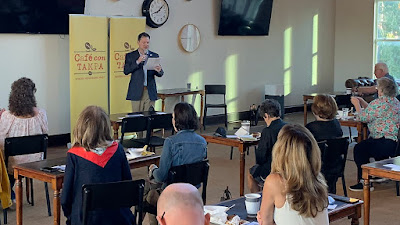
Finally getting my thoughts down about the Rays Sister City presentation at the Cafe Con Tampa meeting at Oxford Exchange in downtown Tampa on October 1, 2021. This may be a long read, so you are warned. Feel free to screenshot, and use an image, but like the issue itself, my thoughts are best understood in full context.
Overall
In attendance were business leaders, politicians, fans, and media. I recognized Charlie Frago of the Tampa Bay Times and JP Peterson of his radio show. There was also Spectrum News and other television networks. The MC of the event was Del Acosta.
Here is Rays President Brian Auld's 11 minute presentation. This was the only part of the morning that was allowed to be video recorded. As per the Cafe con Tampa rules, videoing in the Q&A was discouraged. If you haven't seen it, I recommend watching before you read on. Here is the link if you are on mobile: “One Team Two Cities --The Tampa Bay Rays Sister City Plan” Brian Auld, President, Tampa Bay Rays.
I liked how Brian said this issue is not ideal for discussing on social media or in sound bytes. I agreed with that 100%. It is complicated. I have been writing about it for years.
The following is my perception and an attempt to take apart the Rays Sister City argument. For those new to my work, I have been a loud opponent of the Rays Sister City plan since Day 1.
Talking to Their Target
There are three stakeholders in the Rays stadium saga: politicians, business leaders, and fans.
Friday's presentation was for business leaders and politicians. City council members, lobbyists, lawyers, and prominent business leaders were in attendance. The presentation was geared to them. It was slick, shined, and practiced. Auld spoke about revenue streams, costs and the potential for increased business relationships and tourism. Among the supporters of the idea was Richard Gonzmart of the Colombia Restaurant Group, who added the potential for flights from Tampa to Montreal.
(If you don't know who Richard Gonzmart is, he is a BIG DEAL. Click for is his bio. That the Rays have him in their corner supporting the Montreal plan is a significant win for them.)
Many business leaders don't care about baseball games. They don't care about wins or losses on the emotional level. They don't wear Rays hats to sports bars, or bring their families for a night out at the ballpark. The only reason they go to games is to hobknob and make deals in luxury boxes. They care about how partnering with the team can make them more money.
Politicians also don't care about wins and losses on an emotional level. They are also not going to games for recreation. They care about the image of the city. Champa Bay is a huge hook to hang their marketing and sales pitch on. It doesn't matter if the team plays one or 100 games in Tampa Bay. If they are champions and the name "Tampa Bay" is attached, politicians will attach their efforts to it.
So if the business leaders are on board because they see dollars, and the politicians are on board because the Rays are asking for less money and the team might make the area more attractive, then where does that leave the fans?
If there was a popular referendum on the Sister City plan, my guess is that it would fail spectacularly. But the Rays don't need a vote because they aren't a government entity, even if by their name they do represent the Tampa Bay region. They can do whatever they can afford. That's important to remember.
The Rays also don't understand how fans think. Under the Sister City plan, the Rays want the same amount of fans who go to 81 games in Tampa Bay to go to 40 games. Increasing attendance isn't done by decreasing games, it's done by increasing fans.
(And don't get me started on Brian Auld's mention that people travel all summer and would rather go to North Carolina than a baseball game in St. Pete. Or that any significant amount of fans will travel to Montreal to see the Rays. That just shows who the presentation is geared for. Hint: not the regular fan.)
As proven by the harsh reaction to the Sister City sign the Rays planned to put in the outfield during the playoffs, the fanbase will react negatively to the idea of losing games to Montreal. Especially if all Tampa Bay gets is the beginning of the season - the Rays typically lowest attended and watched games.
I have no doubt season ticket sales will drop. If corporations buy seats, few Rays fans will take their company's tickets. The negative feeling of betrayal may possibly negate the increased revenue of a new stadium, making a new stadium worthless to the Rays and a financial burden on the City of Tampa.
The Rays have proven to be poor at getting the Tampa Bay area excited about Rays baseball. Notice how few gigantic banners support the Rays versus how many support the Lightning or Bucs. It will take a herculean marketing effort to get fans excited in a team after taking 40 games from them. The fanbase does not buy that the Sister City plan is the only way to keep baseball in Tampa Bay. Not with NHL, NFL, four spring training teams, four minor league teams, soccer, and a successful Major League team already in the area. No one believes the Rays are not profitable. Billionaires don't continue to own assets that lose money.
Loans and Leases
Brian Auld was asked what will prevent Stu Sternberg from selling the team and the team being eventually moved to Montreal fulltime. According to Brian, there will be an lock-tight agreement between the Rays and the City of Tampa that will prevent the team from moving.
Of course, the last time Stu Sternberg faced a legal agreement that mandated his location, he went behind everyone's back and negotiated for a move, albeit partial. Legal agreements are only as good as their enforcement and Stu Sternberg has shown he doesn't care about agreements with our region. There is nothing preventing him from selling in 2032 to the Montreal group. Then what happens?
I do believe Brian Auld, Rafaela Fink, and other Rays front office folks love Tampa Bay. I do believe they enjoy living here and enjoy being part of our community. However, I also believe Stu Sternberg does not care about this community one bit. Living here is temporary for him and once he sells the team, he is gone. He has done nothing for this community - more on that later.
Brian Auld also mentioned the Rays don't want to be in the red moving into a new home. This means they don't want to pay a mortgage - they claim this will hurt the on the field product. But shouldn't a new stadium bring in increased income? If the Rays can't maintain their same payroll and use the new park revenue to pay off the ballpark, that's not our problem. That's theirs. Again, they should be able to build more relationships with local businesses and fans. But their behavior over the years has poisoned that water. They don't see their failure to drum up corporate support in 2018 as their fault, they see it as the fault of the region. Then why don't similar sized markets have the same problem?
Yes, they will have to take out a loan. Yes, they can't leverage the value of the team to buy a stadium. But there is an expected revenue gain from new stadium ticket sales - both corporate and individual - as well as many other revenue streams that open with a new stadium. They can also steal advertisers from the Yankees and their organization.
(No one has yet mentioned how that relationship will work. If they move to Ybor, the Rays will essentially be in the Yankees market. They will have to negotiate for the Tarpons lost revenue. Perhaps the Rays know negotiating with the Yankees will not be cheap.)
Maybe the Rays don't think these streams will be enough. Maybe Stu Sternberg should open his own wallet. Maybe he is not as rich as we think.
The Stu Sternberg Perception Gap
During the presentation, Brian Auld mentioned how good of a boss Stu Sternberg is. He mentioned how Sternberg empowers his employees and encourages outside-the-box decision making. Auld said Sternberg allows the Rays to support movements and social issues and allows employees to get involved in their community. These are all good things.
But the Rays don't understand - or don't care - how Stu Sternberg is perceived by the fanbase. I can't speak for the politicians or business leaders, but the fanbase does not like Stu Sternberg. "Screw Stu", "Sell the Team", and "StuSux" are common refrains. Sternberg is often referred to as one of the worst owners in sports. I personally have written about his bad image for over 10 years. He is not customer friendly and his faux pas have added up. The fanbase thinks of him as a carpetbagging, New York investor who has no interest in Tampa Bay other than to make money and not spend his own.
If the Rays want the fans to have an open mind on the Sister City Plan, Stu Sternberg - not the Rays - needs to fix his perception. Because right now, he is not trusted nor liked. While Jeff Vinik sets an extraordinary high bar for a local sports owner, Stu Sternberg doesn't even clear the lowest bar. The Steinbrenners do more for Tampa Bay than Stu Sternberg.
The Partial Market Argument
If you are looking for a summary, here it is: the Rays goal is to create a Top 10 market by combining two mid-sized markets. They claim Tampa Bay, in its current state, is not capable of supporting Major League Baseball. We are too spread out, we lack major corporations, and our per capita income is too low. All of these are true.
We have also voted down transportation initiatives, protested against increased density, and although small to mid-sized companies are moving here, no major corporation has decided to call Tampa home.
They claim that by adding the power of the Montreal market, the Rays will be able to compete regularly with the Red Sox and Yankees. But don't they already do that now? Their only reason to add a complete additional market is to make more money. An additional TV deal, an additional radio deal, and an additional fanbase. Yes, a combined market would have a better chance of signing Wander Franco to a 20-year, billion dollar contract. But it is not needed. What is needed is a centralized stadium and a monopoly of baseball interest. The Rays need to be the only baseball option in Tampa Bay. When I was tracking regularly, the Rays only accounted for 50% of total baseball tickets sold in Tampa Bay. 50% of ticket sales went to local spring training and local Minor League Baseball. A Major League team cannot succeed with this level of competition. Especially if it plays in a bad location.
I would also like to see how the Rays rated all available markets. Why Montreal? What makes Montreal a part-time market? Does MLB think it is unable to sustain a full-time team? How do the Rays and MLB rate other markets?
Why not look to the east to the biggest US market without any baseball? Orlando is completely untapped. Rays fans might not mind splitting the team with a city an hour away. Granted, that would mean only one TV deal. But expanding to the Orlando market would add 2 million people to the Rays fan pool. Outside of a few exhibitions at Disney in 2008, the Rays have completely neglected Orlando.
Speaking of TV, Auld's reference to pandemic ratings as evidence fans will watch no matter where the team plays is incredibly unfair. The Rays, Lightning, and Bucs represented Tampa Bay in 2020. We were all in it together, remember? The best thing fans could do was watch as their favorite teams played in "bubbles". Watching sports was a reprieve from the drama of COVID-19. But when the Montreal Rays play on TV, Tampa fans can't attend those games because an ownership group looking for more revenue moved them from our city, not because of a public health crisis. Huge difference.
Attendance Aspirations
Brian Auld mentioned the Rays would like to have 35,000 tickets sold a night. That was the 2019 average of the Houston Astros, who play in a metropolitan area of 6.5 million, or 3.5 million more than Tampa Bay.
I like to compare Tampa Bay to Pittsburgh. Pittsburgh is a similar sized metro area with three major sports teams. In 2015, the Pittsburgh Pirates drew nearly 2.5 million fans (2.498). They drew over 35k thirty times. 35,000 times 81 is 2,835,000 fans per year. In 2019, an attendance of 2.8 million would be 10th in Major League Baseball. If that's their goal, that is impossible. There are few untapped metropolitan areas that will get the Rays to that goal.
In 2017, I interviewed Brian Auld for this website. He said the Rays goal was league average. In 2019, league average per game was 28,355. That's 2,296,796 for the season. The Washington Nationals were closest to the average in 2019 with 2,259,781 tickets sold.
My conclusion was with "a new stadium closer to the center of Tampa Bay’s population, the Rays may be able to sustain or exceed the average small-market attendance. That, along with a new TV contract, would help with revenue and in turn, aid payroll, which may add to talent depth, and possibly equal more wins making the Rays more long-term competitive."
But as mentioned, the Rays goal is not average among small to mid-sized markets. They want to be a Top 10 market by combining the power of the Tampa Bay and Montreal market. Again, they want the same amount of fans to condense their buying habits in half the time. Tampa Bay's 3 million people and Montreal's 4.2 million people does turn the Rays into a large market, if the fans cooperate, which I don't think will happen.
(Personal note, my birthday is in September. If the Rays do the beginning of the season in Tampa and the second half in Montreal, I will never again be able to go to a local ballgame on my birthday. Something I have done for over 30 years. I can't move my birthday to the beginning of the season. I am sure I am not the only one.)
Opening the Pandora's Box of Relocation
If the Rays succeed in splitting their season between Tampa and Montreal, what is preventing Major League Baseball from splitting other cities? What is preventing them from pairing up expansion markets and making a Portland/Nashville team or a Vegas/Charlotte team?
The Rays are often imitated. The Sister City idea sets a very bad precedent for sports geography. If the Rays can get out of having to try harder to make one market work, then why can't other teams move? If they can combine markets for extra revenue, why can't other teams in similar sized markets? Fans and the record books will be confused with the fluidity when other teams will start moving. Imagine the excitement when the Nashville/Pittsburgh Music Pirates play the Vegas/Cleveland Desert Guardians in a World Series that won't be local to half the applicable fanbases.
MLB needs to nip this stupid idea in the bud now before its gets even more stupid.
What Can Fans Do?
The Rays discussion at Cafe con Tampa was insightful not only to get the Rays perspective, but also to show who supports the effort. For example, I mentioned Richard Gonzmart as someone already excited to work with the Sister City plan. Gonzmart owns the Colombia and Ulele. Rays fans could boycott these restaurants or protest outside of them. If the Rays can't be convinced to drop their support for the Sister City plan, perhaps their business partners could be.
Rays fans also need to be seen. Look up these social meetings for Rays appearances. Spread the word, come in with several questions, and ask one or two. Also meet the movers and shakers. Meet Brian Auld and the Rays front office personnel. Do not give a speech that doesn't end with a question. Force the Rays to engage the fans. Be civil and be seen. The more Rays fans are seen asking the Rays tough questions, the more people will see Rays fans standing up for Major League Baseball in the area.
I have been writing about baseball in this area for over a decade. MLB can succeed here if given a chance. The Rays need to either give it a chance or leave completely.
(This was submitted to the Tampa Bay Times Editorial page on July 7th, 2021. After 3 weeks of no response, I decided to publish it here. I don't have 1% of the Times reach. I do like to think I have an informed opinion on these matters. After all, I have been writing about the Rays and baseball in Tampa Bay for over 10 years. But for whatever reason, the Tampa Bay Times didn't feel the need to print this.)
Over the last two years, all Tampa Bay sports has done is win. No matter the sport, we’ve made championships, won trophies, and been the talk of the sports world. And our fans have enjoyed every minute of it. Most of them.
While Lightning fans get boat parades and Bucs fans get the glory of the greatest of all time, Rays fans are living with the idea that they won’t have a team to see in the summer and fall of 2027. Or maybe sooner if Rays owner Stu Sternberg gets his way.
And while outgoing St Petersburg Mayor Rick Kriseman pushes back on the Rays and calls their plan a non-starter, several St Pete mayoral candidates as well as Tampa Mayor Jane Castor support this plan. Who do you think the Rays will want to negotiate with?
The Rays need a new stadium. That is unequivocally true. The where and how to pay for it has been debated for over 10 years and it is wearing down the fanbase. It is hard for more than diehards to care when the finger pointing and relocation rumors take more headlines than the team’s success.
The Rays’ Sister City plan of “sharing” a team with Montreal makes no sense for the people of Tampa Bay. It is disrespectful to our fanbase and will lead to the team eventually moving to Montreal for good when Stu Sternberg sells the team. Despite front office claims they want the Rays here for generations, there is no doubt selling the team is Sternberg’s final goal. He wants to maximize his profits first. Two new stadiums in two markets would do that. And when he does sell, what is preventing the new owner from completing the move, leaving Tampa Bay with a useless stadium, too small for a new full-time team and too big for another Minor League team?
“Never trade with the Rays” is an axiom well known in baseball. They have one of the smartest front offices ever. With over 10 years to prepare and a staff working night and day on metrics, our politicians have no chance negotiating a winning deal for taxpayers unless they play hardball. The current proposal of 40 games of Rays baseball, Spring Training, and a new home of the Rowdies if Tampa Bay builds a new stadium is like trading an all-star pitcher for two benchwarmers and a punter. Local baseball fans know the late season pennant race is the best part of the season, Spring Training is for tourists, and Rowdies soccer, while fun, isn’t baseball.
Not only will this deal turn off what remains of the Rays fanbase – why support a team that moves midseason? – it will also foster unhealthy debate as to which city supports the team more. Not to mention moments in which the fanbase shows appreciation to players such as jersey retiring ceremonies, statues, or other banners. Will they be held in both locations? Or just the most deserving location?
Prior to the Stanley Cup Championship, Tampa Mayor Jane Castor said she would discuss sharing a baseball team with the Mayor of Montreal, but she wouldn’t discuss sharing the Stanley Cup. If this was a joke, it wasn’t funny. Tampa Bay area baseball fans were disrespected and blasted the mayor on social media. Unfortunately, Jane Castor has yet to apologize. She has no reason to, even if the Rays leave town, she can still wear a Yankees hat.
We hope our politicians don’t bend to the whimsical desires of billionaire sports owners. We should not “share” a baseball team. What the Rays need is a centralized stadium and a monopoly of baseball interest in Tampa Bay, even if that means getting rid of regional Spring Training. The Rays are right, no other Major League market has the difficulties of Tampa Bay. But disrespecting the fans is not a step in the right direction.
Hockey is a big deal in Tampa Bay. The Lightning are quite possibly the second most popular team in Tampa Bay behind the Bucs. And during the NHL playoffs, and especially the Stanley Cup Finals, no other sport in Tampa Bay matters. It is deservedly the Bolts time in the spotlight.
This Stanley Cup quest unfortunately comes with the baggage of pitting Tampa Bay versus Montreal, the city Rays owner Stu Sternberg has courted and threatened to move the Rays to. The jokes and jabs on twitter from Montreal fans and ignorant media have been annoying, albeit tolerable. The Rays ownership put us in this mess, so we have to live with it for as long as Sternberg continues with his shenanigans.
However, we should not have elected officials in the Tampa Bay area jesting, joking, or joshing about losing our baseball team. And that is exactly what Tampa Mayor Jane Castor did in a tweet video before Game 2 of the Stanley Cup Finals.
To quote Castor:
"Alright, I had a great conversation with the Mayor of Montreal. Told her we could discuss sharing a baseball team, but we are not sharing the Stanley Cup! Go Bolts!"
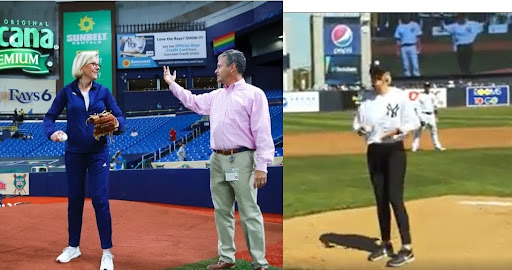
Why would Mayor Castor even joke about this? Apparently she has no finger on the pulse of baseball fans in Tampa Bay. While she has thrown out the first pitch at Rays games, she has also thrown out the first pitch at Yankees spring training games. So baseball loyalty doesn't matter to her. Having a team in Tampa, whether it be the Rays, the Yankees, or both, is transactional to her. There is no emotional attachment to any of them. As long as she gets fans' votes.
The problem with Jane Castor undermining Mayor Kriseman in St Pete and throwing Tampa area Rays fans under the bus is that she has has nothing to lose by supporting the Sister City plan. If she gains 40 games and the Rays in Tampa, she wins. If the Rays stay in St Pete, she has no gain and no loss. If the Rays go to Montreal, she still has the Yankees.
Fortunately, Mayor Castor's tweet was not well received by Rays fans on twitter. As of 1am, July 1st, there was not one positive comment associated with her tweet and over 40 tweets from Tampa Bay sports fans objecting to it. Although twitter is far from public opinion, when the ratio is that bad, it is clear Mayor Castor struck a nerve.
Last week, the St Pete City Council approved a notion to consider the Rays "sister-city" concept. I have been a huge opponent of the sister-city plan since Day 1. Once I heard the City Council not disapprove the plan, I decided to email a letter to all members of the St Pete City Council.
I took a screen shot of the letter and posted it on twitter. To date, it has nearly 100 retweets, over 400 likes, and over 40,000 impressions. I hope the City Council sees it and takes it into consideration the next time they talk to the Rays.
Over the last few days, the Tampa Bay Rays front office have released several quotes advocating their "Sister City" plan to divide Major League Baseball between Tampa Bay and Montreal.
It is a stupid, stupid, stupid plan made by a greedy billionaire designed to rip the heart out of the fanbase and prepare them to lose the team forever.
As I have written several times, I disagree with this plan. I have also been on ABC Action News twice discussing my opposition.
From a business perspective, former Wall Street investor Stu Sternberg is attempting to diversify his assets. He figures if he and his Montreal business partners each have to invest less in smaller stadiums in two markets, there is less total financial commitment while receiving increased stadium attendance bumps in two cities. By going international, he also hedges against a US economic decline. There has been much talk that the US economy will eventually recede, and when it does Sternberg will have Canada to buoy his investment.
Stu Sternberg is not increasing his gains enough here in Tampa Bay. Despite franchise value gains of 27% in 2017, 9% in 2018, 12% in 2019 according to Forbes, that is not enough for his Wall Street wallet. He wants to better maximize his investments. This isn't about emotions or people. It is about dollars and gains.
He invests less, makes more, and is covered against a market tightening. What is there not to like from the perspective of a Wall Street investor?
Consider this: Montreal is a city of 4 million people. In 2015, Montreal had a GDP of $193 billion dollars (Tampa Bay had $118 billion). From 1979 to 1983, the Expos were in the top 5 in attendance in the National League. Montreal is a legit city with an international economy and baseball pedigree.
If they don't reach the level of full-time market, who else doesn't? Does Pittsburgh? Milwaukee? Cincinnati? Cleveland? What is the threshold? Because if owners follow the Rays lead and start splitting seasons throughout MLB, the only teams that will be in their cities full-time will be in the mega markets of New York, Chicago, and Los Angeles.
Would the Pirates consider moving half their season to Nashville? What about the Indians playing half their games in San Antonio? Could the A's play half their games in Portland? Maybe the Marlins split half their games between Miami and Las Vegas.
Where does this end? What is the threshold of a Major League market if neither Tampa Bay nor Montreal make the cut?
By the way, Tampa Bay is a robust enough market for four Minor League Baseball teams, four Spring Training teams, an NFL team, and NHL team, a major college program, and an XFL team. Montreal has excess economic capacity as it only hosts the Montreal Canadiens and the Montreal Alouettes of the Canadian Football League (CFL). But apparently, that is not a enough for a full-time market to Major League Baseball.
Another fallacy in the Sister City argument is that demand is driven by availability. Stu Sternberg and the Rays front office believe they can get the same attendance of 1 million plus fans to Tropicana Field in April, May, and June that they get from April to September because the supply of games is smaller.
There are many reasons why this reduced-supply increased-demand concept isn't realistic.
For one, the Rays will still face an abundance of regional sports competition. If they play in Tampa Bay in the spring, they face competition from four Minor League Baseball teams, the Tampa Bay Lightning, and the new XFL Vipers. As well, many local fans have just spent their money on Spring Training.
Second, traditionally the Rays struggle to draw in the early months of the season, especially in May. May is typically their worst month of the season. People are not yet fully engaged in baseball in May. How do you expect the same type of fanbase excitement in the first half of the season versus the second half? In the first half, teams are still figuring out who they are. There is a saying that baseball teams don't really know what they have until the 1/3 point (54 games) in the season. Will they be contenders? Will they be also-rans? If the Rays play the first three months of the season in Tampa Bay, Tampa Bay will never again experience a pennant race in person.
Third, Stu Sternberg believes the Rays will draw a million people in three months with half a schedule - and maybe less than half the games against the Yankees, Red Sox, and other teams that draw opposing fans. Typically, the Rays play 9 home games each versus the Red Sox and Yankees. What if all 9 games are after June? What if only 3 games versus each are while the Rays are in the bay area? Then the fans in Montreal get to see the Rays top rivals and the fans of Tampa Bay area left with the less appealing part of the schedule.
The Rays cannot expect Major League Baseball to cater the schedule to them and provide them a 50/50 split in opponents for each fan base. And what about interleague rotational games? Fans in Tampa Bay may never get to see players from an interleague team such as the Marlins, Mets, or Cubs play the Rays if those games are always scheduled in the second half of the season.
Fourth and lastly, it is easy to imagine that this arrangement pitting fans and officials of both cities against each other as they will compare and contrast attendance as a measure of what fanbase supports the team more. If Tampa Bay draws less against the Yankees in April (as the Lightning are simultaneously in the playoffs) than Montreal does in September, Tampa Bay fans will probably get mocked. There will be non-stop comparisons as to which city is a better host in the media. Sternberg won't feel this competition as he makes money either way, but the fans and the cities will.
The sister city plan assumes these are loving, cooperating siblings, not competitive, bitter, catty siblings. And if the Montreal team is already saying Montreal is a better city than St. Petersburg, what will they say if the Montreal side of attendance exceeds the Tampa Bay side?
Then again, Sternberg might be the kind of parent who enjoys seeing siblings compete. But the side that has their team ripped from them will not take well to another city saying they are better hosts. There is already a malaise around the Rays. Hearing Montreal boast about being better hosts will only further turn Tampa Bay fans off to the franchise and the arrangement.
Lastly, a huge obstacle to the Rays success in Tampa Bay has always been the presence of the New York Yankees. What if the Rays said they were willing to stay full-time if the city cut their lease with the Yankees? Then Steinbrenner Field could be turned into a larger stadium in a centralized location. The Yankees have enough money to build a new spring training stadium anywhere in the world. The Rays know this, the Yankees know this, the City of Tampa knows this.
But challenging Steinbrenner presence in Tampa is either taboo, forbidden, or never mentioned in public, even though the Yankees have only been playing in Tampa two years more than the Rays have been playing in St Petersburg (1996 to 1998). The City of Tampa loves the Yankees.
“Spring training starts in a couple of weeks, too”, he continued, as sweat formed on his brow. “I forgot about that. Sure, the Rays train way down in Port Charlotte but three teams, including the New York Yankees, possibly the most prolific and beloved franchises in sports history are right here for over a month, smack in the middle of our season.” He stopped, drew a deep breath and sighed, “The New York Yankees. Not the San Diego Padres or some other godforsaken franchise no one cares about, just the Notre Dame of Major League Baseball, that’s all.”
I have been writing about Tampa Bay baseball for over 10 years. For the first five years, I wrote about being a fan. I wrote about the World Series. I wrote about Game 162. I wrote about no-hitters, cowbells, and Rays-hawks. Then in 2014, I started this blog and dedicated myself to determining whether or not Tampa Bay was a Major League market.
As a Tampa resident, I came into the project with biases. I wanted to believe the market was not the problem.
For four years, I wrote every night. I tracked the attendance of the Rays, four Spring Training locations, and the four Minor League teams that call Tampa Bay home. I wrote about promotions. I wrote about bobbleheads. I wrote about traffic conditions and economic growth. I even wrote about hurricanes and Astros games. I was recognized for my research at Fangraphs as a resident writer in June 2017 and by mentions in articles in USA Today and several Tampa area publications.
After landing a consulting job overseas in 2018, I stopped writing regularly. On one hand, I knew writing about baseball from 5,000 miles away was going to be difficult, especially when I didn't know my work tempo. On the other hand, I decided I had written almost everything I could from open source data. From what I could acquire and what I analyzed, Tampa Bay could host a Major League team.
In theory.
Admittedly, there are a lot of problems with the current layout of baseball in Tampa Bay:
While there are over 400 professional baseball games played in Tampa Bay annually, the Rays typically only account for 60% of total ticket sales.
A lot of work needed to be done to make Major League Baseball successful in Tampa Bay. None of these issues were alleviated in 20 years.
On Tuesday, June 25th, the Montreal boogeyman finally appeared in the flesh. After years of avoiding the M-word, Stu Sternberg and the Rays front office announced a plan to split the Rays season between Tampa Bay and Canada. According to Sternberg, the Rays would play the first 40 home games or so of the season in Tampa Bay. Then they would fly to Montreal and play out the rest of the season.
(They also may or may not move their Spring Training back to St. Petersburg from Port Charlotte, Florida in order to give local fans more product. Here is where I say I wrote years ago that Port Charlotte was a mistake and the Rays should have looked to expand their market by spring training near Orlando. But I'm just a guy with a blog.)
The Rays will do this Tampa Bay-Montreal schedule every year. Forever.
While it is creative, this plan is befuddling at best, irrational at worst. It is like having a pitcher play every position and rotating them on the mound based on the weaknesses of each batter. Sure, it is legal, it may look great on paper, and may actually work, but it is not based in reality.
The Rays two-city solution requires two economies, two fanbases, two marketing staffs, two broadcast teams, and two stadiums (as if one was not difficult enough to fund, locate, and build). Sternberg envisions a "sister-city" relationship between Tampa Bay and Montreal marked by business investment and cooperation. He also envisions tourists travelling to and from each city bonded by fandom.
It is almost as if Sternberg wants St. Petersburg and Montreal to share the Rays as Tampa and New York share the Yankees. Per the latest data, approximately 12% of Tampa Bay roots for the Yankees and the Yankees presence is seen on billboards and marquees in Tampa throughout the spring. Instead of openly advocating for Major League Baseball to eradicate this conflict, and create a monopoly of baseball interest in the Tampa Bay region, Sternberg is using the Yankees-Tampa relationship as a model.
For Tampa Bay, Sternberg is advocating a smaller, more intimate, open-air stadium where the estimated one million Rays fans will buy one or two tickets per season over 40 games. What he fails to understand is that there will still be baseball in the area. After the Rays have their proposed "mid-season send off", local baseball fans can still spend their dollars and evenings watching Minor League Baseball at Spectrum Field in Clearwater, Steinbrenner Field in Tampa, LECOM Field in Bradenton, and a newly refurbished Auto Exchange Stadium in Dunedin. All of which are cheaper than Rays games and require much less emotional investment. Emotional investment that used to be spent on the Rays.
"It breaks your heart. It is designed to break your heart. The game begins in the spring, when everything else begins again, and it blossoms in the summer, filling the afternoons and evenings, and then as soon as the chill rains come, it stops and leaves you to face the fall alone. You count on it, rely on it to buffer the passage of time, to keep the memory of sunshine and high skies alive, and then just when the days are all twilight, when you need it most, it stops."
Stu Sternberg and the Tampa Bay Rays are planning to break the hearts of Tampa Bay when the summer is at it's peak. When the evening showers and humidity weigh down the soul of Florida. When our lethargic summer saunters are matched only by the leisurely pace of baseball. For over 20 years in Tampa Bay, fans waited patiently for their two weeks of Fall with a local beer and a Cuban, cheering on the local nine. Now the realities of politics and economics threaten to replace their summer respite with a vast emptiness. Their season will end early, and like Rogers Hornsby, they will stare out the window, remembering the distant echoes of the crack of the bat and listening for the faint advancement of professional football and hockey - franchises that call Tampa Bay home from start to finish.
The biggest shame of this whole debacle is that Stu Sternberg has roots in Brooklyn. He likes to remind listeners that he named his son after Sandy Koufax. But what would Brooklyn have said to Walter O'Malley if he told the Dodger faithful their beloved Bums would split time between Brooklyn and Los Angeles, that they would leave for the West Coast in the middle of every season? How would a Brooklyn business owner named Samuel Sternberg, a family man and soon-to-be father of Stu Sternberg, have reacted?
O'Malley probably would have been booed out of town. With this idea, Sternberg deserves the same.