Showing posts with label ECONOMICS. Show all posts

Friday, June 28, 2019

It is designed to break your heart: Thoughts on the Rays two-city solution


I have been writing about Tampa Bay baseball for over 10 years. For the first five years, I wrote about being a fan. I wrote about the World Series. I wrote about Game 162. I wrote about no-hitters, cowbells, and Rays-hawks. Then in 2014, I started this blog and dedicated myself to determining whether or not Tampa Bay was a Major League market.

As a Tampa resident, I came into the project with biases. I wanted to believe the market was not the problem.

For four years, I wrote every night. I tracked the attendance of the Rays, four Spring Training locations, and the four Minor League teams that call Tampa Bay home. I wrote about promotions. I wrote about bobbleheads. I wrote about traffic conditions and economic growth. I even wrote about hurricanes and Astros games. I was recognized for my research at Fangraphs as a resident writer in June 2017 and by mentions in articles in USA Today and several Tampa area publications.

After landing a consulting job overseas in 2018, I stopped writing regularly. On one hand, I knew writing about baseball from 5,000 miles away was going to be difficult, especially when I didn't know my work tempo. On the other hand, I decided I had written almost everything I could from open source data. From what I could acquire and what I analyzed, Tampa Bay could host a Major League team.

In theory.

Admittedly, there are a lot of problems with the current layout of baseball in Tampa Bay:
The list goes on.

A lot of work needed to be done to make Major League Baseball successful in Tampa Bay. None of these issues were alleviated in 20 years.

On Tuesday, June 25th, the Montreal boogeyman finally appeared in the flesh. After years of avoiding the M-word, Stu Sternberg and the Rays front office announced a plan to split the Rays season between Tampa Bay and Canada. According to Sternberg, the Rays would play the first 40 home games or so of the season in Tampa Bay. Then they would fly to Montreal and play out the rest of the season.

(They also may or may not move their Spring Training back to St. Petersburg from Port Charlotte, Florida in order to give local fans more product. Here is where I say I wrote years ago that Port Charlotte was a mistake and the Rays should have looked to expand their market by spring training near Orlando. But I'm just a guy with a blog.)  

The Rays will do this Tampa Bay-Montreal schedule every year. Forever.

While it is creative, this plan is befuddling at best, irrational at worst. It is like having a pitcher play every position and rotating them on the mound based on the weaknesses of each batter. Sure, it is legal, it may look great on paper, and may actually work, but it is not based in reality.

The Rays two-city solution requires two economies, two fanbases, two marketing staffs, two broadcast teams, and two stadiums (as if one was not difficult enough to fund, locate, and build). Sternberg envisions a "sister-city" relationship between Tampa Bay and Montreal marked by business investment and cooperation. He also envisions tourists travelling to and from each city bonded by fandom.

It is almost as if Sternberg wants St. Petersburg and Montreal to share the Rays as Tampa and New York share the Yankees. Per the latest data, approximately 12% of Tampa Bay roots for the Yankees and the Yankees presence is seen on billboards and marquees in Tampa throughout the spring. Instead of openly advocating for Major League Baseball to eradicate this conflict, and create a monopoly of baseball interest in the Tampa Bay region, Sternberg is using the Yankees-Tampa relationship as a model.

For Tampa Bay, Sternberg is advocating a smaller, more intimate, open-air stadium where the estimated one million Rays fans will buy one or two tickets per season over 40 games. What he fails to understand is that there will still be baseball in the area. After the Rays have their proposed "mid-season send off", local baseball fans can still spend their dollars and evenings watching Minor League Baseball at Spectrum Field in Clearwater, Steinbrenner Field in Tampa, LECOM Field in Bradenton, and a newly refurbished Auto Exchange Stadium in Dunedin. All of which are cheaper than Rays games and require much less emotional investment. Emotional investment that used to be spent on the Rays.

Former Major League Commissioner Bart Giamatti once famously wrote,
"It breaks your heart. It is designed to break your heart. The game begins in the spring, when everything else begins again, and it blossoms in the summer, filling the afternoons and evenings, and then as soon as the chill rains come, it stops and leaves you to face the fall alone. You count on it, rely on it to buffer the passage of time, to keep the memory of sunshine and high skies alive, and then just when the days are all twilight, when you need it most, it stops."
Stu Sternberg and the Tampa Bay Rays are planning to break the hearts of Tampa Bay when the summer is at it's peak. When the evening showers and humidity weigh down the soul of Florida. When our lethargic summer saunters are matched only by the leisurely pace of baseball. For over 20 years in Tampa Bay, fans waited patiently for their two weeks of Fall with a local beer and a Cuban, cheering on the local nine. Now the realities of politics and economics threaten to replace their summer respite with a vast emptiness. Their season will end early, and like Rogers Hornsby, they will stare out the window, remembering the distant echoes of the crack of the bat and listening for the faint advancement of professional football and hockey - franchises that call Tampa Bay home from start to finish.

The biggest shame of this whole debacle is that Stu Sternberg has roots in Brooklyn. He likes to remind listeners that he named his son after Sandy Koufax. But what would Brooklyn have said to Walter O'Malley if he told the Dodger faithful their beloved Bums would split time between Brooklyn and Los Angeles, that they would leave for the West Coast in the middle of every season? How would a Brooklyn business owner named Samuel Sternberg, a family man and soon-to-be father of Stu Sternberg, have reacted?

O'Malley probably would have been booed out of town. With this idea, Sternberg deserves the same.

Monday, January 7, 2019

Rays cede cheap seats to local Minor League Baseball

Been a while. Not sure if I will post as regularly or just on occasion. But there has been a lot of baseball news in Tampa Bay this offseason. Some of which has been covered very well. For now, when I see an angle that I don’t think is being covered, I’ll discuss it here.)

As most baseball fans in the Tampa Bay area are now aware, last week the Rays announced they are closing off seating in the 300 level, reducing the total capacity in Tropicana Field from 31,042 to somewhere between 25,000-26,000.

Of course, the jury is still out on what the Rays are doing to the space those seats used to occupy. As par for the course, the Rays front office used words like “intimate” and “better fan experience”. Deadspin’s Barry Petchesky rebuked those claims well in his article.

“Intimate,” that buzzword used by every team that moves to a smaller stadium, or renovates its existing one to have a smaller capacity—or just dreams of doing so. It’s about the “fan experience,” you see. Unless the fan experience you’re looking for is buying the cheapest ticket possible because sometimes it’s fun to go to a ballgame and sit in the nosebleeds and eat a dang hotdog.
For now, the Rays claim there will still be cheap ticket options at Tropicana Field. But the Rays still use dynamic pricing so fans only know how much a ticket will cost when tickets are set before the season. By driving up scarcity, and letting the dynamic pricing model take hold as the season progresses, the price of seats goes up according to demand, not by tier. As well, games against the Yankees and Red Sox will always be more expensive, despite attendance against each of those teams decreasing drastically since 2010.


The bigger question remains: Does MLB in Tampa Bay and beyond need cheap ticket options? There are few inexpensive options for NHL, NBA, and NFL games, so why should there be in baseball? Are fans married to the Norman Rockwell myth of knothole gangs looking through wooden fences in the 1940s? 

Are those myths as outdated as speedy lead-off men and starting pitchers?
There will always be inexpensive baseball options in America, and especially in the Tampa Bay area. Despite a 7% decrease from 2016*, Tampa Bay’s four Minor League teams – the Threshers, Marauders, Tarpons, and Blue Jays – combined drew over 350,000 fans for the 8th year in a row in 2018.

(2017 featured Tebow Mania.)


Local Minor League Baseball has always been in competition with the Rays, especially in the spring months of April and May. They market to casual baseball fans with cheaper ticket options, no dynamic pricing, and the same, if not better, “intimacy and fan experience”. There is a reason the Rays worst attended month (May) is typically the local Minor League teams’ best. Tampa Bay area Minor League teams are more conveniently located to most Tampa Bay baseball fans and the teams play outdoors, feature fireworks, and often have the same food and beer options as the Rays.

All for ticket and parking prices far cheaper than Tropicana Field – sometimes as low as $1.
Unlike nearly every other Major League team, the Rays never had a monopoly on low price point baseball in their region. Fans have always had cheaper and more convenient baseball options. And as long as there is Spring Training in Tampa Bay, there will be Florida State League baseball in Tampa Bay.

With their announcement last week, the Rays focused on their niche – dedicated fans who will travel to Tropicana Field to buy tickets to see Major League Baseball. That number will be between 1.1 million and 2.1 million in 2019. Even as the 100-loss Devil Rays, the Rays never drew less than 1 million, so don’t expect attendance to drop that low. And if the current maximum seating is 26,000 per game, the Rays can only max 2.1 million in 81 games.

It will be curious to see if Minor League Baseball in the Tampa Bay area will capitalize on the Rays decision and increase their marketing to casual fans looking for lower price point baseball options.

(It’s good to be back.)

Wednesday, December 7, 2016

Tampa Wages, Personal Income, Cost of Living, and Baseball

A few economic news and notes on the Tampa Bay area:

Tampa Bay's personal income shows why jobs aren't the answer to economic improvement - Tampa Bay Business Journal, 11/17/2016

A few weeks ago, the Tampa Bay Business Journal wrote about a very interesting fact about Tampa Bay area growth: although the amount of jobs are increasing, per capita personal income remains below average.
Job growth in the market was above the national average for 2015, but many of the jobs that are being added are lower-wage positions in retail, leisure and hospitality

That's not a good thing, especially for sports teams looking for season ticket holders. Season tickets of course cost more than individual tickets. It is however, good news for cheaper alternatives such as Minor League Baseball or Arena League Football.

Florida wages still lag national average — but they are getting closer - Tampa Bay Times, 12/7/2016

The Tampa Bay Times recently took a deeper look into wages in Florida and in Tampa Bay.
Hillsborough's wage is 4 percent behind the U.S. average, while Pinellas trails by 11.4 percent

Again, not a good thing for sports teams. Even if teams lower their prices in order to encourage more ticket sales, they will have less potential income from ticket sales. This puts Tampa Bay area teams at a disadvantage compared to teams in cities with higher average income.

Vinik: Tampa's 'most significant weakness' is wages - Tampa Bay Business Journal, 11/9/2016

There is no doubt that sports teams are aware of the economic tea leaves in the Tampa Bay area. Last month, Lightning owner and huge Tampa Bay area advocate Jeff Vinik stated that better paying jobs and higher wages are essential for Tampa's growth.

Vinik has also stated that Tampa Bay needs to keep baseball. He understands that higher wages are needed to support and grow not only sports, but all of Tampa Bay's businesses. Unfortunately, the biggest industries in the area are military, real estate, and tourism - not particularly high paying professions.

Here's how Tampa metro's cost of living index is performing - Tampa Bay Business Journal, 11/11/2016

Although wages are lower, Tampa Bay residents can take a little bit of solace in know that it is slightly cheaper to live in the Tampa Bay area than it is to live in most US metro areas. According to the Tampa Bay Business Journal, the Tampa Bay cost of living index was a 92.2 in 2016, 7.8 points lower than average. Tampa Bay's three-year average was slightly less at 91.9.

So people get paid less here and it costs less to live here. But people still think the sports market has room to grow.

Those people can't support their argument.

Monday, October 3, 2016

Tampa Bay GDP, Personal Income, and the Small Market Blues

Catching up with regional news and notes:

A few weeks ago the Tampa Bay Business Journal detailed the latest annual metro GDP figures from the Bureau of Economic Analysis. According to the BEA, Tampa-St. Pete-Clearwater has the 26th largest Gross Domestic Product (GDP) among US regions with a GDP of $133 billion in 2015.

The following chart depicts all US cities with Major League Baseball and their Metro GDP ranking.


As you can see, all 29 US teams are represented among the top 37 metro areas. 11 teams are represented in the top 7 regions. Only Milwaukee is out of the top 30 regions.

Let's combine this chart with the chart on Personal Income that I published last week. Although the Personal Income Chart did not include PIT, MIL, KC, CLE, CIN, I found those city's 2014 personal income and multiplied it by the national average (+3.8%). Then I took the rankings for each city on GDP and Personal Income and averaged them. I also removed cities that do not have MLB.

I'm not sure if this of any real value, other than showing where the Tampa Bay economy is in regards to other major metro areas with Major League Baseball.


Again, I am not sure what value this chart has other than to show that Tampa Bay is a small market compared to other MLB markets. Any team that averages a 20 or below will probably need to be more resourceful in regards to revenue streams and payroll. They will probably also have problems with attendance at some point in their franchise history. They do not have the luxury of a robust economy in their region in personal income or GDP.

Smaller markets also do not have the population to make mistakes. They walk a fine line in regards to lowly identified and marginally identified fans (think fairweather or barely interested). If a team in a small market does poorly, going to their games is no longer a major topic for the community. It is no longer an event.

And no, I do not buy into the theory that you can win long-term fans with wiz-bang events. Bright shiny things only attract low to marginally identified fans. That's great until something brighter and shinier comes along. It is a nuclear arms race to the bottom of short attention span hell.

But we will have a longer discussion on fanbase and commitment in a later post.

Friday, September 30, 2016

Tampa Bay Median Income not a good sign for local sports

Whenever I can, I write about regional income on this site. Personal income is of course what drives sports ticket purchases. Leisure spending comes from what is left from personal income after all the necessities are purchased. As much as sports fans don't want to admit it, sports are not a necessity.

Unfortunately, a recent article published by TBO.com states Tampa Bay residents might not have the money to support as many local sports as they would like. This is because Tampa Bay is 25th in Median Household Income among major metro areas.

Of the 24 major metro areas above Tampa Bay, 20 are home to 23 Major League Baseball teams (Chicago, NY, and LA have two teams each).
  • Washington, D.C.: $93,294 - YES
  • San Francisco: $88,518 - YES
  • Boston: $78,800 - YES
  • Seattle: $75,331 - YES
  • Baltimore: $72,520 - YES
  • Minneapolis-St. Paul: $71,008 - YES
  • Denver: $70,283 - YES
  • New York: $68,743 - YES (2)
  • San Diego: $67,320 - YES
  • Philadelphia: $65,123 - YES
  • Portland, Ore.: $63,850 - NO
  • Chicago: $63,153 - YES (2)
  • Los Angeles: $62,544 - YES (2)
  • Dallas: $61,644 - YES
  • Houston: $61,465 - YES
  • Atlanta: $60,219 - YES
  • St. Louis: $56,483 - YES
  • Riverside, Calif.: $56,087 - NO
  • Phoenix: $55,547 - YES
  • San Antonio: $55,083 - NO
  • Charlotte: $54,836 - NO
  • Detroit: $53,628 - YES
  • Orlando: $51,077 - NO
  • Miami: $50,441 - YES
  • Tampa Bay: $48,911 - YES

While cost of living is not considered in this and is a huge omission - there are state taxes and other more expensive costs in other areas - the article does mention home prices. It states the median home price in Tampa Bay and Atlanta (#16) are both $265,000. That means people in Tampa Bay have less money in their pockets after spending on their home than people in Atlanta.

That's not a good thing.

Fortunately, there is a lot of talk about increased employment in Tampa Bay. More research would have to be done to determine whether the majority of these jobs is above or below the median income. Because if below, they will bring down the median and only hurt Tampa Bay's ability to support sports in the region.

Monday, May 23, 2016

Could a Rays-less Tampa Bay be the Spring Training Capital of the World?


Last week, I wrote a piece for SaintPetersBlog.com in which I discussed how local Tampa Bay politicians have made the Rays second fiddle by focusing too much of their time, money, and interest into Spring Training and Minor League Baseball.

My conclusion was that in order for the Rays to truly be successful in Tampa Bay, they need a monopoly of interest, by both fans and politicians. Otherwise, they are hindered by obstacles no other team with their market size faces.

Today, however, I want to postulate the opposite.

What if Tampa Bay politicians stopped saying Tampa Bay is a Major League region? What if they all opted to divide the region into Spring Training and Minor League territories and didn't bother kowtowing to the interests of the Tampa Bay Rays?

What if they said Major League Baseball isn't worth the trouble?

If local politicians told the Rays and Major League Baseball they are not interested in supporting Major League Baseball at the regional level and would rather support several Minor League and Spring Training teams, the Rays could move on to more profitable pastures.

For the sake of this post, it doesn't matter where they go: Montreal, Portland, Orlando, or Buford, Wyoming.

If Pinellas and Hillsborough County both told the Rays they are not interested in building a new Major League stadium, Pinellas can then reinterest the Atlanta Braves in the Toytown region. After the Braves new complex is complete, Pinellas County could then receive tourist income from Braves Spring Training fans. Even if the Braves bring in half of what the Yankees claim to bring to Tampa, $81 million dollars would go to Pinellas County, which would easily exceed what the City of St. Petersburg makes on the Rays Use Agreement for Tropicana Field.

Speaking of Tropicana Field, once the Rays are gone, the Trop site would need to be redeveloped. The City of St. Petersburg could building a new Spring Training complex on the Tropicana Field site. Both a Toytown spring training complex and one on the Tropicana Field site would still be cheaper than building a new Major League ballpark.

Perhaps the Cardinals, whose Spring Training lease in West Palm Beach expires in 2027, would consider returning to St. Petersburg. Or perhaps St. Pete can woo a team from Arizona back to Florida.

If that team can also bring in half of what the Yankees claim to bring into Hillsborough County, Pinellas County and St. Petersburg would receive millions more in tourist income.

If Dunedin keeps the Blue Jays and gives them a new complex with a renovated stadium next season, and the Braves and Cardinals move to Pinellas County, there would be six teams training in Tampa Bay. Eight teams if you include the Tigers in Lakeland and the Orioles in Sarasota.

  • Blue Jays (Pinellas)

  • Phillies (Pinellas)

  • Cardinals (Pinellas)

  • Braves (Pinellas)

  • Pirates (Manatee)

  • Yankees (Hillsborough)

  • Orioles (Sarasota)

  • Tigers (Polk)

That's eight teams bringing in tourist income. If the average spring training stadium held 8,000 fans and each team played 15 Spring Training games, then 960,000 possible fans could see baseball. That's only 300,000 less than the Rays drew in 2015. And since most of the Rays attendance is local, they are not spending as much on nearby restaurants, bars, and hotels as Spring Training tourists.

In addition, those local residents won't be disappearing. They will still be spending money on the local economy, just not as many on baseball. They will be spending their money on the movies, museums, and other entertainment.

If we estimate 50% of Spring Training attendance is tourists and 50% are local, then approximately 480,000 Spring Training tickets will be bought by tourists. Maybe the average tourist attends three games. Even though they are taking only one room, they are staying three nights in a hotel, buying at least three meals in the local economy, and buying three tickets.

  • Estimated Room Cost: $150 a night

  • Estimated Meal Cost: $25 a meal

  • Estimated Ticket Cost: $20 a ticket

Total cost x3: $585 per fan per trip

With eight teams from Lakeland to Sarasota and throughout the Tampa Bay area, Tampa Bay could call itself the "Spring Training Capital of the World". Tourist industries would grow around that label as marketing people could create deals and packages that move fans from park to park and game to game.

Gone would be worrying about the Rays, their attendance, or even their wins and losses. Tampa Bay politicians and local businesses would be rooting for the eight regional Spring Training teams to have good regular seasons so their fans would be more likely to visit the following spring.

Tampa Bay would no longer attempt to be its own Major League region. It would become a service economy for other Major League teams' fans. Tampa Bay would cater to those fans, embrace those fans, and willingly take those fans' money. Then, after Spring Training, local fans can get their baseball fix by attending one of eight conveniently located Minor League stadiums.

All the Tampa Bay region would have to sacrifice is a Major League team habitually last in attendance.

Sunday, January 24, 2016

Tampa Bay media links of note

Over the last few weeks, the Tampa Bay Business Journal, Tampa Bay Times, and DRaysBay published several articles that had bearing on the Tampa Bay baseball market.

The Tampa Bay Business Journal conducted a poll of their readers to determine the most influential people in Tampa Bay. Tampa Bay Lightning owner Jeff Vinik received the most votes: 44%. Rays owner Stu Sternberg received only 5% of the total votes.

I've stated this before. There is a huge difference in public perception between Jeff Vinik and any member of the Rays front office. Vinik is everywhere and is heavily invested in the community. Sternberg does not live in Tampa Bay and is rarely seen.

On a positive note, the Tampa Bay Business Journal listed the Top 25 Largest Job Announcements in Tampa Bay in 2015. Leading the way was Amazon.com, and their huge warehouse complex south of Tampa in the Ruskin-Bradenton area, which is hiring 2,000 workers in the area. The Amazon warehouse is 36.4 miles from Tropicana Field but is closest to the Bradenton Marauders home at McKechnie Field (24.7 miles).

While jobs are always a good thing, the Tampa Bay Business Journal also reports that the Tampa Bay area is 15th in the nation in income inequality. So people are getting paid, but there is a wide difference between the top earners and the bottom earners. That is not surprising in a region where our major industries are:
  • Avionics, Defense and Marine Electronics
  • Business and Information Services
  • Financial Services
  • Manufacturing (Microelectronics, Medical Devices)
  • Marine Sciences
  • Port/Maritime
  • Tourism

When tourism makes the list, you know there is going to be a gap in high and low earners. With a small market for professional sports, an area with high income inequality means only the high earners can afford luxury items such as season tickets, or even multiple trips to the ballpark.

Affording tickets is one problem, getting to the ballpark is another. The Tampa Bay Times had two interesting articles discussing transit in the Tampa Bay area. On Tuesday, January 19th, the Times wrote that the Tampa Bay Express expansion project was rated among the US's worst highway projects. It's not good when even "FDOT has acknowledged that adding the express lanes won't solve congestion problems", but still they are pushing for the project.

As we have talked about before, transit is a huge reason why people are not traveling to the far reaches of St Petersburg for Rays games.

Of course, there is slow movement in the Rays hunt for a new stadium. We can definitely expect several locations for a new ballpark to emerge over the next year. The fine folks over at DRaysBay looks at one possible location: the ConAgra plant in downtown Tampa. According to Daniel Russell, despite it's ideal downtown locale, we need to cross that location off the list.

One location that is still being considered is the Tampa Park apartments, but according to Field of Schemes, it might not look good for Mayor Buckhorn if he decides to relocated low income people from that area of the city.

Monday, December 28, 2015

The mixed news about new jobs

Two weeks ago, the Tampa Tribune posted an article on job growth in Florida. The bottomline is that things are going well. But how well? Let's take a quick look at the numbers and how they might affect baseball in the area.

First:
Unemployment in Hillsborough County was 4.4 percent last month, down from 5.5 percent in November 2014. In Hernando County, the rate was 6.1 percent, down from 7.3 percent a year earlier. Pinellas County’s unemployment rate was 4.3 percent in November, down from 5.4 percent in 2014. In Pasco, the unemployment rate dropped to 5.2 percent from 6.3 percent in November 2014.

This is a good thing. However:
While unemployment numbers have continued to drop in Florida, many who are now off the benefits rolls — which reflects that drop — are working in lower paying jobs than they previously had or working fewer hours than they need.

And ...
The Florida industries with the largest gains in jobs over the past year were leisure and hospitality, with 13,300. Those jobs tend to be lower paying and in many cases, part-time jobs or jobs that come with no benefits. Jobs added in education and health services were up 12,500. Jobs in professional business services increased by 8,200.

Not the best news for sports teams in the area. People in low paying jobs working long hours aren't usually season ticket holders. They might buy a ticket or two when they can, but they can't be counted on to go to a game every night. Or they will be looking for low budget alternatives, such as Minor League baseball.

For the major sports, better potential lies in companies that hire increased number of low income workers. These companies should be courted to be corporate season ticket owners or sponsors of the Rays or the Minor League teams.

Tuesday, December 15, 2015

Can the Rays ever draw 2.5 million fans?


Last week, Rays owner Stu Sternberg spoke with Tampa Bay Times Rays beat writer Marc Topkin. Sternberg had a lot to say about the Rays ability to compete within the economic landscape of Major League Baseball. Sternberg talked about how difficult it is for the Rays to field a team given their low income streams.

Of course, the comment that got the most attention was Sternberg's announcement that the TV deal with SunSports does not expire next year as has been frequently mentioned. Several bloggers tracked down where the confusion came from, and now we are sure we don't know what we thought we were sure of.

But another line Sternberg said caught my attention. According to Topkin, "Sternberg admits they don't know for sure whether (a new stadium in a new location) will increase attendance by a million or so to get to the 2.5 million mark he feels would work".

Stu Sternberg believes the Rays need to draw 2.5 million fans. 2,500,000.

Last year, the Rays drew less than 1.25 million fans. In their inaugural year of 1998, the then-Devil Rays drew 2.5 million. They were also a novelty and an event.

I have often compared the Tampa Bay baseball market to the Pittsburgh baseball market. Both cities have three professional sports (MLB, NHL, and NFL), both are small markets, and both cities are too economically stretched out to support the amount of sports they have.

Here is another fact: the Pirates have never drawn 2.5 million fans in their franchise history. Last year, the Pirates drew 2,498,596 fans, the most in their 120-year history. They still ranked 9th in the 15-team National League and 15th overall in MLB in attendance.

Facts about the Pirates past: Prior to the team improvement, the Pirates finished last or second to last in the NL in attendance every year from 2004 to 2012. Going back even further, in the 1980s there were several rumors of relocation, despite the fact that the Pirates had been in Pittsburgh since the 1880s. In 1985, a group of businessmen were exploring buying the Pirates and moving them to Denver and in 1995, Norton Herrick toyed with the idea of buying the Pirates and moving them to Orlando if a new stadium wasn't built in Pittsburgh.

Sound familiar?

Back to attendance potential ...

While the Tampa Bay metro population is approximately 500,000 people greater than Pittsburgh, the Pirates have two huge advantages on the Rays. First and foremost, the Pirates play in a beautiful downtown stadium. Of course, the Rays want a new stadium and hope to build one in the relatively near future.

Even if the Rays can get a new stadium in a perfect location to maximize possible attendance, they still might struggle drawing more than the Pirates. As I mentioned in a post on Rays Index,
Using the Facebook/New York Times survey from 2014, data shows 56% of Pinellas County and 51% of Hillsborough County are Rays fans. Comparably, 68% of Pittsburgh’s Alleghany County roots for the Pirates.

Other counties in the Pittsburgh area also have high percentages of Pirates fans.

  • Butler County: 71%

  • Westmoreland County: 68%

  • Washington County: 68%

  • Fayette County: 66%

Besides Hillsborough and Pinellas counties, no other county in Florida has over 50% Rays fans.

The bottom line is there are more fans of the local team and a less splintered demographic around Pittsburgh than in Tampa Bay. Most people in the Pittsburgh area are Pirates fans. That is not the case for the Rays.

So even with a 500,000 person advantage in population, the Rays would have a very difficult time matching the Pirates in attendance. And the Pirates set a franchise high with an amount just beneath of what Stu Sternberg believes the Rays should reach.

I'm not sure who put the 2.5 million number in Stu Sternberg's head, but even with a new ballpark, following the honeymoon bump, it will be nearly impossible to achieve.

Monday, September 28, 2015

Thoughts on MLB reaction to Braves in Pinellas

Last week, Pinellas County and the Atlanta Braves sent shockwaves through the business of baseball in Tampa Bay. By filing a proposal for land in the Toytown area, the Braves expressed their desire to move their Spring Training location from Disney's Wide World of Sports to Pinellas County.

The day after the announcement, I wrote that the Braves proposal was a bad idea for three reasons: Demographics, Economics, and Territory Rights.

Now we can add a 4th: Because MLB said so.

On Friday, MLB released the following statement:
“Earlier this week, Major League Baseball and the Tampa Bay Rays learned of the St. Petersburg Sports Park proposal for the first time.  Major League Baseball appreciates the support that it has received for the construction of Spring Training facilities throughout the State of Florida. The most pressing need, however, is the construction of a Major League-quality facility for the Rays.

“Major League Baseball is committed to working with the Rays to secure a new ballpark in cooperation with the Tampa Bay region.  This can only happen with the support of local political and business leaders.”

That is MLB swinging the hammer.

Last week, I wrote:
If I was a betting man, I would say the Rays have already blocked this from happening. Or they have their legal team ready play the territory card. And I would also bet the Rays are not happy with Pinellas County for opening up the bidding and allowing the Braves to place a bid.

Given the wording of the MLB press release, it is apparent the Rays complained.

Where I was off however, was the perception of territorial rights. According to Charlie Frago of the Tampa Bay Times, territorial rights don't apply to Spring Training.
Major League Baseball also declined to comment on Atlanta's proposal, but did confirm that a league rule prohibiting teams from encroaching on one another's territory doesn't apply to spring training.

How territorial rights don't apply to Spring Training is beyond me. It absolutely should. The question isn't "does one training facility encroach on another?", such as in the case of Dunedin and Clearwater. The question is "does Spring Training have an economic and market impact on regional Major League clubs?"

The answer to that is YES.

Let's look at this logically, not traditionally. (And by the way, if "that's the way it has always been" is the reason, you might as well play 81 daytime doubleheaders with pitchers throwing underhand to batters wearing wool uniforms.)

There is only a certain amount of revenue in a market. Additional revenue arrives via tourism. There are usually upper levels, lower levels, and averages to tourism. Add tourism and local revenue, and you get the total revenue possible for an attraction designed to attract tourists, such as Spring Training or Busch Gardens.

But here is the problem: not every visitor to Busch Gardens or Spring Training is a tourist. We don't have many overall studies, but the latest in 2009 stated Clearwater and Dunedin had the highest tourist rates (nearly 75%) and the Yankees were closer to 40%. Given the higher Yankees attendance, these numbers are not valued the same.

Let's estimate Spring Training attendance is typically 55% tourists. That means 45% of Spring Training attendees are local and 45% of all ticket revenue is local dollars going to teams that reside outside of Tampa Bay, not to the Rays.

If you base how a team can survive on the market's annual discretionary income, how is their spending in February and March not competition? Local fans' potential to spend doesn't magically regenerate at the end of Spring Training. If they bought tickets March 31, they have less money to spend on April 1.

(For those who bring up the Cactus League and the Diamondbacks, yes, more teams train the Phoenix area than near the Rays and Marlins. But can't all three teams have the same complaint? Perhaps the Diamondbacks are less impacted because Phoenix is nearly twice the size of Tampa Bay (5 million to 2.8 million). However, Phoenix is also on the list of cities that are economically stretched too thin to support all their sports.)

There is also evidence Spring Training is not the boon to tourism some make it out to be. From the Palm Beach Post in 2014:
In Florida markets that have no spring training or lost teams, tourism spending jumped 21 percent from March 2008 to March 2013, according to a Palm Beach Post analysis of data from the state Office of Economic & Demographic Research. In the metro areas that host the Grapefruit League’s 15 teams, tourism spending rose only 15 percent during the same time.

So if locals spend their money on baseball that is not the Major League product, and Spring Training is not a magic attraction for tourists, then why is it in the same region as the team with the lowest attendance in Major League Baseball?

How is that fair to the Major League product? How is that not diverting funds that could be in the pocket of the Tampa Bay Rays?

Despite this simple economic logic, Pinellas politicians remain ignorant. From the Tampa Bay Times:
Many county leaders embraced the Braves project. One of them, County Commissioner Ken Welch, said he didn't see why the two prospects were mutually exclusive.

He'd like to see a deal struck with the Rays. But another spring training in Pinellas County is a big deal, too.

"We can multitask," he said. "We can't say no to all other future opportunities."

Yes, you can say no. And you should. Doing otherwise is disingenuous to the Major League team, which should be your priority if you consider the region a "Major League region".

The idea of where to spend public dollars will only get more interesting next year when the agreement between the City of Dunedin and the Blue Jays expires. The Blue Jays want upgrades to their Spring Training facilities. What if Pinellas County allows funds for expansion of the Blue Jays facility in order to keep them in the area?

Isn't that violating MLB's focus for the region and their aforementioned statement? Would MLB be ok with maintaining the status quo? Or do they want the Blue Jays to move out so they can slowly clear the area for the Rays?

I would be very surprised if the Blue Jays Spring Training had a bigger economic impact and return on investment than the proposed Braves sports megaplex. Losing the Blue Jays might hurt the City of Dunedin, but its effect on the region as a whole would probably be negligible.

As a reminder, most of the other regional Spring Training agreements end in the 2020s, just before the Rays use agreement with Tropicana Field ends. Is the MLB plan to move all the teams out, help the Rays get a new stadium, and allow the Rays a monopoly in the region similar to that of other small market teams such as Pittsburgh, Kansas City, or Milwaukee?

I'm afraid we haven't heard the end of politicians suffocating and sabotaging the Tampa Bay baseball market.

Wednesday, September 23, 2015

Spring Training in Toytown is a bad idea

According to the Tampa Bay Times and Tampa Tribune, former MLB player Gary Sheffield is among a group of investors who put in a proposal to Pinellas County to build a Spring Training and baseball complex in Toytown. Via the Tribune:
SportsPark Partners LLC is one of three groups to submit plans to Pinellas County’s Economic Development Office to develop the sprawling 240 acres in the gateway area off of Interstate 275 near Roosevelt Boulevard.

The SportsPark group envisions a $662-million international professional and amateur sports complex that would include the Braves and possibly a second Major League Baseball team for spring training.

This is the second time Sheffield and other investors hoped to lure the Braves to Tampa Bay. Last year, Sheffield and others were planning a baseball complex in the Wesley Chapel area north of Tampa.

Last year, I thought another Spring Training complex in Tampa Bay was a bad idea. This year, I think it is a horrible idea for three major reasons: Demographics, Economics, and most importantly, Territorial Rights.

The final of which could make even opening the bidding a very bad gamble for the powers that be in Pinellas County.

Demographics

When I wrote about Sheffield's plan last year, I looked at it from a demographic angle:
Adding the Braves to the area would either create new Braves fans or solidify fandom in a market the Rays really need to penetrate and capture. That would be five Spring Training complexes in the Tampa Bay area. Even if we assume most Spring Training revenue is generated from tourists, there is still a presence and a small amount of local dollars going to a team that is not the local Major League squad.

And given that the Braves used to be the South's number one team, there are probably still some Braves fans in the Florida. So fans coming to see the Braves might not be Atlanta tourists. They would be Floridians seeing their favorite team. Floridians would not likely root for the Major League team if their favorite team trains nearby.

(By the way, a new Public Policy Poll released this week has the Braves tied with the Rays as Florida's favorite team.)

Economics

In May, I wrote a post for Rays Index that described how overstretched the Tampa Bay market is in regards to sports. According to the economic data I used, Tampa Bay is the fifth-most overstretched sports market in the US. And the study didn't account for non-MLS soccer, arena football, Minor League Baseball, or Spring Training.

Without regurgitating the economic numbers, Tampa Bay does not have the economic capacity to sustain yet another sports facility. Even with the injection of tourists, the market is too small. If you put a McDonalds on every corner, eventually some will fail. Even Starbucks had to slow down growth.

Territorial Rights

Although there are four teams training in the Tampa Bay area, none of the four are within the Rays territorial area as defined by MLB Territorial Rule 52. I've written about Territorial Rule 52 here and here.

Part of the rule states:
No team may play home games within 15 miles from the boundary of the home territory of another team, unless specifically expected.

And ...
Overlap between MLB and MiL team – (1) neither club’s ballpark may be within 15 miles of the boundary of another home territory; and (2) home territories may not be shared without consent of the MLB club unless the ballpark is 50+ mile from the MLB club’s boundaries.

Toytown is 9.7 miles from Tropicana Field.

If I was a betting man, I would say the Rays have already blocked this from happening. Or they have their legal team ready play the territory card. And I would also bet the Rays are not happy with Pinellas County for opening up the bidding and allowing the Braves to place a bid.

Usually in stadium negotiations, teams get cities to the negotiating table by flirting with other cities. In Tampa Bay, it seems the county is trying to get the Rays to the table by flirting with other teams.

According to the Tampa Bay Times, St. Petersburg council member Karl Nurse is open to hitting the Rays where it hurts.
"The Braves — at one point — were the team of the South," Nurse said. "Bringing spring training back here I think is a helpful thing."

That could backfire in a very bad way.

Friday, May 22, 2015

Rays Index guest post on Tampa Bay sports economics

Before I started this site, I occasionally wrote at Cork Gaines's blog Rays Index. Cork allowed me to write whatever I wanted about the Rays. It was a great opportunity to establish a voice and write long pieces about the team, the players, fans, and the ballpark experience.

Cork was also a big help when I started this site, providing advice and words of wisdom.

With that in mind, over the last year, I knew I wanted to write a guest post for Rays Index that coincided with what I write about here. Something that would inform his readers about the market and the Rays ability to win "hearts and minds".

For a local comparison, this is a blogging version of when one of the smaller Tampa Bay micro breweries go to Cigar City Brewery and brew their own top beer and sell it in the Cigar City tasting room.

With an invite to Rays Index secure, I decided to explore the conclusions of few interesting recent economic studies and look at their results from the Rays perspective.

While I think the article turned out well, the overall result is not good.
we can conclude the Tampa Bay market is overstretched and over-saturated, especially in baseball. The decisions of professional sports leagues and city governments in St. Petersburg, Tampa, Clearwater, and Dunedin have created an environment difficult for the success of Major League sports.

Click here to read the post. And thanks again to Cork for the opportunity.

Tampa Bay sports market is overstretched and over-saturated (Rays Index)

Thursday, May 21, 2015

Tampa Bay sports market is overstretched and over-saturated


A few weeks ago, the American City Business Journals published a study that explored the economic capacity of various sports markets in America and Canada. The study was designed to see which markets were underutilized in regards to sports and which markets, if any, were overstretched. The results also gave insight into if expansion or franchise relocation were to happen, where should teams move to and where might they be best to move from.

The amount of research done in this study was massive. According to their methodology page, the ACBJ used a metric called Total Personal Income (TPI), “the sum of all money earned by all residents of an area in a given year”. This data came from 2013, “the latest year for which statistics are available from the U.S. Bureau of Economic Analysis.”

After determining TPI, the ACBJ did the following:

  • Analyzed U.S. combined statistical areas and metropolitan statistical areas (as defined by the U.S. Office of Management and Budget) and Canadian census metropolitan areas (as defined by Statistics Canada).

  • Used team revenue data and average ticket prices to estimate the amount of TPI needed to adequately support a team in each of the professional leagues, as well as any of the 64 college football/basketball programs within the Power Five conferences (Atlantic Coast, Big Ten, Big 12, Pacific-12 and Southeastern)

  • Determined minimum TPI bases to be $104 billion for an MLB team, $48 billion in the NFL, $45 billion in the NBA, $50 billion in the NHL, $14 billion in MLS and $26 billion in the Power Five.

  • Calculated each area’s remaining amount of TPI by subtracting the sums needed to support the market’s existing teams.

Of course, there were some shortcomings to the study and not every market is the same. As the methodology page states in its conclusion,
Economic capacity is only one facet of any decision to expand or relocate. Other considerations would obviously be of similar importance, such as the proximity to existing teams, the availability of stadiums or arenas, and unique local factors.

The study also does not factor in non-Major League sports, such as non-MLS soccer, arena football, or Minor League Baseball. All of which Tampa Bay has.

According to the study, the Tampa Bay area is tied for the fifth most overextended market in professional sports.


Based on the ACBJ study, Tampa-St Pete compares well with Pittsburgh and Kansas City in regards to market size, amount of teams, TPI, and the over-extension of their markets. Also of note, both cities with Spring Training (Phoenix and Tampa Bay) are considered overextended. Although Spring Training is heavily influenced by tourist income, there are many local dollars being spent on Spring Training in the Tampa Bay area.

When combined with demographics, the Tampa Bay market looks even worse, especially for the Tampa Bay Rays. Using the Facebook/New York Times survey from 2014, data shows 56% of Pinellas County and 51% of Hillsborough County are Rays fans. Comparably, 68% of Pittsburgh’s Alleghany County roots for the Pirates and 64% of Kansas City’s Jackson County roots for the Royals.

While not every resident is on Facebook or “likes” the team on Facebook, if we believe “liking” behavior is the same in the Tampa Bay area and is the same as it is in Pittsburgh and Kansas City, then we have to conclude the Rays have less local support than the Pirates or Royals.

So not only does the area lack the funds to support the Rays, the Rays lack the people willing to provide it funds.

Comparing Baseball to Baseball

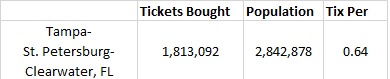
There was a second interesting article published last week exploring market support for sports. This article focused specifically on baseball and calculated total baseball ticket purchases per population. It totaled tickets purchases for Major and Minor League Baseball in each market and divided the total by population – basically, how many baseball tickets the average person in an area buys.

According to author Brett McGinness, Tampa Bay baseball fans almost buy as many tickets per person as residents of the City of Boston (.67) and slightly more than the residents of Washington DC (.62).


Again, some interesting points: this does not include Bradenton in the Tampa Bay area, which I normally do. It only includes purchases for the Rays, Tampa Yankees, Dunedin Blue Jays, and Clearwater Threshers. It also does not include Spring Training.

Let’s assume half of the 341,379 tickets purchased in 2014 for Yankees, Phillies, and Blue Jays Spring Training were done by locals. That would mean 170,690 more tickets purchased from Tampa Bay baseball fans. Let’s see how the chart changes.


By adding half of Spring Training, the Tampa Bay area moves from 15th on McGinness’s chart to 11th, above San Diego and Seattle, and below Minneapolis-St. Paul. However, the Tampa Bay area still purchased only 70% of the baseball tickets per person that residents of Pittsburgh (1.07) and Kansas City (1.08) purchased.

While adding a fraction of Spring Training ticket purchases is good for the area, for the Rays, adding Spring Training to the equation is also not good. With the addition of 50% of Spring Training tickets, the Rays share of total Tampa Bay baseball tickets purchased drops from 80% to 73%. Comparatively, the Indians, another team with low attendance and several Minor League teams in the area, have 81% of Cleveland area baseball ticket purchases.

Looking again at Kansas City and Pittsburgh, Google maps shows those teams do not have the Minor League competition the Rays face. The only Minor League team in Missouri or Kansas is the Springfield Cardinals in Springfield, Missouri, 165 miles from Kansas City. While Pennsylvania has several Minor League teams, the team closest to the Pittsburgh Pirates is the Altoona Curve, 95.7 miles away.

Considering their lack of competition, there is a good chance 100% of baseball ticket purchases in Pittsburgh and Kansas City are for Pirates and Royals games, respectively.

Of course, we can’t get carried away with Minor League competition. Minor League Baseball does not eat into the above-mentioned TPI as much as Major League sports do. The average Florida State League ticket is $4-6 and parking is often free, if not less than $5. Minor League teams also often have discounted ticket promotions, ranging from $1 to 2-for-1 to free.

However, while Minor League Baseball in Tampa Bay doesn’t have a large economic impact, it may be an acceptable substitute good, especially for the casual fan who just wants to hang out, grab a beer, and could care less about a score. And according to another McGinness post, the three Tampa Bay area Florida State League teams have the lowest season ticket costs in professional baseball.

As a matter of fact, you could buy season tickets to all three Tampa Bay area Minor League teams (210 games total) for $601.45. As of May 20th, a Rays June-October weekend-only season ticket plan (27 games) costs $551.30.

So what does all this mean for Tampa Bay sports, and the Rays in particular?

Through the work of the ACBJ and Brett McGinness, we can conclude the Tampa Bay market is overstretched and over-saturated, especially in baseball. The decisions of professional sports leagues and city governments in St. Petersburg, Tampa, Clearwater, and Dunedin have created an environment difficult for the success of Major League sports. The Tampa Bay Lightning and Tampa Bay Buccaneers are fortunate a majority of their seasons do not overlap with other sports. For the Tampa Bay Rays, until major market changes occur, reliance on revenue sharing and opposing fanbases is essential to their success.

Tampa Bay sports market is overstretched and over-saturated

A few weeks ago, the American City Business Journals published a study that explored the economic capacity of various sports markets in America and Canada. The study was designed to see which markets were underutilized in regards to sports and which markets, if any, were overstretched. The results also gave insight into if expansion or franchise relocation were to happen, where should teams move to and where might they be best to move from.

The amount of research done in this study was massive. According to their methodology page, the ACBJ used a metric called Total Personal Income (TPI), “the sum of all money earned by all residents of an area in a given year”. This data came from 2013, “the latest year for which statistics are available from the U.S. Bureau of Economic Analysis.”

After determining TPI, the ACBJ did the following:
  • Analyzed U.S. combined statistical areas and metropolitan statistical areas (as defined by the U.S. Office of Management and Budget) and Canadian census metropolitan areas (as defined by Statistics Canada).
  • Used team revenue data and average ticket prices to estimate the amount of TPI needed to adequately support a team in each of the professional leagues, as well as any of the 64 college football/basketball programs within the Power Five conferences (Atlantic Coast, Big Ten, Big 12, Pacific-12 and Southeastern)
  • Determined minimum TPI bases to be $104 billion for an MLB team, $48 billion in the NFL, $45 billion in the NBA, $50 billion in the NHL, $14 billion in MLS and $26 billion in the Power Five.
  • Calculated each area’s remaining amount of TPI by subtracting the sums needed to support the market’s existing teams.
Of course, there were some shortcomings to the study and not every market is the same. As the methodology page states in its conclusion,
Economic capacity is only one facet of any decision to expand or relocate. Other considerations would obviously be of similar importance, such as the proximity to existing teams, the availability of stadiums or arenas, and unique local factors.
The study also does not factor in non-Major League sports, such as non-MLS soccer, arena football, or Minor League Baseball. All of which Tampa Bay has.

According to the study, the Tampa Bay area is tied for the fifth most overextended market in professional sports.

Based on the ACBJ study, Tampa-St Pete compares well with Pittsburgh and Kansas City in regards to market size, amount of teams, TPI, and the over-extension of their markets. Also of note, both cities with Spring Training (Phoenix and Tampa Bay) are considered overextended. Although Spring Training is heavily influenced by tourist income, there are many local dollars being spent on Spring Training in the Tampa Bay area.

When combined with demographics, the Tampa Bay market looks even worse, especially for the Tampa Bay Rays. Using the Facebook/New York Times survey from 2014, data shows 56% of Pinellas County and 51% of Hillsborough County are Rays fans. Comparably, 68% of Pittsburgh’s Alleghany County roots for the Pirates and 64% of Kansas City’s Jackson County roots for the Royals.

While not every resident is on Facebook or “likes” the team on Facebook, if we believe “liking” behavior is the same in the Tampa Bay area and is the same as it is in Pittsburgh and Kansas City, then we have to conclude the Rays have less local support than the Pirates or Royals.

So not only does the area lack the funds to support the Rays, the Rays lack the people willing to provide it funds.

Comparing Baseball to Baseball

There was a second interesting article published last week exploring market support for sports. This article focused specifically on baseball and calculated total baseball ticket purchases per population. It totaled tickets purchases for Major and Minor League Baseball in each market and divided the total by population – basically, how many baseball tickets the average person in an area buys.

According to author Brett McGinness, Tampa Bay baseball fans almost buy as many tickets per person as residents of the City of Boston (.67) and slightly more than the residents of Washington DC (.62).

Again, some interesting points: this does not include Bradenton in the Tampa Bay area, which I normally do. It only includes purchases for the Rays, Tampa Yankees, Dunedin Blue Jays, and Clearwater Threshers. It also does not include Spring Training.

Let’s assume half of the 341,379 tickets purchased in 2014 for Yankees, Phillies, and Blue Jays Spring Training were done by locals. That would mean 170,690 more tickets purchased from Tampa Bay baseball fans. Let’s see how the chart changes.

By adding half of Spring Training, the Tampa Bay area moves from 15th on McGinness’s chart to 11th, above San Diego and Seattle, and below Minneapolis-St. Paul. However, the Tampa Bay area still purchased only 70% of the baseball tickets per person that residents of Pittsburgh (1.07) and Kansas City (1.08) purchased.

While adding a fraction of Spring Training ticket purchases is good for the area, for the Rays, adding Spring Training to the equation is also not good. With the addition of 50% of Spring Training tickets, the Rays share of total Tampa Bay baseball tickets purchased drops from 80% to 73%. Comparatively, the Indians, another team with low attendance and several Minor League teams in the area, have 81% of Cleveland area baseball ticket purchases.

Looking again at Kansas City and Pittsburgh, Google maps shows those teams do not have the Minor League competition the Rays face. The only Minor League team in Missouri or Kansas is the Springfield Cardinals in Springfield, Missouri, 165 miles from Kansas City. While Pennsylvania has several Minor League teams, the team closest to the Pittsburgh Pirates is the Altoona Curve, 95.7 miles away.

Considering their lack of competition, there is a good chance 100% of baseball ticket purchases in Pittsburgh and Kansas City are for Pirates and Royals games, respectively.

Of course, we can’t get carried away with Minor League competition. Minor League Baseball does not eat into the above-mentioned TPI as much as Major League sports do. The average Florida State League ticket is $4-6 and parking is often free, if not less than $5. Minor League teams also often have discounted ticket promotions, ranging from $1 to 2-for-1 to free.

However, while Minor League Baseball in Tampa Bay doesn’t have a large economic impact, it may be an acceptable substitute good, especially for the casual fan who just wants to hang out, grab a beer, and could care less about a score. And according to another McGinness post, the three Tampa Bay area Florida State League teams have the lowest season ticket costs in professional baseball.

As a matter of fact, you could buy season tickets to all three Tampa Bay area Minor League teams (210 games total) for $601.45. As of May 20th, a Rays June-October weekend-only season ticket plan (27 games) costs $551.30.

So what does all this mean for Tampa Bay sports, and the Rays in particular?

Through the work of the ACBJ and Brett McGinness, we can conclude the Tampa Bay market is overstretched and over-saturated, especially in baseball. The decisions of professional sports leagues and city governments in St. Petersburg, Tampa, Clearwater, and Dunedin have created an environment difficult for the success of Major League sports. The Tampa Bay Lightning and Tampa Bay Buccaneers are fortunate a majority of their seasons do not overlap with other sports. For the Tampa Bay Rays, until major market changes occur, reliance on revenue sharing and opposing fanbases is essential to their success.

Saturday, April 18, 2015

Could the Rays ever deny opposing jerseys and ticket purchases?


Before the first round of the NHL playoffs began, the Tampa Bay Lightning issued two unusual policies. According to the Tampa Tribune, the Lightning restricted ticket sales to Florida residents and also told those who purchase tickets that those wearing opposing team logos would not be allowed in certain areas of Amalie Arena.

The new rules caused quite a tiff in Detroit, home city of the Lightning's first round opponent.

From the Lightning's perspective, the policy makes sense. They want to ensure their fanbase, the fanbase that supported them the entire season, gets priority for playoff tickets. With 1,170,000 Florida residents hailing from Midwest states, and an unknown percentage of those rooting for the Red Wings, it makes sense that the team would want to ensure a pro-Lightning environment.

This policy will not concern the Lightning in the least, as they know they will sell-out playoff games no matter the opponent. And the team has no obligation to cater to Red Wings fans.

Such policies are also not uncommon in baseball. At Chase Field in Phoenix, the Diamondbacks have caught heat for their policy that mandates fans sitting behind home plate wear either Diamondbacks or neutral attire.

Could the Rays ever enact such a policy? Would it behoove them?

Despite over 3.5 million people New York baseball fans living Florida, the Rays would be foolish to ban Yankees attire at Tropicana Field, even if it is visible behind home plate. Yankees fans have increased average game attendance by an average of 30% since 2007. At approximately 9,000 Yankees fans per game times 9 games a year versus the Yankees at Tropicana Field, the Rays sell roughly 81,000 tickets to Yankees fans each year. At approximately $25 per ticket, that's $2,025,000 generated by Yankees fans visiting Tropicana Field.

Or more than the combined salaries of Kevin Kiermaier, Jake Odorizzi, and Brad Boxberger.

Given the Rays' current economic situation and stadium location, inconveniencing Yankees fans would be a bad idea. They have proven to be well-attending and well-spending guests.

Except for last night.

Tuesday, March 31, 2015

Exploring the Rays Forbes Valuation Data

Last week, Forbes released their annual look at the values of all 30 Major League Baseball teams. As they have been over the last few years, the Rays continue to be one of the least valuable franchises in MLB. Someone has to be last, and the Rays are it.

However, the Rays value increased 29% over 2014, from $485 to $625 million. That's a nice return on investment for Stu Sternberg and friends, who have earned 199% since 2006. Cork Gaines at Rays Index posted this chart that goes a little further back than the Forbes page.


However, how does the valuation relate to some of the other measurements Forbes gives us? This post will explore the Rays 2015 data and look at Rate of Change with past Rays data. We will look at how the Rays compare to other teams in a future post.

Let's first look at the rate of change in franchise value as compared to the rate of change in revenue used for debt payments. Maybe as revenue goes up, so does franchise value. That should make sense.


From 2007 to 2012, we see franchise value and revenue moving almost hand-in-hand. That's interesting. Then in 2012, the franchise value jumps 40% and the rate of change in revenue is only 3%. In 2014, both increase 8%. Then in 2015, franchise value sees another huge spike. Perhaps these factors are not tied together.

Let's look at some other factors for similarities and patterns.

Here is the rate of change in revenue and the rate of change in attendance from 2006 to 2014. We don't have 2015's attendance yet so we stop at 2014.


There are few similarities here. Perhaps revenue lags attendance by a year. Maybe the funds generated by attendance are not counted until the following year. I'm not an accountant, so I am not sure how that works. But there are years that stand out. In 2011, attendance dropped 18%. In 2012, revenue only dropped 2%. In 2013 and 2014, attendance decreased both years, yet revenue increased.

Perhaps these factors are not related as much as people think. There are of course, many other revenue streams, such as television, merchandise, and concessions. And the Rays also make money from the rest of Major League Baseball due to revenue sharing. So even if attendance goes down, the Rays could still make money. As a matter of fact, they could still make a lot of money. Further proof that while good for appearance, attendance really doesn't matter.

Here is another interesting chart comparing the rate of change in franchise value and the rate of change in player expense (aka payroll).


Perhaps what we see here is that the value of the franchise does not increase much when the rate of change in payroll increases more rapidly than the value of the franchise (2009-2011). In 2012, player expense was slashed 27%. Franchise value dropped a bit, but not much. Since 2013, the franchise value has gone up more than the increase in payroll.

Update: Contributor Josh Simmons pointed out a very interesting coincidence: The change in value matches the changes in player expense at the same time revenue stops matching valuation. Could this be coincidence or an effect from a change in Forbes' methodology?

Here are the two charts side-by-side. I added a line at 2012 for clarity:


Now let's look at the Rate of Change in Value versus Rate of Change in Player Expense versus Rate of Change in Revenue on the same chart.


While all three moved in unison from 2007 to 2008, rate of change in player expense decoupled from 2009 to 2012. Meanwhile, rate of change in value and rate of change in revenue moved similarly. Then in 2012, rate of change in player expense increased and decreased at a similar path as value, while revenue moved only slightly.

Could be coincidence. Could be something more.

Update 2: E-migo and reader William Juliano, lead writer at The Captain's Blog, provided some insight into the franchise value and payroll trend.

and


and

Big thanks to everyone who provided insight!

Overall, interesting stuff from Forbes.

My one major problem with the Forbes data:

According to Forbes, the Rays make $31 per fan. This is the most misleading number in the study. "Revenue Per Fan" is defined as "Local revenues divided by metro population with populations in two-team markets divided in half."

So $31 multiplied by the 2.8 million metro population is $86.8 million in local revenue. This would mean the Rays make a little over $100 million in other revenue (cable, revenue sharing, etc.). Gate receipts are $33 million. That means $53.8 million comes from local revenue not ticket sales.

But let's look again at "Revenue Per Fan". Everyone knows there is a wide array of fans in the Tampa Bay area. They do not all support the Rays. As a matter of fact, according to demographic studies, less than 60% of the Tampa Bay area are Rays fans. But for a rough estimate, let's use 60%.

Before we do that, we have to consider only 50% of Floridians are baseball fans. So to begin, we have 1.4 million baseball fans in Tampa Bay.

60% of the 1.4 million baseball fans equals 840,000 Rays fans in Tampa Bay.

Let's divide $86.8 million in local revenue by the 840,000 Rays fans. The math shows each Rays fan contributing $103.33 per season to the franchise.

That's a little more realistic.