Monday, June 8, 2020

The Green Fields of the Mind - a baseball fan must-read

As a die-hard baseball fan, I have always tried to stay true to two traditions: the first, read a baseball book as the season opens and second, read the first paragraph of A. Bartlett Giamatti's "The Green Fields of the Mind" at the season's end. This season I looked up Giamatti's essay and read it in it's entirety. Although the players have long since past from the game, the feeling remains, and few writers, if any, have expressed the passion of a baseball fan with more clarity.

Here is "The Green Fields of the Mind" in its entirety 
(acquired from http://mason.gmu.edu/~rmatz/giamatti.html):
---------------------------------------------------

"The Green Fields of the Mind "

It breaks your heart. It is designed to break your heart. The game begins in the spring, when everything else begins again, and it blossoms in the summer, filling the afternoons and evenings, and then as soon as the chill rains come, it stops and leaves you to face the fall alone. You count on it, rely on it to buffer the passage of time, to keep the memory of sunshine and high skies alive, and then just when the days are all twilight, when you need it most, it stops. Today, October 2, a Sunday of rain and broken branches and leaf-clogged drains and slick streets, it stopped, and summer was gone.

Somehow, the summer seemed to slip by faster this time. Maybe it wasn't this summer, but all the summers that, in this my fortieth summer, slipped by so fast. There comes a time when every summer will have something of autumn about it. Whatever the reason, it seemed to me that I was investing more and more in baseball, making the game do more of the work that keeps time fat and slow and lazy. I was counting on the game's deep patterns, three strikes, three outs, three times three innings, and its deepest impulse, to go out and back, to leave and to return home, to set the order of the day and to organize the daylight. I wrote a few things this last summer, this summer that did not last, nothing grand but some things, and yet that work was just camouflage. The real activity was done with the radio--not the all-seeing, all-falsifying television--and was the playing of the game in the only place it will last, the enclosed green field of the mind. There, in that warm, bright place, what the old poet called Mutability does not so quickly come.

But out here, on Sunday, October 2, where it rains all day, Dame Mutability never loses. She was in the crowd at Fenway yesterday, a gray day full of bluster and contradiction, when the Red Sox came up in the last of the ninth trailing Baltimore 8-5, while the Yankees, rain-delayed against Detroit, only needing to win one or have Boston lose one to win it all, sat in New York washing down cold cuts with beer and watching the Boston game. Boston had won two, the Yankees had lost two, and suddenly it seemed as if the whole season might go to the last day, or beyond, except here was Boston losing 8-5, while New York sat in its family room and put its feet up. Lynn, both ankles hurting now as they had in July, hits a single down the right-field line. The crowd stirs. It is on its feet. Hobson, third baseman, former Bear Bryant quarterback, strong, quiet, over 100 RBIs, goes for three breaking balls and is out. The goddess smiles and encourages her agent, a canny journeyman named Nelson Briles.

Now comes a pinch hitter, Bernie Carbo, onetime Rookie of the Year, erratic, quick, a shade too handsome, so laid-back he is always, in his soul, stretched out in the tall grass, one arm under his head, watching the clouds and laughing; now he looks over some low stuff unworthy of him and then, uncoiling, sends one out, straight on a rising line, over the center-field wall, no cheap Fenway shot, but all of it, the physics as elegant as the arc the ball describes.

New England is on its feet, roaring. The summer will not pass. Roaring, they recall the evening, late and cold, in 1975, the sixth game of the World Series, perhaps the greatest baseball game played in the last fifty years, when Carbo, loose and easy, had uncoiled to tie the game that Fisk would win. It is 8-7, one out, and school will never start, rain will never come, sun will warm the back of your neck forever. Now Bailey, picked up from the National League recently, big arms, heavy gut, experienced, new to the league and the club; he fouls off two and then, checking, tentative, a big man off balance, he pops a soft liner to the first baseman. It is suddenly darker and later, and the announcer doing the game coast to coast, a New Yorker who works for a New York television station, sounds relieved. His little world, well-lit, hot-combed, split-second-timed, had no capacity to absorb this much gritty, grainy, contrary reality.

Cox swings a bat, stretches his long arms, bends his back, the rookie from Pawtucket who broke in two weeks earlier with a record six straight hits, the kid drafted ahead of Fred Lynn, rangy, smooth, cool. The count runs two and two, Briles is cagey, nothing too good, and Cox swings, the ball beginning toward the mound and then, in a jaunty, wayward dance, skipping past Briles, feinting to the right, skimming the last of the grass, finding the dirt, moving now like some small, purposeful marine creature negotiating the green deep, easily avoiding the jagged rock of second base, traveling steady and straight now out into the dark, silent recesses of center field.

The aisles are jammed, the place is on its feet, the wrappers, the programs, the Coke cups and peanut shells, the doctrines of an afternoon; the anxieties, the things that have to be done tomorrow, the regrets about yesterday, the accumulation of a summer: all forgotten, while hope, the anchor, bites and takes hold where a moment before it seemed we would be swept out with the tide. Rice is up. Rice whom Aaron had said was the only one he'd seen with the ability to break his records. Rice the best clutch hitter on the club, with the best slugging percentage in the league. Rice, so quick and strong he once checked his swing halfway through and snapped the bat in two. Rice the Hammer of God sent to scourge the Yankees, the sound was overwhelming, fathers pounded their sons on the back, cars pulled off the road, households froze, New England exulted in its blessedness, and roared its thanks for all good things, for Rice and for a summer stretching halfway through October. Briles threw, Rice swung, and it was over. One pitch, a fly to center, and it stopped. Summer died in New England and like rain sliding off a roof, the crowd slipped out of Fenway, quickly, with only a steady murmur of concern for the drive ahead remaining of the roar. Mutability had turned the seasons and translated hope to memory once again. And, once again, she had used baseball, our best invention to stay change, to bring change on.

That is why it breaks my heart, that game--not because in New York they could win because Boston lost; in that, there is a rough justice, and a reminder to the Yankees of how slight and fragile are the circumstances that exalt one group of human beings over another. It breaks my heart because it was meant to, because it was meant to foster in me again the illusion that there was something abiding, some pattern and some impulse that could come together to make a reality that would resist the corrosion; and because, after it had fostered again that most hungered-for illusion, the game was meant to stop, and betray precisely what it promised.

Of course, there are those who learn after the first few times. They grow out of sports. And there are others who were born with the wisdom to know that nothing lasts. These are the truly tough among us, the ones who can live without illusion, or without even the hope of illusion. I am not that grown-up or up-to-date. I am a simpler creature, tied to more primitive patterns and cycles. I need to think something lasts forever, and it might as well be that state of being that is a game; it might as well be that, in a green field, in the sun.
Tuesday, February 11, 2020

Delusionally Doubling Down on the Montreal Plan

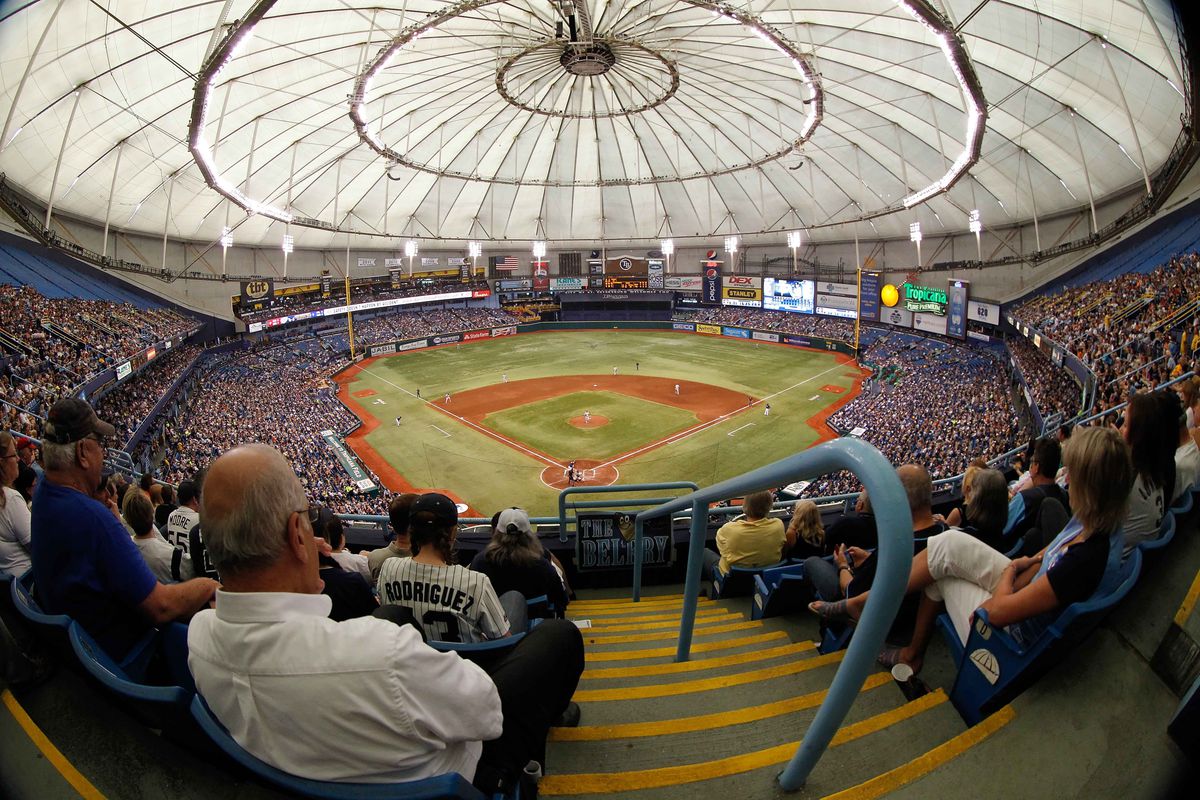
Over the last few days, the Tampa Bay Rays front office have released several quotes advocating their "Sister City" plan to divide Major League Baseball between Tampa Bay and Montreal.

It is a stupid, stupid, stupid plan made by a greedy billionaire designed to rip the heart out of the fanbase and prepare them to lose the team forever.

As I have written several times, I disagree with this plan. I have also been on ABC Action News twice discussing my opposition.


From a business perspective, former Wall Street investor Stu Sternberg is attempting to diversify his assets. He figures if he and his Montreal business partners each have to invest less in smaller stadiums in two markets, there is less total financial commitment while receiving increased stadium attendance bumps in two cities. By going international, he also hedges against a US economic decline. There has been much talk that the US economy will eventually recede, and when it does Sternberg will have Canada to buoy his investment.

Stu Sternberg is not increasing his gains enough here in Tampa Bay. Despite franchise value gains of 27% in 2017, 9% in 2018, 12% in 2019 according to Forbes, that is not enough for his Wall Street wallet. He wants to better maximize his investments. This isn't about emotions or people. It is about dollars and gains.

He invests less, makes more, and is covered against a market tightening. What is there not to like from the perspective of a Wall Street investor?

If one billionaire can do it, can others? Where does this split-city plan stop? In his interview with WDAE at Rays Fan Fest, Sternberg mentioned that MLB did not consider Montreal a full-time MLB market. That is the first I have heard that said, and it should be a big deal.

Consider this: Montreal is a city of 4 million people. In 2015, Montreal had a GDP of $193 billion dollars (Tampa Bay had $118 billion). From 1979 to 1983, the Expos were in the top 5 in attendance in the National League. Montreal is a legit city with an international economy and baseball pedigree.

If they don't reach the level of full-time market, who else doesn't? Does Pittsburgh? Milwaukee? Cincinnati? Cleveland? What is the threshold? Because if owners follow the Rays lead and start splitting seasons throughout MLB, the only teams that will be in their cities full-time will be in the mega markets of New York, Chicago, and Los Angeles.

Would the Pirates consider moving half their season to Nashville? What about the Indians playing half their games in San Antonio? Could the A's play half their games in Portland? Maybe the Marlins split half their games between Miami and Las Vegas.

Where does this end? What is the threshold of a Major League market if neither Tampa Bay nor Montreal make the cut?

By the way, Tampa Bay is a robust enough market for four Minor League Baseball teams, four Spring Training teams, an NFL team, and NHL team, a major college program, and an XFL team. Montreal has excess economic capacity as it only hosts the Montreal Canadiens and the Montreal Alouettes of the Canadian Football League (CFL). But apparently, that is not a enough for a full-time market to Major League Baseball.

Another fallacy in the Sister City argument is that demand is driven by availability. Stu Sternberg and the Rays front office believe they can get the same attendance of 1 million plus fans to Tropicana Field in April, May, and June that they get from April to September because the supply of games is smaller.

There are many reasons why this reduced-supply increased-demand concept isn't realistic.

For one, the Rays will still face an abundance of regional sports competition. If they play in Tampa Bay in the spring, they face competition from four Minor League Baseball teams, the Tampa Bay Lightning, and the new XFL Vipers. As well, many local fans have just spent their money on Spring Training.

Second, traditionally the Rays struggle to draw in the early months of the season, especially in May. May is typically their worst month of the season. People are not yet fully engaged in baseball in May. How do you expect the same type of fanbase excitement in the first half of the season versus the second half? In the first half, teams are still figuring out who they are. There is a saying that baseball teams don't really know what they have until the 1/3 point (54 games) in the season. Will they be contenders? Will they be also-rans? If the Rays play the first three months of the season in Tampa Bay, Tampa Bay will never again experience a pennant race in person.

Third, Stu Sternberg believes the Rays will draw a million people in three months with half a schedule - and maybe less than half the games against the Yankees, Red Sox, and other teams that draw opposing fans. Typically, the Rays play 9 home games each versus the Red Sox and Yankees. What if all 9 games are after June? What if only 3 games versus each are while the Rays are in the bay area? Then the fans in Montreal get to see the Rays top rivals and the fans of Tampa Bay area left with the less appealing part of the schedule.

The Rays cannot expect Major League Baseball to cater the schedule to them and provide them a 50/50 split in opponents for each fan base. And what about interleague rotational games? Fans in Tampa Bay may never get to see players from an interleague team such as the Marlins, Mets, or Cubs play the Rays if those games are always scheduled in the second half of the season.

Fourth and lastly, it is easy to imagine that this arrangement pitting fans and officials of both cities against each other as they will compare and contrast attendance as a measure of what fanbase supports the team more. If Tampa Bay draws less against the Yankees in April (as the Lightning are simultaneously in the playoffs) than Montreal does in September, Tampa Bay fans will probably get mocked. There will be non-stop comparisons as to which city is a better host in the media. Sternberg won't feel this competition as he makes money either way, but the fans and the cities will.

The sister city plan assumes these are loving, cooperating siblings, not competitive, bitter, catty siblings. And if the Montreal team is already saying Montreal is a better city than St. Petersburg, what will they say if the Montreal side of attendance exceeds the Tampa Bay side?

Then again, Sternberg might be the kind of parent who enjoys seeing siblings compete. But the side that has their team ripped from them will not take well to another city saying they are better hosts. There is already a malaise around the Rays. Hearing Montreal boast about being better hosts will only further turn Tampa Bay fans off to the franchise and the arrangement.

Lastly, a huge obstacle to the Rays success in Tampa Bay has always been the presence of the New York Yankees. What if the Rays said they were willing to stay full-time if the city cut their lease with the Yankees? Then Steinbrenner Field could be turned into a larger stadium in a centralized location. The Yankees have enough money to build a new spring training stadium anywhere in the world. The Rays know this, the Yankees know this, the City of Tampa knows this.

But challenging Steinbrenner presence in Tampa is either taboo, forbidden, or never mentioned in public, even though the Yankees have only been playing in Tampa two years more than the Rays have been playing in St Petersburg (1996 to 1998). The City of Tampa loves the Yankees.

By the way, if you haven't read the parody site Tampa News Force article entitled "Tampa Bay Vipers thankful to finally have sports spotlight to themselves", I highly recommended it. It is as much a commentary on the Vipers competition as it is the Rays local competition.
“Spring training starts in a couple of weeks, too”, he continued, as sweat formed on his brow. “I forgot about that. Sure, the Rays train way down in Port Charlotte but three teams, including the New York Yankees, possibly the most prolific and beloved franchises in sports history are right here for over a month, smack in the middle of our season.” He stopped, drew a deep breath and sighed, “The New York Yankees. Not the San Diego Padres or some other godforsaken franchise no one cares about, just the Notre Dame of Major League Baseball, that’s all.”

Wednesday, October 2, 2019

Talking Rays Marketing on ABC Action News

On the field, there is no doubt the Rays have had an amazing season, winning 96 games and making the postseason for the first time in six years. Off the field, the season was less than spectacular, with the Montreal situation and the continued stadium saga looming over the franchise.

As the team enters the postseason, I have noticed a lack of marketing by the team throughout the region, especially when compared to the marketing of the Tampa Bay Lightning and Tampa Bay Bucs. My tweets on the issue caught the eye of Erik Waxler of ABC Action News. Waxler paid me a visit on Wednesday and asked me a few questions about the Rays and the attitude of Rays fans.

Always great to be able to talk to a bigger audience. Many thanks to Erik Waxler and ABC Action News.


Friday, June 28, 2019

It is designed to break your heart: Thoughts on the Rays two-city solution


I have been writing about Tampa Bay baseball for over 10 years. For the first five years, I wrote about being a fan. I wrote about the World Series. I wrote about Game 162. I wrote about no-hitters, cowbells, and Rays-hawks. Then in 2014, I started this blog and dedicated myself to determining whether or not Tampa Bay was a Major League market.

As a Tampa resident, I came into the project with biases. I wanted to believe the market was not the problem.

For four years, I wrote every night. I tracked the attendance of the Rays, four Spring Training locations, and the four Minor League teams that call Tampa Bay home. I wrote about promotions. I wrote about bobbleheads. I wrote about traffic conditions and economic growth. I even wrote about hurricanes and Astros games. I was recognized for my research at Fangraphs as a resident writer in June 2017 and by mentions in articles in USA Today and several Tampa area publications.

After landing a consulting job overseas in 2018, I stopped writing regularly. On one hand, I knew writing about baseball from 5,000 miles away was going to be difficult, especially when I didn't know my work tempo. On the other hand, I decided I had written almost everything I could from open source data. From what I could acquire and what I analyzed, Tampa Bay could host a Major League team.

In theory.

Admittedly, there are a lot of problems with the current layout of baseball in Tampa Bay:
The list goes on.

A lot of work needed to be done to make Major League Baseball successful in Tampa Bay. None of these issues were alleviated in 20 years.

On Tuesday, June 25th, the Montreal boogeyman finally appeared in the flesh. After years of avoiding the M-word, Stu Sternberg and the Rays front office announced a plan to split the Rays season between Tampa Bay and Canada. According to Sternberg, the Rays would play the first 40 home games or so of the season in Tampa Bay. Then they would fly to Montreal and play out the rest of the season.

(They also may or may not move their Spring Training back to St. Petersburg from Port Charlotte, Florida in order to give local fans more product. Here is where I say I wrote years ago that Port Charlotte was a mistake and the Rays should have looked to expand their market by spring training near Orlando. But I'm just a guy with a blog.)  

The Rays will do this Tampa Bay-Montreal schedule every year. Forever.

While it is creative, this plan is befuddling at best, irrational at worst. It is like having a pitcher play every position and rotating them on the mound based on the weaknesses of each batter. Sure, it is legal, it may look great on paper, and may actually work, but it is not based in reality.

The Rays two-city solution requires two economies, two fanbases, two marketing staffs, two broadcast teams, and two stadiums (as if one was not difficult enough to fund, locate, and build). Sternberg envisions a "sister-city" relationship between Tampa Bay and Montreal marked by business investment and cooperation. He also envisions tourists travelling to and from each city bonded by fandom.

It is almost as if Sternberg wants St. Petersburg and Montreal to share the Rays as Tampa and New York share the Yankees. Per the latest data, approximately 12% of Tampa Bay roots for the Yankees and the Yankees presence is seen on billboards and marquees in Tampa throughout the spring. Instead of openly advocating for Major League Baseball to eradicate this conflict, and create a monopoly of baseball interest in the Tampa Bay region, Sternberg is using the Yankees-Tampa relationship as a model.

For Tampa Bay, Sternberg is advocating a smaller, more intimate, open-air stadium where the estimated one million Rays fans will buy one or two tickets per season over 40 games. What he fails to understand is that there will still be baseball in the area. After the Rays have their proposed "mid-season send off", local baseball fans can still spend their dollars and evenings watching Minor League Baseball at Spectrum Field in Clearwater, Steinbrenner Field in Tampa, LECOM Field in Bradenton, and a newly refurbished Auto Exchange Stadium in Dunedin. All of which are cheaper than Rays games and require much less emotional investment. Emotional investment that used to be spent on the Rays.

Former Major League Commissioner Bart Giamatti once famously wrote,
"It breaks your heart. It is designed to break your heart. The game begins in the spring, when everything else begins again, and it blossoms in the summer, filling the afternoons and evenings, and then as soon as the chill rains come, it stops and leaves you to face the fall alone. You count on it, rely on it to buffer the passage of time, to keep the memory of sunshine and high skies alive, and then just when the days are all twilight, when you need it most, it stops."
Stu Sternberg and the Tampa Bay Rays are planning to break the hearts of Tampa Bay when the summer is at it's peak. When the evening showers and humidity weigh down the soul of Florida. When our lethargic summer saunters are matched only by the leisurely pace of baseball. For over 20 years in Tampa Bay, fans waited patiently for their two weeks of Fall with a local beer and a Cuban, cheering on the local nine. Now the realities of politics and economics threaten to replace their summer respite with a vast emptiness. Their season will end early, and like Rogers Hornsby, they will stare out the window, remembering the distant echoes of the crack of the bat and listening for the faint advancement of professional football and hockey - franchises that call Tampa Bay home from start to finish.

The biggest shame of this whole debacle is that Stu Sternberg has roots in Brooklyn. He likes to remind listeners that he named his son after Sandy Koufax. But what would Brooklyn have said to Walter O'Malley if he told the Dodger faithful their beloved Bums would split time between Brooklyn and Los Angeles, that they would leave for the West Coast in the middle of every season? How would a Brooklyn business owner named Samuel Sternberg, a family man and soon-to-be father of Stu Sternberg, have reacted?

O'Malley probably would have been booed out of town. With this idea, Sternberg deserves the same.

Monday, January 7, 2019

Rays cede cheap seats to local Minor League Baseball

Been a while. Not sure if I will post as regularly or just on occasion. But there has been a lot of baseball news in Tampa Bay this offseason. Some of which has been covered very well. For now, when I see an angle that I don’t think is being covered, I’ll discuss it here.)

As most baseball fans in the Tampa Bay area are now aware, last week the Rays announced they are closing off seating in the 300 level, reducing the total capacity in Tropicana Field from 31,042 to somewhere between 25,000-26,000.

Of course, the jury is still out on what the Rays are doing to the space those seats used to occupy. As par for the course, the Rays front office used words like “intimate” and “better fan experience”. Deadspin’s Barry Petchesky rebuked those claims well in his article.

“Intimate,” that buzzword used by every team that moves to a smaller stadium, or renovates its existing one to have a smaller capacity—or just dreams of doing so. It’s about the “fan experience,” you see. Unless the fan experience you’re looking for is buying the cheapest ticket possible because sometimes it’s fun to go to a ballgame and sit in the nosebleeds and eat a dang hotdog.
For now, the Rays claim there will still be cheap ticket options at Tropicana Field. But the Rays still use dynamic pricing so fans only know how much a ticket will cost when tickets are set before the season. By driving up scarcity, and letting the dynamic pricing model take hold as the season progresses, the price of seats goes up according to demand, not by tier. As well, games against the Yankees and Red Sox will always be more expensive, despite attendance against each of those teams decreasing drastically since 2010.


The bigger question remains: Does MLB in Tampa Bay and beyond need cheap ticket options? There are few inexpensive options for NHL, NBA, and NFL games, so why should there be in baseball? Are fans married to the Norman Rockwell myth of knothole gangs looking through wooden fences in the 1940s? 

Are those myths as outdated as speedy lead-off men and starting pitchers?
There will always be inexpensive baseball options in America, and especially in the Tampa Bay area. Despite a 7% decrease from 2016*, Tampa Bay’s four Minor League teams – the Threshers, Marauders, Tarpons, and Blue Jays – combined drew over 350,000 fans for the 8th year in a row in 2018.

(2017 featured Tebow Mania.)


Local Minor League Baseball has always been in competition with the Rays, especially in the spring months of April and May. They market to casual baseball fans with cheaper ticket options, no dynamic pricing, and the same, if not better, “intimacy and fan experience”. There is a reason the Rays worst attended month (May) is typically the local Minor League teams’ best. Tampa Bay area Minor League teams are more conveniently located to most Tampa Bay baseball fans and the teams play outdoors, feature fireworks, and often have the same food and beer options as the Rays.

All for ticket and parking prices far cheaper than Tropicana Field – sometimes as low as $1.
Unlike nearly every other Major League team, the Rays never had a monopoly on low price point baseball in their region. Fans have always had cheaper and more convenient baseball options. And as long as there is Spring Training in Tampa Bay, there will be Florida State League baseball in Tampa Bay.

With their announcement last week, the Rays focused on their niche – dedicated fans who will travel to Tropicana Field to buy tickets to see Major League Baseball. That number will be between 1.1 million and 2.1 million in 2019. Even as the 100-loss Devil Rays, the Rays never drew less than 1 million, so don’t expect attendance to drop that low. And if the current maximum seating is 26,000 per game, the Rays can only max 2.1 million in 81 games.

It will be curious to see if Minor League Baseball in the Tampa Bay area will capitalize on the Rays decision and increase their marketing to casual fans looking for lower price point baseball options.

(It’s good to be back.)

Wednesday, February 14, 2018

Moving on

This is the end.

For now, possibly. Or maybe for good. I haven’t decided. But this website won’t be as active as it was in the past. And I owe you an explanation why.
  1. For most of the 2018 baseball season, I will not be living in the US. I will be 5,000 miles away doing analysis for the US Government. I left Tampa Bay during the first week of February and won’t be back until August at the earliest. It will be stressful challenge to write about baseball daily from my location.
  2. Although Tampa Bay is a growing vibrant area with billions in new construction and rising income and arriving businesses, I am not convinced the baseball market will be anything but a convoluted mess of hyperlocal interests superseding regional interests. For anyone who lives in Tampa Bay, this is not out of the norm.
  3. I think I am maxed out on new research. I can update charts and graphs, but as long as things stay the same – and they will until the Rays stadium situation is rectified – public data can’t give me any new insight that I don’t already have.
  4. I am tired of getting into the same arguments. Those who have been with me since Day 1 with this website are either interested, agree, or have expressed their differing opinions long ago. People in the know know who I am and what this website is all about. Anyone else without a blue twitter checkmark will need to email me.
  5. I am not convinced the Rays will stay in Tampa Bay. It is difficult for me to be motivated to track the business of a team that may not exist in 10 years. The Ybor location, while nice, doesn’t have the funding and as I have said numerous times, unless a million people move within 30 minutes of Tropicana Field in 5 years, it will remain a horrible location.
If you have read this far, thank you.

I started this website in January 2014. It began as a project while I was enrolled in the USF MBA program where I could showcase my analytical skills in business on a topic I was very familiar with – baseball in the Tampa Bay area. I had written about the Rays for several blogs as well as covered the Florida State League for MiLB.com and other sites.

I figured if I could add my growing business acumen to a discussion on baseball in Tampa Bay I could fill an unfulfilled niche. That is what business is all about, finding opportunities and making products to fill those opportunities. The goal was not to make money, but to prove I could write about business, do some solid analysis, and maybe convey my findings to a wider audience. If my findings made the desk of decision makers, even better.

Entering this project, I had two major assumptions: 1) Tampa Bay is a growing market 2) The market of baseball in Tampa Bay is highly competitive. I quickly concluded that there is more baseball in Tampa Bay from February to October than in any other city. Tampa Bay has four spring training teams, four minor league teams, and one Major League team. Combined, there are over 400 home games every calendar year in Tampa Bay.

As I continued, I found data that showed fan behavior and fan allegiances in Tampa Bay. Of course, it is now common knowledge that Tropicana Field is too far from the center of the region’s population, but I also published articles on rooting interest, discovering that only 50% of baseball fans in Tampa Bay are Rays fans. Another 20% are Yankees fans, roughly 6% are Red Sox fans, and the remaining 24% are fans of other teams.

While that was eye-opening, it wasn’t entirely a surprise. Florida metro areas are often landing places for people wanting to escape the cold of the north. These people bring their fandoms and they rarely ever change (despite all the fans and radio hosts who want them to). Local spring training also serves to reinforce out-of-town fandom by allowing those fans to spend money on their teams in March and April. 

Other research showed that roughly 50% of Spring Training attendance in Tampa, and 25% of Spring attendance in Clearwater and Dunedin were locals. Local money was going into the coffers of teams that were not the local Major League team. Adding insult to injury, two of the local spring training teams are in the Rays division.

When I started this project, I looked at the leases for the local Spring Training teams. I thought perhaps there was a way for the Rays to gain more of a share of the local market if Tampa Bay spring training teams left when their leases expired. If I could enlighten people to the idea that Tampa Bay was overstretched and oversaturated, perhaps local politicians would see past their hyperlocal ideals and see the big sports picture.

Then Hillsborough County gave the Yankees 20 more years for no reason and Pinellas is ready to extend the Blue Jays – contrary to every economic study saying it is a bad idea.

So the landscape of the Tampa Bay baseball market isn’t changing, even if it is to the detriment of the Major League franchise.

That brings us to my efforts this season.

The highlight of my 2017 and the peak of this project was when I was featured as a Fangraphs Resident for the month of June. To be acknowledged within the baseball research community as a person in the know who could bring clarification to an ongoing problem was awesome.

Definitely the highlight of this website’s effort.

Unfortunately, while the baseball research community embraced me, local sports media rarely did. Only a small percentage talked to me about my findings and even fewer allowed me a bigger forum to discuss my ideas.

It would have been nice to get a little love from Tampa Bay Times beat writer Marc Topkin or be asked to appear on any of the many local sports radio shows. Their hosts knew who I was and in many cases followed me on social media.

Let me be clear for the media folks who ignored me or outright dismissed me: I do and have done analysis for over 20 years in various forms. I have provided insight to corporate executives and senior military leaders around the world. I take being ignored or dismissed as a professional slight. You and your audience are worse off and less educated because of your inaction. Congratulations.

Now that I have that off my chest, I do want to thank the many people who have read, commented constructively, or even just followed for the sake of learning something. You are all awesome and greatly appreciated.

There is a saying that writers should write for themselves and if anyone follows, then great. That is true to a point. I believe eventually the relationship between writer and audience becomes symbiotic, with both sides feeding from each other. The writer is given extra motivation from the community and the community enjoys more work from the writer.

That’s how I felt for most of this website’s existence. So thank you to all who read.

As I mentioned in the intro, I may post occasionally. I may still track attendance on my daily spreadsheets and may still post monthly trends. But I won’t be putting near as much energy into this site. I think four years is long enough.

Again, thank you to all who read and interacted. I greatly appreciate it. We had fun.

Monday, February 12, 2018

Dunedin Blue Jays 2017 Attendance Review

Welcome to our 5th attendance review of 2017 and the 11th attendance review post on the Dunedin Blue Jays, minor league affiliate of the Toronto Blue Jays.

Background:

The Dunedin Blue Jays began play in the Florida State League in 1987. After three seasons playing at Grant Field, the Dunedin Blue Jays moved to Florida Exchange Stadium in 1990. Florida Exchange Stadium is also the spring training home of the Toronto Blue Jays. The current population of Dunedin is 35,444.

Dunedin Blue Jays 2017:

Home Games: 69
Total attendance: 38,956 (down 22% from 2016: 50,063)
Average attendance: 572 (down 25% from 2016: 770)
Highest attended game: 4,527 on Monday, July 3rd vs Daytona
Lowest attended game: 291 on Tuesday, August 22nd vs Florida
Average Time of Game: 2 hours, 43 minutes
Double headers: 1 (May 25)
Cancellations: 0
Notable rehab assignments: Josh Donaldon, Troy Tulowitzki
Other notable appearances: None

Breakdown:
(red highlight = below 2016 annual average of 572)

Overall:


By Month:
The following graph depicts the average attendance by month.


By Day:


Blue Jays attendance increased 5% on the weekend compared to their average Monday through Thursday attendance.
  • Mon-Thurs average attendance: 559 (38 games)
  • Fri-Sun average attendance: 588 (31 games)
  • Difference: 5%
The following graph depicts the average attendance by day.


The following chart looks at how often daily attendance increases when compared to the day prior.


By Opponent:


By Starting Pitcher:


This chart depicts how attendance reacted from one starter to the next. If a pitcher is a great draw, the percentage between he and the prior starter should be higher.


For other years, see:

Thursday, February 1, 2018

Clearwater Threshers 2017 Attendance Review

Welcome to our fourth attendance review of 2017 and our eleventh attendance review of the Clearwater Threshers. Today we look at the home attendance of the 2017 Clearwater Threshers.

Overview: The Clearwater Threshers began play in the Florida State League in 1985. The Threshers moved to Bright House Field in 2004. Bright House Field is also the spring training home of the Philadelphia Phillies. In 2013, the population of Clearwater was 109,703.

Clearwater Threshers 2017:

Home Games: 72

Total attendance: 200,201 (up 10% from 2016: 181,594)

Per Game Average: 2,988 (up 10% from 2016: 2,710)

Highest attended game: 9,729 on Monday, July 3rd vs Tampa

Lowest attended game: 1,211 on Wednesday, July 26th vs Daytona

Double headers: 5 (Apr 13, June 5, June 14, July 25, July 30)

Cancellations: 0

Average time of game: 2 hours, 31 minutes

Notable rehab assignments: None

Other notable appearances: None
Breakdown:

(red highlight = below annual average of 2,988)

Overall:


Top 10 attended games:


By Month:


The following graph depicts the average attendance by month.


By Day of the Week:


Threshers attendance increased 11% on the weekends compared to their average Monday through Thursday attendance.
  • Mon-Thurs average attendance: 2,867 (41 games)

  • Fri-Sun average attendance: 3,179 (26 games)

  • Increase: 10.8%
The following graph depicts the average attendance by day.


The following chart shows how often each day outdrew the game prior.


By Opponent:


By Starting Pitcher:


The following chart depicts how attendance reacted from one starter to the next. If a pitcher is a great draw, the percentage between he and the prior starter should be higher.


Additional Clearwater Threshers Reviews:

2016 Clearwater Threshers Attendance Review
2015 Clearwater Threshers Attendance Review
2014 Clearwater Threshers Attendance Review
2013 Clearwater Threshers Attendance Review
2012 Clearwater Threshers Attendance Review
2011 Clearwater Threshers Attendance Review
2010 Clearwater Threshers Attendance Review
2009 Clearwater Threshers Attendance Review
2008 Clearwater Threshers Attendance Review
2007 Clearwater Threshers Attendance Review